Category: Foreign

  • At least 42 Palestinians killed by Israeli attacks on Gaza City: sources

    At least 42 Palestinians killed by Israeli attacks on Gaza City: sources


    GAZA:   (Xinhua)/Flowerbudnews :– At least 42 Palestinians were killed in Israeli airstrikes on residential houses in two areas of Gaza City, according to Palestinian security and medical sources.

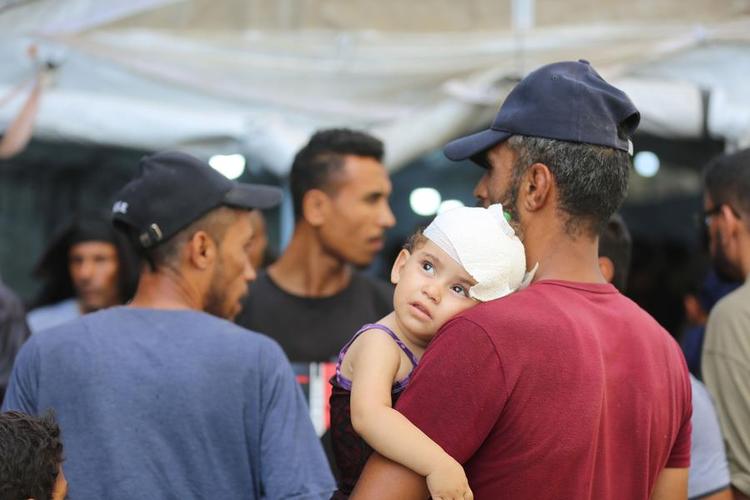
    “About 18 were killed and dozens of others wounded in al-Shati refugee camp after the Israeli warplanes attacked a residential square,” Palestinian medical sources told Xinhua.

    The medical sources noted that the number of victims is likely to increase as the civil defense teams were still trying to pull out the victims from the rubble, adding that the residential square had become “a huge amount of ruins.”

    Palestinian security sources said that Israeli warplanes launched several raids on al-Shati refugee camp, destroying seven inhabited homes.

    Also on Saturday, at least 24 Palestinians, including women and children, were killed during Israeli airstrikes on houses in the al-Tuffah neighborhood in the northeast of Gaza City, the Hamas-run government media office said in a press statement.

    The Israeli army said on Saturday in a press statement that its warplanes had attacked two Hamas military infrastructure sites in Gaza City.

    According to the Times of Israel, the Israeli army targeted Raed Saad, a senior commander of Hamas in Gaza. So far, there has been no official Palestinian confirmation of his death.

    Saad, identified as a chief of Hamas operations, was reportedly believed to have been at Gaza City’s al-Shifa Hospital during an Israeli raid in March, although he was not found there at the time.

    Israel launched a large-scale war on the Gaza Strip since Oct. 7, 2023, after Hamas carried out a military attack on Israeli towns near the Strip, killing about 1,200 and capturing around 250 others.

    The health authorities in Gaza said in a press statement that as of Thursday, the Palestinian death toll from Israeli military operations has risen to 37,431 people, with 85,653 others wounded.

  • Africa’s Continental Criminal Court Can No Longer Wait

    Africa’s Continental Criminal Court Can No Longer Wait


    By Chidi An selm Odinkalu

    Flowerbudnews:    Less than a decade ago, the detention centre of the International Criminal Court (ICC) in Scheveningen on the outskirts of The Hague could easily have been mistaken for a committee meeting of leaders of the African Union.

    One of its long-term guests was Laurent Gbagbo, a former president of Côte d’Ivoire. From neighbouring Liberia, Gbagbo’s contemporary, Charles Taylor, kept up a punishing schedule on the tennis courts of the facility. With them there also was former Vice-President of the Democratic Republic of the Congo (DRC), Jean-Pierre Bemba.

    At about the same time, Kenya’s President, Uhuru Kenyatta; and his Deputy and future successor, William Ruto, were suspects on trial before the ICC. For over five years before that, since 2009, the Court had an arrest warrant still outstanding for Sudan’s President Omar Hassan Al-Bashir.

    Even as the ICC advanced towards an arrest warrant for Sudan’s then dictator, the African Union (AU) complained somewhat vainly that “abuse and misuse of indictments against African leaders have a destabilizing effect that will negatively impact on the political, social and economic development of States and their ability to conduct international relations.”

    The month before the ICC authorized the arrest warrant against Omar Al-Bashir, in February 2009, the summit of the African Union’s Heads of State and Government requested the Commission of the African Union “in consultation with the African Commission on Human and Peoples’ Rights, and the African Court on Human and Peoples’ Rights, to examine the implications of the Court being empowered to try international crimes such as genocide, crimes against humanity and war crimes, and report thereon to the Assembly in 2010.”

    In the wake of the onset of the crisis in Libya, the African Union decided that the ICC’s focus on the African continent was “discriminatory.”

    In Malabo, the capital of Equatorial Guinea, in June 2014, the AU adopted a treaty to confer on the court jurisdiction over international crimes. This treaty is known as “the Malabo Protocol”, after the city where it was adopted.

    It was the assessment of the AU then that the Bashir arrest warrant would “seriously undermine the ongoing efforts aimed at facilitating the early resolution of the conflict in Darfur.”

    More than five years after Omar Al-Bashir’s ouster and one and a half decades after the ICC’s arrest warrant for him, the current metastasis of atrocities in Darfur provides reason to reassess the African Union’s fears.

    At the time when the AU first voiced its fears and suspicions about the ICC in the first decade of this millennium, they were largely greeted with derision. This attitude was foundational to the existence of the ICC.

    At the adoption of the statute establishing the court in 1998, then UK Foreign Secretary, Robin Cook, infamously sniffed that “this is not a court set up to bring to book Prime Ministers of the United Kingdom or Presidents of the United States.”

    This colonial superciliousness did not preclude African countries from recognizing the opportunities in the ICC.

    The continent was the single largest source of resilient support to the project and process that culminated in the creation of the Court.

    With 33 of the 124 member states of the ICC, Africa provides over 26.6% of the signatories to the Statute establishing the Court, the largest single bloc of any continent.

    In January 2004, when few trusted the Court to exercise its functions with skill or responsibility, Uganda’s President Yoweri Museveni voluntarily referred the situation in the country to the court, yielding up the first case received by it.

    By the end of the first decade of its operations, the prosecutorial docket of the ICC read like a political geography of Africa: Central African Republic, Côte d’Ivoire, DRC, Kenya, Libya, Mali, Sudan, Uganda.

    A senior lawyer practising at the ICC accused it of being “a vehicle for its primarily European funders, of which the UK is one of the largest, to exert their influence and, particularly, in Africa.”

    For a long time, fundamentalists of the ICC dismissed this view as lacking in credibility.

    As the current prosecutor of the Court, Karim Khan, prepared to turn his attentions to the atrocities in the ongoing crisis in Gaza earlier this year, however, all the suspicions about the targeting of Africa by the court were confirmed.

    In a high profile interview with the Cable News Network (CNN) last month, Mr. Khan disclosed that an unnamed senior Western official seeking to dissuade him from seeking an arrest warrant against Israel’s Prime Minister, had told him that the ICC was “built for Africa and for thugs like Putin.”

    At about the same time, it emerged that the head of Israel’s much feared foreign intelligence agency, the Mossad, had “allegedly threatened a chief prosecutor of the international criminal court in a series of secret meetings in which he tried to pressure her into abandoning a war crimes investigation.”

    According to The Guardian in London, this was part of “an almost decade-long campaign by the country (Israel) to undermine the court (ICC).” In the wake of these disclosures, those who issue gratuitous lectures to Africa about the impunity and accountability have seen nothing and said even less.

    The Prosecutor whom they threatened was Fatou Bensouda, Gambia’s current High Commissioner to the United Kingdom whose courage in defending the independence of her office as the second Prosecutor of the ICC made her the subject of punitive sanctions by the United States.

    In the Malabo Protocol, the African Union, tired of protesting the pigmented project of the ICC, decided to endow an African Court of Justice and Human and Peoples’ Rights with jurisdiction over 14 crimes of an international or trans-boundary nature on the continent. These include aggression; war crimes; crimes against humanity; genocide; trafficking in persons, in hazardous wastes or in drugs; terrorism, corruption; money laundering; mercenarism; piracy; illicit exploitation of natural resources; and unconstitutional changes in government.

    Despite the truly capacious scope contemplated by this treaty, a sustained international campaign frightened most African states into losing their sovereign nerves about the establishment of the court.

    The current scandal around the skulduggery and double standards in relation to the ICC’s efforts to address Afghanistan and Palestine have finally persuaded African countries to return attention to the project of an African competence on international crimes.

    On 31 May, Angola became the first country to ratify the Malabo Protocol. That leaves 14 more to do so before the African Court of Justice and Human and Peoples’ Rights can be established. That cannot happen too soon.

    When it does, the new court will have 15 judges who will sit in three sections.

    The General Affairs section will handle cases on mostly trade, regional integration and continental institutions. The section on Human and Peoples’ Rights will focus on human rights cases. There will also be a section on International Criminal Law which will have a pre-trial, trial and appellate chamber.

    The new Court will house one prosecutor and also one registrar.
    Fundamentalists of the ICC mock the idea of an international crimes instance for Africa. In truth, in the period of just over two decades of its operations, the record of the ICC has been largely underwhelming. It can do with all the help that it can get.

    The continental criminal instance proposed by the AU should be seen as a pay-down by Africa on precisely that kind of assistance.

    Ten years after its adoption, there is no longer time to wait; Angola’s leadership in the push to bring the Malabo Protocol into force deserves to be quickly complemented by other African countries.

    *A lawyer and a teacher, Odinkalu can be reached at chidi.odinkalu@tufts.edu*

  • Zambian children embrace sports amid power cuts

    Zambian children embrace sports amid power cuts


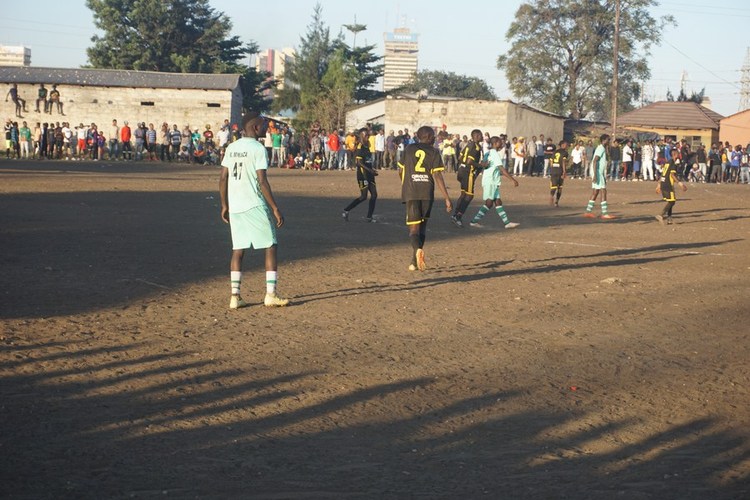
    Xinhua/Flowerbudnews:      For years, children in Zambia’s urban areas, as in many parts of the world, have been drawn to screens, spending hours in front of televisions, computers, phones, and gaming devices. However, the power cuts have forced them to find alternative ways to entertain themselves, leading to a resurgence of traditional and indigenous games.

    LUSAKA, June 16 (Xinhua) — It was 12:00 p.m., and 11-year-old Zanele Mbewe, a resident of Northgate Gardens in the Zambian capital of Lusaka, had just come home from school.

    After completing her homework, Zanele would head next door to play Nsolo, a simpler form of chess. She would also participate in other traditional and indigenous games with other children. This has been her routine for the past five days.

    “This week, the power goes off at 5 a.m. and comes back on at 5 p.m.,” she explained while looking at the power rationing timetable from Zambia’s national electricity supply company, ZESCO, stuck on the door of the refrigerator in her household.

    As homes and communities endure more than 10 hours of power cuts each day, children in Zambia are finding themselves with a newfound opportunity to engage in traditional indigenous games, replacing hours spent in front of televisions and other electronic devices.

    For years, children in Zambia’s urban areas, as in many parts of the world, have been drawn to screens, spending hours in front of televisions, computers, phones, and gaming devices. However, the power cuts have forced them to find alternative ways to entertain themselves, leading to a resurgence of traditional and indigenous games.

    In the densely populated community of the Mandevu Compound, on the northern side of Lusaka, children can be seen playing a variety of games, such as skipping rope, hopscotch, and tag, which were once part of the daily routine of previous generations.

    “Before the power rationing started, children were always indoors, glued to their screens, watching TV or playing video games. Now, with the lack of electricity for several hours each day, they have turned to playing traditional games,” Herald Kakomai, 62, a senior citizen residing in Mandevu Compound.

    He also noted that the lack of electricity has compelled children in his neighborhood to engage in various sports activities, building relationships that go beyond the virtual world.

    Justine Nyirenda, a traditional and indigenous sports promoter, asserted that the current electricity rationing in Zambia has unintentionally encouraged a return to age-old pastimes that involve teamwork, creativity, and physical activity, which are often overlooked in a digitally dominated world.

    Nyirenda, who heads Kombolani, an indigenous sports association, further said the resurgence of traditional and indigenous games has allowed children to connect with Zambia’s cultural heritage and learn about traditions that have been passed down from previous generations.

    “These games not only provide entertainment, but also serve as a way for children to connect with their roots and foster a sense of pride in their cultural identity,” he said.

    Interactions with different members of the public have shown that the decrease in screen time has also resulted in children becoming more physically active, decreasing sedentary behavior, and improving their overall health and well-being.

    Electricity rationing in Zambia has often been necessitated by low water levels at the Kariba Dam, a key hydroelectric generation point for the country. Low water levels at the dam are caused by insufficient rainfall and drought conditions.

    Zambian Minister of Energy Peter Kapala said in a statement in May that the Kariba Dam power station was producing only 166 megawatts out of an installed capacity of 1,080 megawatts, leaving communities without electricity for more than 10 hours a day.

    While the lack of access to electricity has posed challenges for households and businesses, it has created opportunities for children to embrace age-old games that were once at risk of being forgotten.

    As children across the country trade the glow of screens for the warmth of community interaction, the positive ripple effects of this unexpected situation will continue to serve as a silver lining to Zambia’s power cuts.

  • Palestinians getting life back on track in N. Gaza’s Jabalia amid truce hopes

    Palestinians getting life back on track in N. Gaza’s Jabalia amid truce hopes


    GAZA, (Xinhua)/Flowerbudnews:  — Finally in June, Mohammed Adel, a Jabalia-based Palestinian man, could reopen his stall on the rubble of his house flattened by Israeli warplanes in nearly three weeks of military operation.

    “A month ago, I used to set up my stall in front of my house, but today I set up my stall on its ruins,” the 25-year-old young man told Xinhua.

    The stall became possible after the Israeli army withdrew from the Jabalia refugee camp in the northern Gaza Strip at the end of May after its military operation that left dozens dead and widespread destruction to homes, facilities, and infrastructure.

    On May 31, the Israel Defense Forces said that during its mission in eastern Jabalia, it retrieved seven bodies of hostages, eliminated hundreds of “terrorists” and destroyed 10 km of a subterranean tunnel network.

    It did not take long for Adel to get his life back on track. The Israeli forces “may kill dozens of us and destroy our houses, but we insist on continuing our lives and rebuilding our houses as soon as possible,” he said. “We will never give up our hopes for life.”

    Not far from Adel’s place, 50-year-old Sobhi Hassan installed a swing on the remains of his destroyed house for children to have some fun.

    “I returned to put the small swing on the ruins of my house so that the children can play and relieve what they have experienced in the past days,” the father of six told Xinhua while trying hard to crack a smile on his sad-looking face.

    In fact, the middle-aged man is earning some money from the swing to help keep his family afloat amid the dire situation due to the war.

    “When I see the children laughing, I feel that life is worth fighting for even when we are mired in a war,” the man said.

    Adel and Hassan both expressed their hopes that the war will end and a ceasefire deal be reached in Gaza as soon as possible.

    Jabalia camp is the largest of the eight refugee camps in Gaza. Since the beginning of the Israeli war on Gaza, Jabalia camp has seen deadly confrontations between the Israeli army and armed Palestinian factions, led by Gaza-ruling Hamas.

    After the latest Israeli military operation, a lot of waste was left behind, including wooden ammunition boxes. This encouraged Samir Ahmed, a Jabalia-based Palestinian man, to collect and sell them as firewood in local markets.

    “Such boxes included dozens of bombs that killed our people, but I used them to help people prepare food to stay alive. This is the difference between Israelis and us. They (Israelis) brought death and destruction while we spread life and hope all the time,” the young man told Xinhua.

    “The war will end, no doubt, but hopefully it will end today before tomorrow,” he said.


  • Malawi VP, nine others, killed in plane crash

    Malawi VP, nine others, killed in plane crash

    June 11, 2024

    Malawi’s Vice President Saulos Chilima was killed in a plane crash, the nation’s president said on Tuesday, after searchers located the wreckage of the aircraft in a foggy forest.

    The military plane carrying Chilima, 51, and nine others disappeared on Monday, after it failed to land in the northern city of Mzuzu due to bad weather and was told to return to the capital, Lilongwe.

    “The search and rescue team have found the aircraft … completely destroyed with no survivors, as all passengers on board were killed on impact,” Malawi’s President Lazarus Chakwera said addressing the nation.

    “Words cannot describe how heartbreaking this is,” he said, describing the accident as a “terrible tragedy.”

    Photographs shared with AFP by a member of the military rescue team showed army personnel standing on a foggy slope near debris bearing the registration number of the Malawi Army Air Wing Dornier 228-202K aircraft.

    Rescuers had been combing a fog-cloaked forest south of Mzuzu on Tuesday, after authorities located the last tower it transmitted to before the plane disappeared.

    Earlier, army commander General Paul Valentino Phiri said other countries, including Malawi’s neighbours, had been aiding the search effort, with support including helicopters and drones.

    The group departed just after 9:00 am (0700 GMT) from Lilongwe on Monday to attend the funeral of a former cabinet minister some 370 kilometres (230 miles) away in Mzuzu.

    Malawi’s former first lady Shanil Dzimbiri was also on board.

    Chakwera said he had previously flown on the same aircraft for similar trips. The crew had successfully operated it just hours before the accident, he added.

    “And yet, despite the track record of the aircraft and the experience of the crew, something terrible went wrong with that aircraft on its flight back to Lilongwe, sending it crashing down,” he said.

    First elected vice president in 2014, the charismatic yet stern-talking Chilima was a widely loved figure in Malawi, particularly among young people.

    But in 2022, during his second stint in the job, Chilima was stripped of his powers after being arrested and charged with graft over a bribery scandal involving a British-Malawian businessman.

    Last month, a Malawian court dropped the charges and he resumed his official duties.

    “Chilima was a good man, a devoted father and husband, a patriotic citizen who served his country with distinction and a formidable vice president,” Chakwera said.

    “I consider it one of the greatest honours of my life to have had him as my deputy and counsellor for the past four years.”

  • Malawi’s vice president confirmed dead in plane crash

    Malawi’s vice president confirmed dead in plane crash

    LILONGWE:  (Xinhua)/Flowerbudnews: — Vice President of Malawi Saulos Chilima, along with nine other individuals who were on board a military aircraft, have been confirmed deceased after the aircraft went missing on Monday morning, President Lazarus Chakwera announced on Tuesday.

    Chilima was traveling to a funeral of the country’s former Attorney General and Minister of Justice Ralph Kasambara, who was found dead in a room at a lodge in Lilongwe, the capital of Malawi, Friday, and his body was buried Monday at his home village in Nkhata Bay, a few kilometers from Mzuzu Airport.

    The plane failed to make its scheduled landing at Mzuzu Airport at 10:02 a.m. (0802 GMT) on Monday, according to the country’s Secretary to the President and Cabinet Colleen Zamba.

  • Israel’s Forever War

    Israel’s Forever War

    Courtesy:  Independent N/P


    The Long History of Managing—Rather Than Solving—the Conflict


    By Ottih Chinedu

    To Israelis, October 7, 2023, is the worst day in their country’s 75-year history. Never before have so many of them been massacred and taken hostage on a single day. Thousands of heavily armed Hamas fighters managed to break through the Gaza Strip’s fortified border and into Isra­el, rampaging unimpeded for hours, destroying several villages, and committing gruesome acts of bru­tality before Israeli forces could re­gain control.

    Israelis have compared the attack to the Holocaust; Prime Minister Benjamin Netanyahu has described Hamas as “the new Na­zis.” In response, the Israel Defense Forces have pursued an open-ended military campaign in Gaza driven by rage and the desire for revenge.

    Netanyahu promises that the IDF will fight Hamas until it achieves “total victory,” although even his own military has been hard put to define what this means. He has of­fered no clear idea of what should happen when the fighting stops, other than to assert that Israel must maintain security control of all of Gaza and the West Bank.

    For Palestinians, the Gaza war is the worst event they have expe­rienced in 75 years. Never have so many of them been killed and uprooted since the nakba, the ca­tastrophe that befell them during Israel’s war of independence in 1948, when hundreds of thousands of Palestinians were forced to give up their homes and became ref­ugees.

    Like the Israelis, they also point to terrible acts of violence: by late March, Israel’s military cam­paign had taken the lives of tens of thousands of Palestinians, among them thousands of children, and rendered well over a million home­less.

    As the Palestinians see it, the Israeli offensive is part of a larger plan to incorporate all Palestinian lands into the Jewish state and get them to abandon Gaza entirely—an idea that has in fact been raised by some members of Netanyahu’s gov­ernment.

    The Palestinians also hold on to the illusion of return, the prin­ciple that they will one day be able to reclaim their historic homes in Israel itself—a kind of Palestinian Zionism that, like Israel’s maximal­ist aspirations, can never come true.

    Ever since the first Zionists began to conceive of a Jewish homeland in Palestine in the late nineteenth century, Jewish leaders and their Arab counterparts have understood that an all-encompass­ing settlement between them was likely impossible.

    As early as 1919, David Ben-Gurion, Israel’s future first prime minister, recognized that there could be no peace in Pal­estine. Both the Jews and the Arabs, he observed, were claiming the land for themselves, and both were doing so as nations.

    “There is no solution to this question,” he repeatedly de­clared. “There is an abyss between us, and nothing can fill that abyss.” The inevitable conflict, he conclud­ed, could at best be managed—lim­ited or contained, perhaps, but not resolved.

    In the months since the October 7 attacks, critics of Netanyahu, not­ing his efforts to bolster Hamas and his push for Arab normalization deals that sideline the Palestinian issue, have accused him of trying to manage the conflict rather than end it. But that complaint misreads history. Netanyahu’s cardinal blun­der was not his attempt to parry the issues that divide Jews and Arabs. It was that he did so more incompe­tently—and with more disastrous consequences—than anyone else over the past century. Indeed, con­flict management is the only real option that either side, and their international interlocutors, has ever had.

    From its beginnings, the conflict has always been perpetuat­ed by religion and mythology—vio­lent fundamentalism and messianic prejudices, fantasies and symbols, and deep-rooted anxieties—rather than by concrete interests and cal­culated strategies.

    The irrational nature of the conflict has been the main reason why it could never be resolved. Only by confronting this enduring reality can world leaders begin to approach a crisis that de­mands not more empty talk of solu­tions for the future but urgent action to better cope with the present.

    This Land Is My Land

    Not far from the grave of The­odor Herzl, the father of political Zionism, on the mountain in Je­rusalem that bears his name, is a national memorial to generations of Jewish victims of terrorism. The monument reflects an Israeli tendency to try to prove that Jews were persecuted by Arabs in Pal­estine long before the first Zionists set foot there.

    The earliest victim mentioned is a Jew from Lithuania who was killed by an Arab in 1851 after a financial dispute, and the eviction of some Arabs, related to the rebuilding of a synagogue in the Old City of Jerusalem. The memo­rial also mentions several Jewish victims of Arab robberies and 13 Jews who were killed in British bombing raids on Palestine during World War I. Palestinian historiog­raphy and commemorative culture rely on a similarly tendentious use of history.

    At the beginning of the nine­teenth century, fewer than 7,000 Jews were living in Palestine, making up about 2.5 percent of the population of what was then an Ottoman province. Some of their communities had been there for many centuries. As more Arabs and Jews migrated there, the ter­ritory’s population grew, and with it the relative proportion of Jews. Most Arabs came from neighboring countries in search of employment. Most of the Jews came for religious reasons and as refugees from po­groms in Eastern Europe, and they tended to settle in the Old City of Jerusalem. These immigrants had no intention of establishing Jewish statehood in Palestine. In fact, most Jews at the time did not believe in the Zionist ideology, and many of them even opposed secular Zionism on religious grounds.

    By the end of the nineteenth century, there were about half a million Arabs in Palestine, where­as the number of Jews, although it had increased steadily, was around 50,000, or about one-tenth of the population. Nonetheless, Herzl’s international activities, including a visit in 1898 to Jerusalem, where he was received by the German Kaiser Wilhelm II, began to worry leaders of the Palestinian Arabs.

    The following year, Yusuf Diya al-Khalidi, the mayor of Jerusa­lem, expressed his concerns about the Zionists in a remarkable letter written to the chief rabbi of France. “Who could contest the rights of the Jews in Palestine?” Khalidi began in polite, even sympathetic, French prose. “My God, historically it is your country!” But that history was now deep in the past, he con­tinued. “Palestine is an integral part of the Ottoman Empire, and more gravely, it is inhabited by others,” Khalidi wrote. The world was big enough, with plenty of uninhabited land for Jewish independence, he concluded.

    “For God’s sake—let Palestine be left alone!” Herzl, who received the letter from the French chief rabbi, assured Khalidi in his reply that the Zionists would develop the land for the benefit of all inhabitants, includ­ing the Arabs. Previously, however, he had written that the Zionist proj­ect might require the resettlement of poor Palestinians to neighboring countries.

    Around the time of Herzl’s death, in 1904, young Zionists, mostly so­cialists from Eastern Europe, began to come to Palestine. One was Da­vid Gruen, who later changed his name to David Ben-Gurion. Born in Poland, he arrived in 1906 at the age of 20 and joined a Jewish work­ers’ group in the Galilee. His first political activity was the promotion of “Hebrew labor”—an attempt to require Jewish employers to hire Jews rather than Arabs. At the time, the Zionists’ acquisition of land also led to the dispossession of some Arab agricultural workers, some of whom reacted violently. In the spring of 1909, Ben-Gurion’s settle­ment was attacked, and two of his fellow members were killed, one of them apparently in front of Ben-Gu­rion. The future prime minister of Israel concluded that the Jews and the Palestinian Arabs had irrecon­cilable differences; there was no escaping the conflict.

    Ben-Gurion’s attitude toward the Arabs was further shaped by two other experiences. During World War I, he was expelled from Pales­tine by the Ottoman authorities. On one of his last days in Jerusalem, he ran into a young Arab with whom he had studied in Istanbul. When Ben-Gurion reported that he was about to be expelled, his acquain­tance replied that as his dear friend, he was deeply sorry for him, but as an Arab nationalist, he was very happy. “That was the first time in my life that I heard an honest an­swer from an Arab intellectual,” Ben-Gurion said. “His words burned themselves into my heart, very, very deeply.” Years later, Ben-Gurion had a conversation with Musa Alami, a prominent Arab Palestinian and politician. Ben-Gurion promised as usual that the Zionists would devel­op Palestine for all its inhabitants. According to Ben-Gurion, Alami re­plied that he would rather leave the land poor and desolate for another century, if need be, until the Arabs could develop it themselves.

    Ben-Gurion often dismissed the “easy solutions” that he attributed to some of his colleagues, such as the notion that Jews could be en­couraged to learn Arabic or even that Jews and Arabs could live together in one state. They were refusing to acknowledge the facts. Ben-Gurion’s own concept of the Jewish future in Palestine was based simply on acquiring as much land as possible, if not necessarily the entire territory, and populating it with as many Jews and as few Arabs as possible. His views about the conflict remained unchanged to the end of his life and continuously informed his efforts to manage it.

    Switzerland In Judea

    In 1917, the Zionist movement achieved one of its most important successes when British Foreign Sec­retary Arthur Balfour declared the United Kingdom to be in favor of establishing a “national home” for the Jewish people in Palestine. The Balfour Declaration, as it became known, was part of a strategic Brit­ish plan to take the Holy Land from Ottoman dominion. In reality, like almost everything to do with that land, Balfour’s policy was driven more by sentimental religious ideas than by rational statecraft. A staunch Christian Zionist, Balfour was committed to the idea that the people of God should return to their homeland after a 2,000-year exile so that they could fulfill their biblical destiny. He aspired to go down in history as the man who made this messianic transformation possible.

    Advertisement
    As was often the case with West­ern officials at the time, Balfour’s apparent reverence for the Jews si­multaneously drew on deep anti-Se­mitic prejudice. Like others of his era, he attributed almost unlimited power and influence to “the Jew,” in­cluding an ability to determine his­tory and even convince the United States to enter World War I. (It was hoped that the Balfour Declaration would sway American Jews to push the United States to join the Allied powers in the war.)

    By the end of 1917, the United Kingdom had conquered Palestine, thus beginning nearly 30 years of British rule. During this period, the Zionist movement laid the political, economic, cultural, and military foundations for the future state of Israel. Tensions with the Arabs in­creased over the years as hundreds of thousands of new Jewish immi­grants, mainly from Europe, con­tinued to arrive. In the 1920s, these immigrants were motivated not by support for Zionism but by the se­vere new immigration restrictions imposed by the United States. In the 1930s, more than 50,000 Jewish refugees arrived in Palestine from Nazi Germany, although in less des­perate circumstances most of them would have preferred to stay in their country.

    Large-scale immigration of Jews sparked more waves of Arab violence against Jews and against the British authorities, who were seen as supporting Zionist aims. This came to a head in the Arab revolt of 1936–39, in which Pales­tinians rose up against the British colonial administration through a general strike, an armed insur­rection, and attacks on railways and Jewish settlements. Amid this turmoil, the British began to regard Palestine as a nuisance. To get rid of the problem, they appointed the so-called Peel Commission, which recommended dividing the land into Jewish and Arab states—the very first “two-state” solution.

    Although the Jewish state it en­visioned was small, amounting to just 17 percent of British Mandate Palestine, Ben-Gurion supported the plan. Notably, Arab inhabitants of the area designated for the Jew­ish state were to be transferred to the Arab state, a provision that he described in his diary as a “forced transfer,” drawing a thick line under the words. Most of his colleagues, however, wanted much more land for the Jewish state, setting off a contentious debate between the center-left Zionist leadership and right-wing “Revisionists” who cul­tivated a dream of a Greater Israel on both banks of the Jordan River. Although they stood to gain control of about 75 percent of the land, the Arabs rejected the idea of a Jewish state in principle, and the British withdrew the plan. Here, again, was the “abyss” between Jews and Ar­abs that Ben-Gurion had identified years earlier and that would become even deeper after the Holocaust and the war of 1948.

    In January 1942, a few weeks before Nazi leaders met at the in­famous Wannsee Conference to discuss the “Final Solution to the Jewish Question,” Foreign Affairs published an article by the Zionist leader Chaim Weizmann calling for the establishment of a Jewish state in Palestine. At the time, no one outside Germany knew about the Nazis’ planned extermination camps, but their treatment of Jews in occupied Western Europe and during Germany’s ruthless assault on the Soviet Union had already made clear that the Nazis were threatening the existence of the entire Jewish people. Only total victory over the Third Reich could halt the extermination of the Jews, and although Weizmann expressed a hope that a better world could be built after the war, his article was an urgent appeal for a Jewish home­land. Palestine, he wrote, was the only place where Jews, particularly Jewish refugees, could survive.

    From a Zionist perspective, Weizmann’s proposal contained el­ements of compromise: more than 20 years earlier, at the Versailles peace conference after World War I, he had presented a map of the Land of Israel with biblical borders that extended to the east bank of the Jordan River—territory much larger than the country would ever attain. In his article, by contrast, Weizmann did not specify borders but proposed unlimited Jewish im­migration to a democratic country that would offer equal rights to all its inhabitants, including Arabs. Although he wrote that the Arabs must be “clearly told that the Jews will be encouraged to settle in Pales­tine, and will control their own im­migration,” he asserted that Arabs would not be discriminated against and would “enjoy full autonomy in their own internal affairs.” He also did not rule out the possibility that the new Jewish state could join “in federation” with neighboring Arab states. But like Ben-Gurion, he also foresaw the need to contain the Pal­estinian Arabs: should they wish, he wrote, “every facility will be given to them to transfer to one of the many and vast Arab countries.”

    Attempting to convince his readers that the Jews were wor­thy of help, Weizmann somewhat pathetically promised that “the Jew” no longer fit the anti-Semit­ic stereotypes that were prevalent in the West before the start of the Zionist project. “When the Jew is reunited with the soil of Palestine,” he wrote, “energies are released” that if “given an outlet, can create values which may be of service even to richer and more fortunate coun­tries.” Weizmann compared the hoped-for Zionist state to Switzer­land, “another small country, also poor in natural resources,” that had nevertheless become “one of the most orderly and stable of Europe­an democracies.” Seven years later, he was elected the first president of Israel. In the meantime, the Nazis had murdered six million Jews.

    Unrealized Gains

    In November 1947, the UN Gen­eral Assembly recommended the partition of Palestine, this time in a division that would give each side broadly equitable areas of land, with the Old City of Jerusalem un­der international control. The Ar­abs rejected the plan, in accordance with their traditional objection to Jewish statehood in Palestine. The Zionists accepted partition, al­though Ben-Gurion expected war and hoped that it would end with territory that was empty of Arabs.

    Soon afterward, Arab militias be­gan a series of attacks on the Jew­ish population, and Zionist groups retaliated with actions against Arab communities. In May 1948, Ben-Gu­rion declared Israel’s independence. It was a dangerous gamble. Regular Arab armies and volunteers from Egypt, Iraq, Lebanon, Saudi Arabia, Syria, and Transjordan were about to invade the new country, and top commanders of the Jewish armed forces warned that the odds of de­feating them were even at best. U.S. Secretary of State George Marshall demanded an immediate cease-fire; Ben-Gurion feared that the Zionists were not ready for war. Before the UN partition plan was announced, he had tried in vain to persuade the British to stay in Palestine for five to ten more years, which could have given the Jews more time to in­crease immigration and strengthen their forces.

    But faced with the historic op­portunity to declare a Jewish state, Ben-Gurion chose to obey a Zionist imperative that he said had guided him since the age of three. He later explained that the Israelis won not because they were better at fighting but because the Arabs were even worse.

    In keeping with his abiding view that establishing a Jewish majority was more important than gaining territory, he led the army to push out or expel most of the Arabs—some 750,000—who fled to the West Bank, East Jerusalem, and Gaza, which Ben-Gurion left unoc­cupied, as well as to neighboring Arab countries.

    A direct line could be traced from the Zionists’ cam­paign in the 1920s to replace Arab workers with Jews to the far larger effort in 1948 to remove Arabs from the land of the new Jewish state. Israel lost close to 6,000 soldiers in that war, nearly one percent of the new country’s Jewish population at the time.

    When the war ended in early 1949, green pencils were used to draw armistice boundaries between Israel and its Arab neighbors, the famous “Green Line.”

    Gaza became an Egyptian protectorate, and the West Bank was annexed by Jordan. Israel now controlled more terri­tory than it had been allocated in the UN partition plan. It was also almost free of Arabs; the ones who remained were subjected to a rather arbitrary and often corrupt military rule. Most Israelis at the time saw this as an acceptable situation—a rational way of managing the con­flict.

    The Arabs in turn considered Israel’s existence a humiliation that had to be remedied. In Jordan, Lebanon, and Syria, authorities did not allow Palestinian refugees to be integrated into their new countries of residence, forcing them instead to live in temporary camps, where they were encouraged to nurture the idea of return.

    In the first two decades after in­dependence, Israel made remark­able achievements. But it failed to reach the Zionist goal of providing the entire Jewish people with a safe national homeland.

    Most of the world’s Jews, including many survivors of the Holocaust, still pre­ferred to remain in other countries; those in the Soviet Union and other communist countries were forbid­den to emigrate by the authorities in those places. After the 1948 war, most Middle Eastern Jews, many of whose families had been in the region for thousands of years, no longer felt safe in Muslim coun­tries and chose—or were forced—to leave.

    Most settled in Israel, at first often as destitute refugees. By the mid-1960s, immigrants who had ar­rived since independence made up around 60 percent of the Israeli pop­ulation. Most had not yet mastered the Hebrew language, and they of­ten disagreed on basic values and even on how to define a Jew.

    Ben-Gurion continued to man­age the conflict, but many Israelis, particularly newcomers, felt that Is­rael’s existence was still in danger. Only a few close confidants knew about Ben-Gurion’s nuclear project. Border wars frequently broke out; the IDF prepared contingency plans for the occupation of the West Bank and Gaza.

    During the Suez crisis of 1956, Israeli forces invaded Egypt, occupying Gaza and the Sinai Pen­insula, but withdrew a few months later. In a cabinet meeting, Ben-Gu­rion said that if he believed in mir­acles, he would ask for Gaza to be swallowed up by the sea.

    After Ben-Gurion resigned in 1963, Israelis were left with a weak and hesitant leadership and a deep economic crisis. More and more of them began to lose confidence in Is­rael’s future. In 1966, the number of Jews emigrating from the country exceeded the number entering it. A popular joke referred to a sign sup­posedly hanging at the exit gate of the international airport that read: “Would the last person to leave the country please turn off the lights?”

    Continued on Foreign Affairs (www. foreignaffairs.com), April 23, 2024.


  • Palestinians recall horrors “not even in nightmares” after Nuseirat refugee camp attacks

    Palestinians recall horrors “not even in nightmares” after Nuseirat refugee camp attacks


    Xinhua

    GAZA,  (Xinhua)/Flowerbudnews: — Pedestrians can hardly walk through the streets of the Nuseirat refugee camp in central Gaza Strip on Sunday, which has been transformed overnight into a devastated area with the smell of death.

    Burned cars, destroyed houses, and bloodstains from the victims are found on the camp’s roads and in its alleys after Israeli special forces launched a military operation in the camp to free four Israeli hostages on Saturday.

    As Israeli troops entered the camp, warplanes launched a series of violent raids on dozens of targets inside the camp, mostly civilian houses, according to the media office of the Hamas-run government.

    At least 274 Palestinians were killed and more than 698 others injured during the Israeli military operation, according to figures released by the Hamas-run health authorities on Sunday.

    “I was drinking a cup of coffee on the balcony of my house overlooking the street. Everything was normal: passers-by and vendors in the street, children playing in the sun, but everything changed in an instant,” recalled Othman Zaki, a resident of the Nuseirat camp.

    “Suddenly, Israeli planes started bombing violently everywhere. No one understood anything. Everyone started running without knowing where to go safely,” said the 27-year-old man.

    “The continuous bombing, the rapid events, and the bodies of the victims lying everywhere — no one can describe it,” said Ahmed Shaaban, a displaced Palestinian man.

    “We couldn’t save anyone. The situation was catastrophic and crazy. No one could have imagined it, not even in their nightmares,” he added.

    Since early Sunday morning, the 42-year-old father of six has been trying in vain to identify landmarks in his neighborhood. The street where he once lived with his family has been reduced to rubble.

    “We can only see the rubble of houses destroyed by Israeli airstrikes. The dead and wounded were lying on the sides of the road. No one could save them due to the violent and continuous bombing,” he said with teary eyes.

    When the bombing, which lasted for more than half an hour, finally subsided, Shaaban and his neighbors started to leave and seek safety. “We were shocked by what we saw. The victims were everywhere,” he recalled.

    In a desperate attempt to rescue the injured people, they used anything that could move — vehicles, bicycles, even donkey carts — to transport them to hospitals.

    Yahya Ayoub from the city of Beit Hanoun in the northern Gaza Strip described how the bombing forced many displaced people and dozens of residents of Nuseirat camp to flee their homes.

    “Destruction is everywhere here. Houses were burned, some destroyed. Victims were killed inside their homes without understanding what was happening or what their fault was,” Ayoub said.

    With a tone of sadness, Ayoub said he could not believe he had survived the bombing. He recounted carrying an injured, unconscious child from the street, running a long distance until he found a car to take the child to the hospital.

    “I still do not know the condition of the child, but I hope he is fine and that the doctors succeed in saving his life,” he said.

  • Implications of Conference of Sahel States in Senegal*

    Implications of Conference of Sahel States in Senegal*

    By Paul Ejime

    Senegal will host a conference on Saturday, 1 June under the theme “The Alliance of Sahel States, a new platform for Senegal’s regional integration,” a development that could have potential implications on the unity and cohesion among ECOWAS member States, according to diplomatic sources.

    In an ironic but provocative move, Niger, one of the three so-called Alliance States of the Sahel (AES/ASS), which are dissociating themselves from ECOWAS, has invited other ECOWAS member States to join the Alliance, even when the 15-nation regional economic bloc is making efforts to win the three back to its fold.

    “I don’t intend to be provocative, but I suggest that ECOWAS countries join the AES. There are ECOWAS states that probably would like to join the AES because the AES respects the sovereignty of each State and the continent as a whole,” Niger Prime Minister Ali Lamine Zeine was quoted as saying on Thursday.

    According to organisers of the Dakar meeting, attendees will be representatives of Senegal’s civil society, including the ruling Coalition PASTEF, the Front for a Popular and Pan-African Anti-Imperialist Revolution, FRAPP, and the West African Economic and Monetary Union, UEMOA.

    “The current situation in the areas of economy and security” would be addressed, diplomatic sources said, noting that Senegal “has a mutually beneficial economic and trade partnership with the countries of the (AES/ASS) region.

    The conference follows Senegalese President Diomaye Faye’s recent visits to Mali and Burkina Faso.

    Junta leaders in the two countries, along with their counterparts in Niger, set up what they called Sahel Alliance States (AES/ASS) last September and announced their countries’ withdrawal from ECOWAS in January this year.

    ECOWAS, after lifting the sanctions imposed on the three countries along with Guinea over the military takeover of elected civilian governments, has insisted on the return of the four to constitutional rule.

    However, the junta leaders have proposed long political transition timetables of three to five years, with provisions that they will also be eligible for post-transition elections.

    Analysts consider this confirmation that the soldiers are out for a power grab rather than their professed salvation of the population.

    Before his trip to Mali and Burkina Faso, President Faye had paid a lightning visit to Nigeria for talks with President Bola Tinubu, the current Chairman of ECOWAS on 16 May. During their discussion, both men agreed to work together, toward the return of the four countries to the ECOWAS fold.

    ECOWAS has never recognised the AES/ASS as an entity, neither has any country or organisation.

    The regional bloc also maintains that the withdrawal of any member State takes a one-year procedure according to the organisation’s protocol.

    Assuming Faye is working on behalf of ECOWAS, his government’s hosting of a conference with AES/ASS member States as a group could be interpreted as a recognition of the group and this could pose a diplomatic problem for his administration and the cohesion/unity of ECOWAS.

    Senegal as a sovereign nation can engage in bilateral cooperation with any of the three countries but engaging them as a group could constitute an affront to ECOWAS and undermine the collective efforts by the regional bloc to win back the four countries.

    Senegal’s Minister for Livestock, Dr Mabouba Diagne, was quoted during Faye’s visit to Bamako on May 21, as saying that Senegal in 2022, exported goods worth more than US$1 billion to Mali, with petroleum products as the main export followed by cement, while meat imports from Mali contributed “significantly to the development of Senegalese agriculture.”

    The AES/ASS countries have established Joint Forces to fight terrorism and armed groups while sharing intelligence, and Senegalese Prime Minister, Ousmane Sonko is quoted as saying, that he “shared the visions of the AES/ASS leaders and was ready to support them.”

    The big question is whether Senegal is pursuing its bilateral/national interests or working for ECOWAS by hosting this meeting.

    “The role of external economic and political actors (France, USA and other Western countries) in Senegal” is another topic on the Dakar conference agenda.

    Senegal’s economy is highly dependent on France, with about 80% of the companies operating in Senegal being French, which means a large capital outflow from Senegal to the treasury of its former colonial power.

    Meanwhile, like the three AES/ASS countries, Senegalese authorities, have already announced their intention to renegotiate trade agreements with international partners.

    In this regard, the French-controlled CFA franc used by its former African colonies is a hot topic.

    The Dakar conference is also expected to discuss the French military presence in the region.

    France still has a military presence in Senegal, but French soldiers have been expelled from Mali, Burkina Faso, and Niger, with growing anti-French sentiments in Francophone African countries.

    The meeting is also expected to discuss other topics of mutual interest including the “effectiveness of modern African institutions such as ECOWAS and the African Union,” the diplomatic sources added. ##