Category: Foreign

  • THE ECOWAS OF YESTERDAY, TODAY AND TOMORROW

    THE ECOWAS OF YESTERDAY, TODAY AND TOMORROW


    By Paul Ejime

    Nigeria’s late Professor Adebayo Adedeji and Togo’s Edem (Kodjovi) Kodjo would likely be turning in their graves in disappointment if not utter shock at what has become of the Economic Community of West African States (ECOWAS), which they laboured with others to establish in 1975.

    After its civil war of 1967-70 and the uncoordinated support from foreign powers, the then-Federal Military Government of Nigeria under the leadership of Gen. Yakubu Gowon, wanted to recalibrate the country’s foreign policy thrust based on the concentric circle model, driven by the axiom that charity begins at home.

    As a young military officer then, saddled with the huge task of governing a complex country like Nigeria, Gowon, now arguably the only surviving “founding father” of ECOWAS bought into the idea canvassed by international relations experts that Nigeria must first master the art of “a big fish in a small river, before rubbing shoulders with the Big Boys at the global stage.”

    Adedeji, a brilliant, full-fledged professor of Economics at age 36, as Nigeria’s Federal Commissioner (Minister) of Economic Development and National Reconstruction (1971-75), sold his boss, Gen. Gowon the idea of a regional body with Nigeria as the hegemon.

    Adedeji passed on in 2018, but his legacy as a development pioneer lives on.

    Relating his experiences to an ECOWAS delegation, including this writer that visited him at his Ijebu-Ode home in Western Nigeria in 2013, he recalled the “marching order” given to him by Gen. Gowon to make ECOWAS a reality after he had convinced him about the need for an organization that would foster regional integration.

    Given the cultural, language and colonial differences of countries in the region, Adedeji recalled the “shuttle diplomacy” he undertook to various capitals in his days as Minister and the pivotal roles played by Gen. Gowon and his Togolese counterpart Gnassingbé Eyadéma in the formation of ECOWAS.

    The Anglophone-Francophone dichotomy and rivalry between France and Nigeria for regional influence dates back to the early post-independence period of African States, yet Eyadéma was the first convert to the Gowon-Adedeji idea of regional integration.

    As Gowon did to Adedeji, Eyadéma volunteered Kodjo, who was his finance minister from 1973-77 and Foreign Minister from 1976-78 for the ECOWAS birthing project.
    The two government ministers did not disappoint.

    According to Adedeji, thanks to their relentless shuttles and diplomatic suavity, the *Lagos Treaty of 28th May 1975* on the establishment of ECOWAS was one of the few Treaties signed by all Heads of State at a sitting.

    Senegal’s then-President Sedar Senghor was eventually convinced to abandon his initial reservations and after much persuasion, involving facilitating his transportation from Abidjan to Lagos and the concession of making an Ivorian the first Executive Secretary of ECOWAS, President Felix Houphouet Biogeny of Cote d’Ivoire also “suspended” his opposition to the ECOWAS idea in preference to the formation of a France-Afrique Union and joined other regional leaders to initial the Lagos Treaty.

    ECOWAS Member States grew to 16, until the year 2000 when Mauritania left but now wants to rejoin. Other countries, even outside the region are also seeking ECOWAS membership.

    However, like most inter-governmental organizations, ECOWAS has had its fair share of internal crises and divisions between and among Member States, but until recently, it had managed the conflicts, fault lines and differences effectively to record tremendous achievements as Africa’s trailblazer Regional Economic Community.

    “This (ECOWAS) is the only region in Africa where citizens can visit and stay in a country other than their own for at least 90 days without a visa,” Adedeji had enthused in 2013, in a reference to the ECOWAS 1979 flagship Protocol on Free Movement of Persons, Rights to Residence and Establishment.

    Moving forward, Adedeji had enjoined ECOWAS Member States to work toward the harmonization of policies, laws, and regulations to consolidate regional integration.

    He and Kodjo were able to take their visionary and dynamic Pan-Africanist advocacy beyond the West African region.

    Mentioned in a 2006 publication as one of the world’s 50 influential thinkers on development, Adedeji after the setting up of ECOWAS advanced his integration campaign to the United Nations Economic Commission for Africa (UNECA) in Addis Ababa where he served as UN Under-Secretary-General and Executive Secretary for 16 years (1975-91).

    His dynamism under the UNECA platform also resulted in the creation of two more Regional Economic Communities (RECs) – the Common Market for Eastern and Southern Africa (COMESA) and the Economic Community of Central African States (ECCAS) in 1981 and 1983, respectively.

    The professor will also be remembered for his other unique initiatives, such as the *Lagos Plan of Action (1980),* and the *Final Act of Lagos (1980).*

    When the World Bank and the IMF hoisted the *Structural Adjustment Programme (SAP)* on hapless so-called developing and least developed nations – many of which are in Africa – Adedeji and fellow pan-Africanist thinkers raised an alarm and developed the African Alternative Framework to *Structural Adjustment Programme (AAF-SAP, 1989)* followed by the *African Charter for Popular Participation (ACPP, 1990),* as legendary blueprints for the continent’s home-grown development and governance paradigms.

    Kodjo, before he died in 2020, had also served as Togo’s 3rd Prime Minister from 1994-96 and before then, as finance and foreign minister (1973-77) and from 1978-83 as the 4th Secretary General of the Organisation of African Unity (OAU), which was replaced by the African Union (AU) in 2002.

    He called it quits with internal politics in 2009, but until his death, continued to profess his pan-African beliefs despite his several unsuccessful attempts to be elected Togo’s president, and his controversial romance with the regimes of the late Eyadéma and his son, current President Faure Gnassingbe.

    In 2016, Kodjo served as the African Union’s mediator in a dispute between the government and the opposition in the Democratic Republic of the Congo over the fixing of national elections.

    Kodjo also founded a magazine, *Afrique (Africa) 2000* and in 1985 published a book, *Africa Tomorrow.*

    The greatest tribute Africans can pay their departed great sons and daughters is to immortalise their pan-Africanist legacies, values, and selfless service to lift the people and continent from pervasive poverty, hunger, deprivation, backwardness, mismanagement, corruption, and underdevelopment.

    However, it is doubtful whether Adedeji, Kodjo and their contemporaries would be proud of the present leadership of the AU and its eight RECs, including ECOWAS, which once received international acclaim for achievements, especially in conflict prevention, management, and resolution.

    The same ECOWAS that ended the civil wars in Liberia and Sierra Leone and resolved conflicts in other Member States now appears spineless and even unable to issue a statement or take any effective actions against member States that violate its protocols/instruments.

    Particularly worrisome is Nigeria’s palpable weakness and incapacity to play its role as a regional hegemon, despite its strategic position, quality of human capital and the size of its population, (more than 220 million out of Africa’s estimated 1.3 billion people are Nigerians).

    The AU and its RECs require visionary and dynamic leaders to put Africa in its rightful place among the regions of the World.

    Those in leadership positions in Africa must be reminded that it is not about themselves, but the future of a continent and its people, who “labour like elephants but eat like rats.”

    Thousands of African youths are dying on perilous journeys to escape from the continent, endowed with abundant natural resources.

    African rulers must change their ways; lead by example and educate themselves on the goals and objectives of pro-people Pan-Africanism. Africa is not poor, but badly managed/governed. Its present situation is unjustifiably unsatisfactory and must change for the better.

    The citizens themselves must elect servant leaders and demand accountability from them.

    In the same vein, given the hope pinned on Nigeria by Africans and Blacks worldwide, the country and its leadership must rise above internal crises or divisions to play its destined role as a regional hegemon, from ECOWAS to the continental level and beyond.

    **Ejime is an Author, Global Affairs Analyst, and Consultant on Peace & Security and Governance Communications*

  • China congratulates Putin on his inauguration

    China congratulates Putin on his inauguration


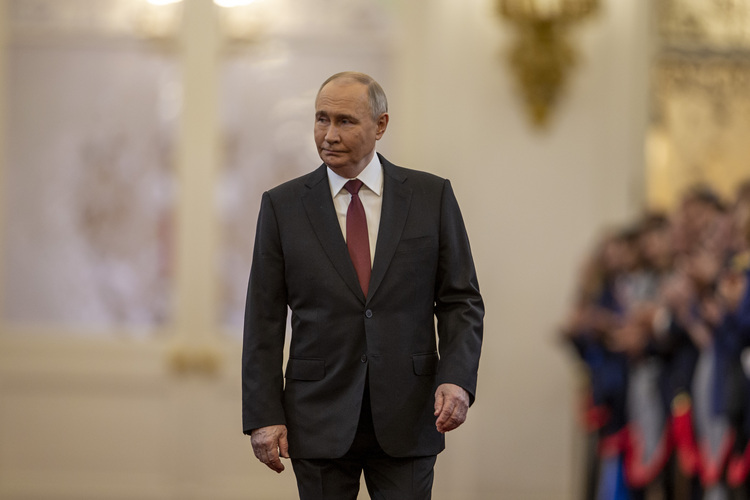
    Vladimir Putin attends an inauguration ceremony at the Kremlin in Moscow, Russia, May 7, 2024. (Xinhua/Cao Yang)

    BEIJING, Xinhua) /Flowerbudnews: – China congratulates President Putin on his inauguration, and believes Russia will make new achievements in national development and economic and social progress under his leadership, a Chinese foreign ministry spokesperson said on Wednesday.

    Spokesperson Lin Jian made the remarks at a daily press briefing when asked to comment on the fact that Vladimir Putin was officially sworn in on Tuesday as President of the Russian Federation for a six-year term and Russian presidential aide Yury Ushakov said that the President will visit China in the first foreign trip of his new term in office.

    “Under the strategic guidance of the two heads of state, China-Russia relations have enjoyed sound and steady growth,” Lin said.

    He added that the two sides uphold the principle of non-alliance, non-confrontation and not targeting any third party and advance bilateral relations and cooperation in various fields on the basis of mutual respect, equality and mutual benefit, bringing tangible benefits to the two peoples and playing a positive role in advancing global common development.

    Noting this year marks the 75th anniversary of China-Russia diplomatic ties, Lin said that the two sides will follow the guidance of the common understandings between the two presidents, further enhance mutual trust, expand cooperation and carry forward their friendship to jointly advocate an equal and orderly multipolar world and universally beneficial and inclusive economic globalization, implement true multilateralism and make global governance more just and equitable.

    “China highly values the strategic guidance from head-of-state diplomacy for China-Russia relations. The two presidents agreed to maintain close interactions and ensure the smooth and steady growth of China-Russia relations,” he said. Xinhua,/Flowerbudnews


  • The Changing Russia –

    The Changing Russia –


    By Noctis Draven

    I’m noticing a change from Russia, a transformation of sorts. After the fall of the Soviet Union Russia was sold out to the west, much like Germany and Japan after WW2. The people were broken, the economy in shambles. Russia took on a reputation of being for sale and corrupt.

    This era is what some Russians referred to as, “the terrible 90s.” Russians were quiet, there was a heaviness that hung over the Russian people and culture.

    There has been a shift, since Putin has taken office Russia has been quietly healing, growing and now thriving. Removing the corrupt oligarchs, strengthening the military and embracing instead of shaming Russian culture.

    Now, with the west at war with Russia via Ukraine and economic sanctions the Russian people have banded together in ways not seen in our lifetimes.

    By all means Russia has much of the world working against them but instead of folding and crumbling they are thriving.

    Decidedly winning on the battlefields of Ukraine, leading a cultural revolution in Africa and leading an economic revolution through BRICS, Russia has nearly completely filled the void left by the United States, and it has done so not through threats, force and economic pressure as the US and Britain has done but instead through trust and good will.

    The most noticeable change I see however is the Russian people are different now. They are proud of their heritage, they realize that being Russian means thousands of years of rich history instead of simply being forever in the shadow of the Soviet Union.

    Russia has give more to the world and humanity than there is space for me to list. From revolutionary breakthroughs in science, medicine and technology to breathtaking art, artists and musicians. From the dancers on ice to the dancers on stage and the warriors on the battlefield.

    Russians have realized that much of the world’s animosity comes from envy, jealousy and bitterness. My friends the greatest crime Russia has ever and continues to commit is sticking around, thriving and not selling out to the west as so many others have.

    The old analogy is that pressure makes diamonds and if that is true, with all the pressure on Russia 🇷🇺 and they still manage to thrive, grow and lead, then Russia is a flawless diamond 💎, a true jewl of the east.

    From a humble American, well done Russia, well done 🇷🇺.

  • Binance Founder Sentenced, Bags Four Months Imprisonment

    Binance Founder Sentenced, Bags Four Months Imprisonment


    Courtesy: 1440


    Binance founder Changpeng Zhao was sentenced to four months in prison yesterday for violating US money laundering laws and federal sanctions at the world’s largest cryptocurrency exchange.

    The sentence is less than the three years prosecutors had sought and the 12- to 18-month sentencing guidelines for the crime.


    Zhao, a UAE and Canada dual citizen, pleaded guilty in November. He agreed to resign as CEO and pay a $50M fine for failing to maintain an effective anti-money laundering program, which resulted in sanctions violations linked to users in Iran, Cuba, Syria, and Russian-occupied parts of Ukraine.

    Binance also agreed to pay $4.3B in fines and forfeiture (see 101). The news comes a month after former FTX executive Sam Bankman-Fried was sentenced to 25 years for fraud tied to his crypto company.

    Under the plea agreement, Zhao waived the right to appeal any sentence up to 18 months. Zhao has an estimated $43B fortune, including his Binance ownership, and will become the richest person ever to serve time in US federal prison.

  • Sword Attack:  Dabiri- Erewa Condoles  With Family of Young Daniel Anjorin

    Sword Attack:  Dabiri- Erewa Condoles  With Family of Young Daniel Anjorin


    By Danladi Ahmed

    Abuja (Flowerbudnews):  Hon. Abike Dabiri- Erewa, Chairman/ CEO, Nigerians in Diaspora Commission has condoled with the family of the 14 years old Daniel Anjorin on his sudden demise.

    In a statement by Head of Media, Abdur-Rahman Balogun, the NiDCOM boss described the incident as very unfortunate, sad and gruesome

    She condoled with the family of the deceased and the Nigerian communities in the UK, praying unto God to rest the soul of young Daniel whose life was cut short on Tuesday.

    Daniel Anjorin was knifed in his school uniform in Hainault, East London, on Tuesday by a sword-wielding man in a terrifying rampage that left four others injured.

    She is optimistic that drastic measures will be used to make sure that the culprit who is already in the Police custody will be punished accordingly. (Flowerbudnews)

  • TOGO’S 2024 PARLIAMENTARY ELECTIONS: MATTERS ARISING

    TOGO’S 2024 PARLIAMENTARY ELECTIONS: MATTERS ARISING


    By Paul Ejime

    The international community, particularly ECOWAS and the African Union have been passive or at best non-committal towards events leading up to Togo’s 29 April 2024 Parliamentary and Regional elections, which were overshadowed by controversial constitutional and electoral reforms, with potentially far-reaching consequences.Parliamentary elections are crucial to Togo’s governance system, and more so with the constitutional changes recently pushed through by President Faure Gnassingbé’s government.

    An estimated 4.2 million Togolese voters were expected to vote on Monday to elect a 113-seat Parliament, up from 91, and 179 regional councillors from more than 2,348 candidates, including 593 women.

    It is the country’s first regional election with balloting in more than 14,200 polling stations nationwide.The government declared Monday a public holiday and the country’s borders were closed for the elections.Members of Parliament are elected by closed-list proportional representation from multi-member constituencies ranging in size from two to ten seats with the seats allocated using the highest average method.

    Togo’s political life has been dominated for more than five decades by the ruling Union for the Republic (UNIR), led by President Faure Gnassingbé, who has been in power since the death of his father Gnassingbé Eyadéma in 2005.

    After Togo’s independence from France in 1960, the late Eyadéma, who had served in the French army, was involved in two military coups, first in 1963 and then, in1967, when he seized power until his death.

    After seizing power as interim president in 2005, the young Eyadéma was elected to the presidency later the same year and then re-elected in 2010 and 2015.

    However, the heavily criticized electoral processes and what analysts call “dynastic democracy” are characterized by repression of the opposition and unilateral modifications of the constitution.

    The 2018 parliamentary elections were boycotted by the C14 Alliance, the main opposition group of fourteen parties, over allegations of irregularities in the electoral process and Faure’s refusal to abandon his constitutional review project.

    Having failed to reset the presidential term to allow him to remain in power beyond the third term, which ended in 2020, the campaigns for the 2018 parliamentary elections were marked by repression against demonstrators, resulting in several deaths and the government’s blanket ban on all marches or public gatherings in mid-December.

    In the absence of any real opposition, the UNIR retained its absolute majority in Parliament, winning 59 of the 91 seats and with a sharp increase in the number of independent deputies to 18, while the Union of Forces for Change (UFC) and four other groups shared the remaining seats.Even so, the UNIR still failed to get the four-fifths majority of seats required for a constitutional amendment.

    However, in 2019, the government still managed to amend the constitution almost unanimously, which could allow Faure to remain in office until 2030. He was re-elected in the first round of the 2020 presidential election with more than 70% of the vote, a result contested by the opposition which accused the government of electoral fraud. The 2024 Parliamentary elections were to be held on 13 April 2024, but on March 25, the parliament approved the constitutional reforms changing the country’s system of government from a presidential to a parliamentary model and the method of voting for the president from direct to indirect. Under the new system, executive powers are vested in the Prime Minister/President of the Council of Ministers, voted by fellow parliamentarians. The President of the Republic will be more a less a ceremonial position.As a result of heightened political tension and outcry against the reforms, President Faure paused the process and ordered an indefinite postponement of the elections.On 19 April, the Parliament eventually approved the reforms by 87 votes and the government then rescheduled the national elections to 29 April.Some opposition parties and civil society groups described the postponement as a ploy by the regime to “endorse its constitutional coup,” but the protests they called for from 11 to 13 April, were suppressed since protests are banned in the country.On 23 April, the request by the Catholic Church to deploy observers to the elections was also rejected by the Electoral Commission, which questioned the group’s source of funds.Foreign journalists are barred from covering the elections, but ECOWAS, the regional economic bloc, the African Union, and the International Organization of La Francophonie have deployed observation missions at the request of Togolese authorities.ECOWAS’ 40-member Observation Mission is led by Gambia’s former Vice President Mrs Fatoumata Jallow-Tambajang. This is even though the pre-election constitutional and electoral reforms are in clear violation of the ECOWAS 2001 Supplementary Protocol relating to the Mechanism for Conflict Prevention, Management, Resolution, Peacekeeping, and Security, otherwise known as the Supplementary Protocol on Democracy and Good Governance.Article 2(1), SECTION II of the Protocol states that “No substantial modification shall be made to the electoral laws in the last six (6) months before elections (in member States), except with the consent of a majority of political actors.”To further complicate matters, ECOWAS had issued two different press statements before deploying its recent fact-finding mission of 15-20 April to Togo. The first press release said the mission was “exploratory,” and would consult with stakeholders against the background of recent political developments, while the second statement said it was solely a “pre-election observation mission.”By contradicting itself instead of asserting a principled stance on Togo, especially after the successful Presidential election in Senegal, analysts are of the view that ECOWAS has missed a golden opportunity to burnish its dented image and reputation in the wake of four of its member States – Mali, Guinea, Burkina Faso, and Niger – under military dictatorships.Mali, Burkina Faso, and Niger have served notice of their intention to quit ECOWAS altogether, citing the organization’s inconsistency or double standards, in dealing with “constitutional, political or electoral coups,” as against “military coups,” as one of the reasons.While military takeover of governments cannot be justified, the same 2001 ECOWAS Supplementary Protocol, has provisions on Zero-Tolerance for unconstitutional change of government, which application should not be limited to military putsches alone.Ardent followers of Togo’s chequered political history know that the latest controversial constitutional reforms are part of a grand ploy for tenure elongation by Faure similar to former Senegalese President Macky Sall’s failed political manoeuvrers.Faure has been propped by Togo’s ethnically divided military, notorious for repression and their strong backing for his father, who transmuted from a soldier to a politician during his 38-year iron-fist rule.The lack of visionary and dynamic leadership in ECOWAS allowed Faure to break ranks and bypass regional sanctions to cozy up with the military juntas in the region without any consequences.The outcome of Monday’s elections might pan out in Faure’s favour, but how long Togo’s generally docile population will tolerate the Eyadema dynasty in power remains to be seen!With its lack of cohesion, alienation of the estimated 400 million Community citizens, and attendant reputational damage, ECOWAS risks avoidable dismemberment, if urgent steps are not taken to quickly seal its gaping fault lines and disunity.The regional integration vision of the founding fathers of the organization, which will be 50 next year is in serious peril.*Ejime is an Author, Global Affairs Analyst, and Consultant on Peace & Security and Governance Commu

  • Commentary | U.S. police brutality against student protesters exposes hypocrisy on free speech

    Commentary | U.S. police brutality against student protesters exposes hypocrisy on free speech


    Xinhua

    As the world watches in horror at the footage of U.S. police viciously suppressing student protests, it becomes painfully evident that America’s espousal of free speech is a sham.

    by Xinhua writer Wang Xinyi

    BEIJING,  (Xinhua) /Flowerbudnews: — Harassment, doxxing, death threats, stereotyping, unequal treatment … And then there was tear gas, water cannons and rubber bullets, all fired at student protesters across the United States.

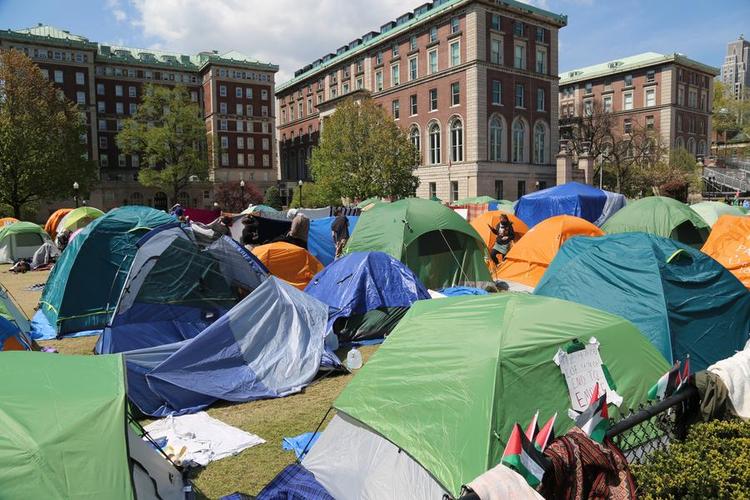
    Campuses have been torn apart this week as pro-Palestinian protests roiled U.S. colleges and escalated over more forceful and violent countermeasures by administrators and police.

    Footage showing police beating protesters, dragging students to the ground and carrying them off in handcuffs flooded social media in a fray going from merely demanding ceasefire and divestment to lodging legal maneuvering and civil rights claims.

    Hundreds of students and faculty members were arrested. Now the drama goes on as more colleges on Friday joined in Columbia University’s lead in a coast-to-coast protest. The Ivy League school has been the epicenter of student protests for over a week.

    Perhaps a much heavier blow than a forced switch to remote learning, delayed classes, canceled commencement ceremonies and disrupted graduation plans is a dangerous encroachment on academic freedom and a painful disillusionment with the American system.

    Peaceful student demonstrators were framed by armed police and U.S. media as “perpetrators” deserving “crackdown.” Capitol Hill elites were fast enough to define this protest as “anti-Semitic,” bashing the students for incorrectly associating the civil rights movement with what is going on in Palestine and suggesting external tinges as behind the protest without producing a single shred of evidence.

    “Arrests being made right now & will continue until the crowd disperses,” Governor of Texas Greg Abbott wrote Thursday on X. “These protesters belong in jail. Antisemitism will not be tolerated in Texas. Period. Students joining in hate-filled, antisemitic protests at any public college or university in Texas should be expelled.”

    While our memory may wane, the Internet has it intact. In 2019, Abbott proudly tweeted “I just signed a law protecting free speech on college campuses,” in stark contrast with his hardline take this time.

    For him and the like, these encampments on campuses are clearly not “a beautiful sight to behold.” Not in the slightest when they appear on U.S. soil.

    Influencers and politicians on the far-right portrayed the protesters as “violent, dangerous and intent on taking over the country,” USA Today observed in a report on Friday, saying “the claims were similar to what happened after mostly peaceful protests against police brutality in 2020 following the murder of George Floyd.”

    This distorted portrayal not only serves to demonize the protesters but also perpetuates a narrative that undermines the legitimacy of their grievances. Nearly four years after the Floyd tragedy, real change in policing remains elusive, despite outcries triggered by one nationwide protest after another.

    Or perhaps, deep down, U.S. politicians know what it is, they just play dumb at home with filibusters and play the judge abroad whenever they feel their geopolitical interests at stake or whatchamacallit “a national security threat”.

    And when necessary, they blur the lines between rights and crimes. Because in the end, they reserve the right to explain, designate and interpret such terms as democracy, civil rights, national security, or whatsoever.

    As the world watches in horror at the footage of U.S. police viciously suppressing student protests, it becomes painfully evident that America’s espousal of free speech is a sham.

    This appalling display of state-sponsored violence lays bare the hypocrisy of a nation that prides itself on democracy while trampling on the very principles it claims to uphold.

  • Palestinian president warns of results of possible Israeli attack on Rafah

    Palestinian president warns of results of possible Israeli attack on Rafah


    Xinhua

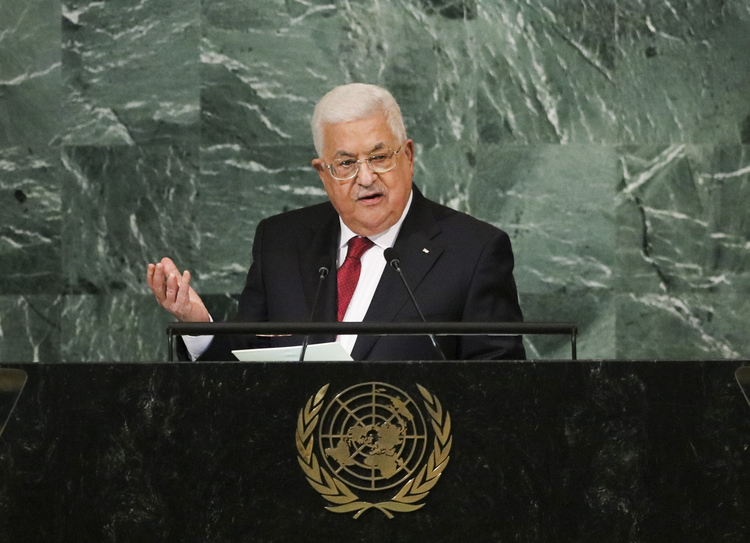
    File Photo: Palestinian President Mahmoud Abbas speaks during the General Debate of the 77th session of the UN General Assembly at the UN headquarters in New York, on Sept. 23, 2022. (Xinhua/Wang Ying)

    GAZA, (Xinhua)/Flowerbudnews: — Palestinian President Mahmoud Abbas on Sunday warned of a possible Israeli attack on the southern Gaza Strip city of Rafah, expressing his fear of the displacement of Palestinians in the West Bank to Jordan after the end of the conflict.

    Abbas said in a speech during a special meeting of the World Economic Forum hosted by Saudi Arabia, according to the official Palestinian news agency WAFA.

    “If Israel invades the city of Rafah, where most of the people of the Gaza Strip gather, the biggest catastrophe in the history of the Palestinian people will occur, and they will be displaced outside the Gaza Strip,” stressed the president.

    “We called for an end to the aggression and to supply the population with the humanitarian supplies they need, and under no circumstances will we accept the displacement of Palestinians, whether from Gaza or the West Bank outside their homeland,” he added.

    Abbas also called on European countries to recognize the State of Palestine and recognize it as a full member state of the United Nations.

    “There must be a political solution that brings together the Gaza Strip, the West Bank, and Jerusalem in an independent Palestinian state through an international conference. This is what we have called for since October 7 (last year) until this day,” he added.

    He noted that “while Israel has the right to obtain security, Palestinians also have the right to obtain the right to self-determination, an independent state like the rest of the peoples of the world.”

    Meanwhile, Abbas expressed his fears that Israel would displace Palestinians from the West Bank to Jordan after the end of the Gaza conflict.

    On Thursday, Israeli Prime Minister Benjamin Netanyahu approved a plan for the ground operation in Rafah but did not allow the army to move yet, according to Israeli media.

    Rafah has become the last refuge for more than 1.4 million Palestinians after their displacement from the northern and central Gaza Strip in light of the ongoing violence between Hamas and Israel for more than six months.

    Israel launched a large-scale offensive against Hamas in the Gaza Strip to retaliate against a Hamas rampage through the southern Israeli border on Oct. 7, 2023, during which about 1,200 people were killed and more than 200 were taken hostage.

  • Tinubu Arrives Riyadh to Attend World Economic Forum

    Tinubu Arrives Riyadh to Attend World Economic Forum


    [Workaholic Mr President]

    By Flowerbudnews

    President Bola Ahmed Tinubu GCFR [@NGRPresident @officialABAT] has arrived in Riyadh, Saudi Arabia, to attend a special meeting of the World Economic Forum [@wef].

    The Special Meeting on Global Collaboration, Growth and Energy for Development, scheduled to take place in Riyadh from 28 to 29 April 2024, will help public and private sector leaders address shared global challenges.

    The meeting will also advance key Forum initiatives in the region and beyond. It aims to bridge the growing North-South divide, which has further widened issues such as emerging economic policies, the energy transition and geopolitical shocks.

    The Special Meeting on Global Collaboration, Growth, and Energy for Development will bring together over 700 leaders from all sectors and industries.

    It will enable a comprehensive dialogue on leveraging global cooperation for economic development, promoting a global energy transition that underpins sustainable development, and furthering technological advancement.

    The meeting will support the Forum’s work to shape a more equitable and resilient global economy. (Flowerbudnews)

    #PBATInSaudi

    @AjuriNgelale @aonanuga1956 @otegaogra @trueNija