
Author: Bushrah Yusuf-Badmus

  • Untitled post 90812

    Kwara 2027:10 APC Aspirants Alert Presidency to Alleged Plot to Enlist Monarchs for Danladi-Salihu

    By Afusat Agunbiade-Oladipo


    Ten governorship aspirants and members of the Elders Caucus of the All Progressives Congress (APC) in Kwara have alleged a plot to enlist traditional rulers in the state to support the emergence of Speaker of the Kwara House of Assembly, Yakubu Danladi-Salihu, as the party’s governorship candidate for the 2027 elections.


    The aspirants claimed that some individuals were mobilising traditional rulers to visit President Bola Tinubu to purportedly thank him for endorsing Danladi-Salihu as the APC governorship candidate.


    The group also dismissed speculations that it had adopted the Director-General of the National Orientation Agency (NOA), Malam Lanre Issa-Onilu, as its preferred candidate, insisting that he did not participate in any nomination process.


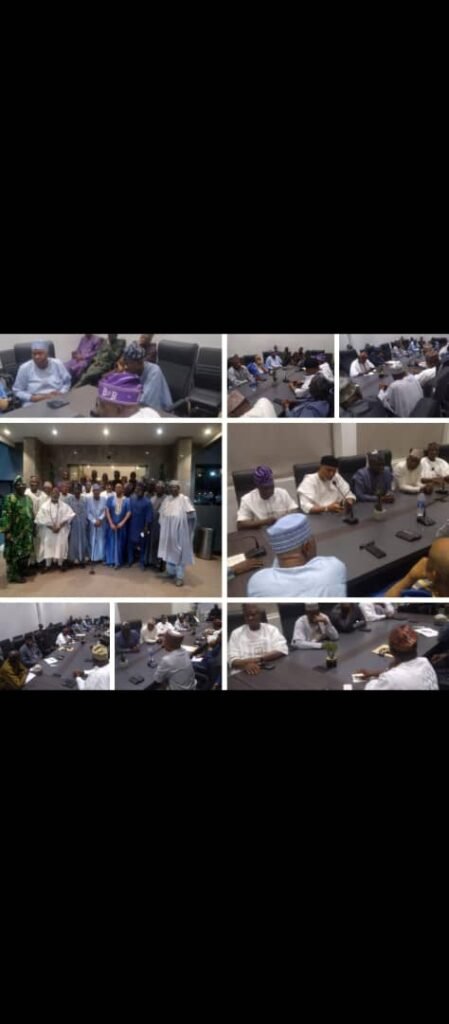
    The concerns were raised during a meeting with the national leadership of the APC held in Abuja on June 17 and June 18.


    The aspirants at the meeting were Dr Bashir Bolarinwa, Sen. Salihu Mustapha, Sen. Ibrahim Oloriegbe, Alhaji Tajudeen Audu, Dr Toyin Alabi, Rt. Hon. Mohammed Bio, Dr Muyideen Salako, Mohammed Dele Belgore (SAN), Amb. Abdulfatai Seriki and Capt. Ahmad Mahmud.


    Speaking on behalf of the group, Chairman of the Kwara APC Elders Caucus, Chief James Ayeni, said no governorship primary election had been conducted in the state to produce Danladi-Salihu as the party’s candidate.


    He also maintained that the APC had not adopted any consensus candidate for the 2027 governorship election in Kwara.

    “To the best of our knowledge, the party has not published the endorsement of any candidate in Kwara State.


    “We therefore caution the planners of this alleged move not to drag our revered traditional rulers into intra-party affairs.

    “Traditional rulers are fathers to all and should remain insulated from partisan political activities,” he said.


    Ayeni described the reported attempt to involve monarchs in APC’s internal affairs as unprecedented and inappropriate.

    According to him, traditional rulers in the state have never been involved in the nomination or emergence of candidates of any political party.


    He noted that even during previous governorship nomination processes in the state, monarchs were not enlisted to support any aspirant.


    The APC elder further said there was no record of traditional rulers being mobilised to visit the Presidency to appreciate appointments given to prominent indigenes of the state since 2019.


    He urged the monarchs not to allow themselves to be drawn into partisan politics or the internal affairs of any political party.


    “We appeal to our respected traditional rulers not to permit anyone, regardless of status, to drag the traditional institution into partisan political activities,” Ayeni said.

  • Don advocates more inclusion, Digital Access, Literacy for women

    Don advocates more inclusion, Digital Access, Literacy for women

    Don advocates more inclusion, Digital Access, Literacy for women

    Prof. Janice Olawoye at the Kwara State University


    By Bushrah Yusuf-Badmus


    A Professor of Rural Sociology at the University of Ibadan, Prof. Janice Olawoye has called for more inclusion, improved Digital access and Literacy for the women gender for economic and personal developments.


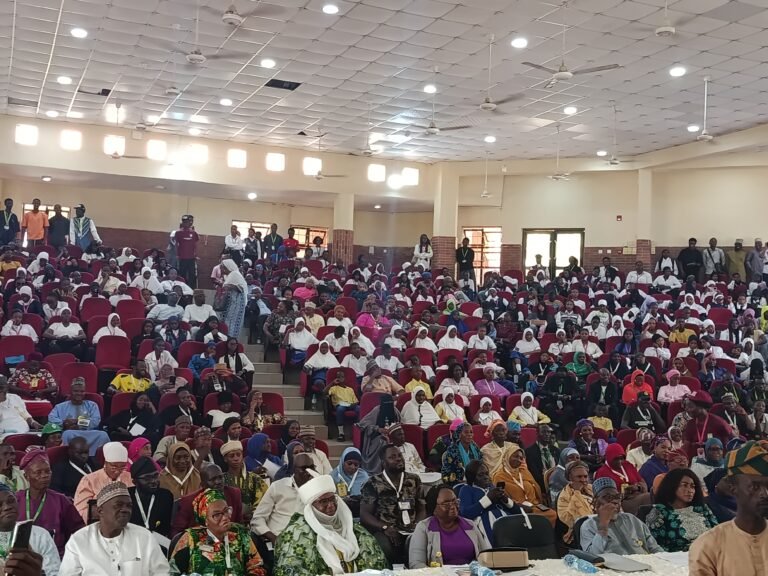
    Olawoye spoke on Wednesday in Malete during the Launch and Public Awareness Symposium of the institution’s Centre for Gender Studies.


    The symposium has it’s theme Gender, Digital Literacy and Sustainable Development: Interrogating Pathways to Inclusion.


    Prof. Olawoye said the Gender Digital Divide showed the gaps/differences between men’s, women’s, boy’s and girl’s access and use of technology, the internet and mobile phones, reflecting gender inequalities.


    She said women and girls face significantly greater barriers to accessing technology, developing digital skills and utilising the internet than men and boys.


    “We have to ensure inclusive and equitable quality education and promote lifelong learning opportunities for all.


    “It is estimated that about 90 percent of jobs worldwide has a digital component, so access to digital financial services has become important for women’s economic empowerment but requires access and ability to use digital services.


    “Further to this, there is the need for digital literacy to enable persons to not only have access but be able to utilise the devices and platform to take advantage of these opportunities,” she said.


    The don however called for a nexus between gender, digital access and literacy, inclusion and sustainable development for everyone to have equal ability to take advantage of opportunities in this era of digitalisation.


    She said as the social dynamics, the technology and the needed skills all change, we must also adjust strategies to promote an inclusive system for all.


    In her lead presentation, Dr Omowumi Macaulay- Adeyelure from the University of Lagos, said the three pathways to inclusion namely, education, economic participation and cultural safety must be guaranteed for women to achieve Digital Access and literacy.


    She said the capabilities of women are usually constrained by social norms and by scarcity, so interventions must close both the devices gap and the gap in permission and expectations.


    In his remarks, KWASU Vice Chancellor, Prof. Jimoh Shaykh-Luqman said the institution remained committed to gender equity and inclusion and will continue to provide an enabling environment where men and women can excel in their careers.


    “The establishment of the Centre for Gender Studies is a natural extension of the University’s commitment to the advancement and empowerment of women and other vulnerable groups in society.


    “The theme of today’s symposium is both timely and relevant because we live in a world where digital technology shapes access to information, education, employment, and participation in public life.


    “Yet many people, especially women and other vulnerable groups, still face challenges in accessing digital opportunities and developing digital skills.


    “As scholars and practitioners, we must continue to examine these challenges and explore practical solutions that promotes inclusion, equity, and sustainable development,” he said.


    The Acting Director, KWASU Centre for Gender Studies, Dr Latifat Olatinwo said the establishment of the Centre reflects the determination to expand the frontiers of knowledge and provide solutions to contemporary societal challenges in gender studies.


    She expressed optimism that the Centre would serve as a hub for impactful research, strategic partnerships, capacity building, and intellectual discourse in gender mainstreaming and inclusivity. (NAN)

  • Cultural Preservation: KWASU Don advocates fusion of tradition with modernity

    Cultural Preservation: KWASU Don advocates fusion of tradition with modernity

    Cultural Preservation: KWASU Don advocates fusion of tradition with modernity


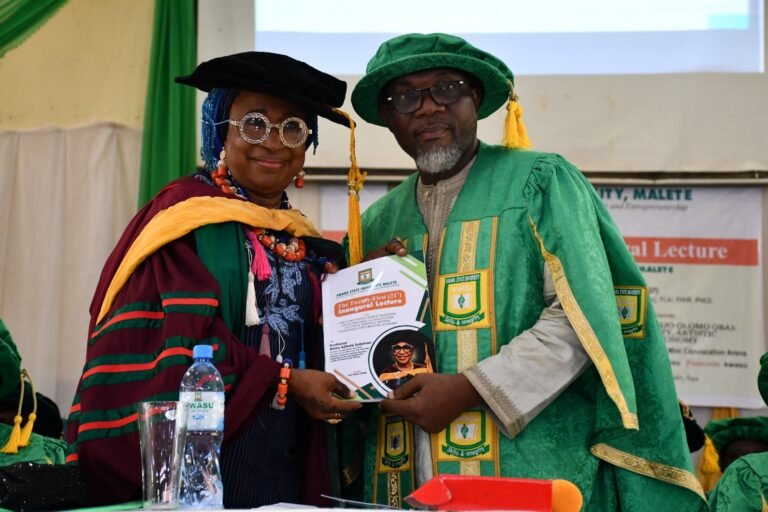
    Prof. Binta Sulaiman delivering KWASU’S 21st Inaugural Lecture


    By Bushrah Yusuf-Badmus


    A professor of Fine Arts and Art Education at the Kwara State University (KWASU), Prof. Binta Sulyman, has said that the preservation of indigenous cultural heritage enhances community cohesion and sustain peace within society.


    Prof. Sulyman made the submission on Wednesday during KWASU’s 21st Inaugural Lecture titled ‘The Ilorin Royal Dance Tradition

    (Ijo Olomo Oba): A Catalyst for Cultural Identity, Artistic Expression, and Creative Economy”.


    She highlighted the connection between fine arts and traditional performative dance, stressing the sustainability of Ijo Ọlọ́mọ Ọba, a traditional dance deeply rooted in the cultural identity of the Ilorin people.


    “Declining youth participation, poor documentation, inadequate institutional support, and the increasing dominance of Western cultural forms makes us perceive traditional arts as outdated.


    “This places valuable cultural heritage at risk of extinction.


    “Preserving cultural traditions does not require resistance to modernisation but rather a careful integration of traditional values with contemporary realities.


    “Such an approach would enable cultural practices to remain relevant to younger generations while retaining their historical significance,” she said.


    Prof. Sulyman also stressed the importance of incorporating indigenous music and performative arts into educational curricula.


    She recommended that Nigerian schools should give greater attention to teaching and performing traditional musical forms from ethnic traditions in Nigeria.


    “Eucation remains one of the most effective tools for transmitting cultural knowledge across generations that fosters a sense of identity and belonging among young


    “Beyond cultural preservation, indigenous arts helps in peace building and social development.


    “Cultural performances such as Ijo Ọlọ́mọ Ọba strengthen social cohesion, promotes intergenerational dialogue, and reinforce shared values that contribute to peaceful coexistence within communities.


    “Also, cultural heritage serves as a unifying force capable of bridging social divides and fostering mutual understanding among diverse groups, making it an important resource for community development and nation-building,” the don said.


    The professor however called for a holistic approach involving education, innovation, community participation, and institutional support to ensure the sustainability of Ijo Ọlọ́mọ Ọba.


    She expressed optimism that with deliberate preservation efforts, the dance would not only survive but also gain wider national and international recognition as a significant component of Nigeria’s rich cultural heritage.

  • Children’s Day: Foundation unveils 2 initiatives for dream actualisation 

    Children’s Day: Foundation unveils 2 initiatives for dream actualisation 

    Children’s Day: Foundation unveils 2 initiatives for dream actualisation


    Miss Ayomitide Ebo, Founder Estelle Education Foundation


    By Bushrah Yusuf-Badmus

    The Estelle Education Foundation has unveiled two initiatives, “The Girl Re-Script Project” and “Adopt A Future”, to help children in the actualisation of their dreams.


    Founder of the Foundation, Miss Ayomitide Ebo made this known while unveiling the initiatives on Saturday in Ilorin, at the foundation’s 2026 Children’s Day Programme.


    The theme of the Programme is “The Power of a Child’s Dream”.


    She said that, an investment in a child is an investment in the future of the society itself.


    “The Girl Re-Script Project is a dedicated initiative designed to support teenage girls who have had to leave school due to early pregnancy or forced marriage.


    “For many of these young women, the loss of education leads to a life of total financial dependency, our mission is to break that cycle.


    “By providing vocational training, mentorship, and essential life skills, we aim to help these girls move from a place of forced reliance to one of self-sufficiency.


    “We want them to know that their mistakes, pain, or circumstances do not have to define the rest of their lives.


    “We believe every girl deserves the chance to re-script her story and build a future defined by her own potential rather than her past circumstances.


    “Because when society gives up on a girl child, we lose more than one life, we lose dreams, leadership, creativity, and generations of possibilities,” she said.


    Miss Ebo added that “Adopt A Future” is an initiative where individuals, families, and organizations can support the education of secondary school students by sponsoring their school fees and learning materials, including textbooks and essential academic resources.


    “Sponsors will receive termly updates, including academic progress reports, notes on performance, and general development updates about their adopted child, thereby ensuring transparency,” she said.


    Miss Ebo said the children’s day programme was to serve as a reminder that child’s dream may seem small today, but the dreams of children often become the solutions of tomorrow.


    An education expert, Dr James Adewale tasked parents and teachers to help children nurture their dreams for them to be successful.


    Adewale said parents should be observant to know their child’s dream and guide them to pursue them.


    He further advised teachers not to kill the dream of their pupils with words and actions, but rather encourage them with affirmative word.


    In her remarks, Miss Faith Adaramola also urged the children to pay attention to their dreams and pursue it by being serious and determined.


    Chairman of the occasion, Dr Segun Oyelabi said the power of a child’s dream is unlimited, hence the importance to support their dreams and help them materialise it.


    Highlights of the programme was a Spelling Bee Competition, games and presentation of certificates to all the children

  • NOA seeks improved partnership with NURTW to curb insecurity 

    NOA seeks improved partnership with NURTW to curb insecurity 

    NOA seeks improved partnership with NURTW to curb insecurity


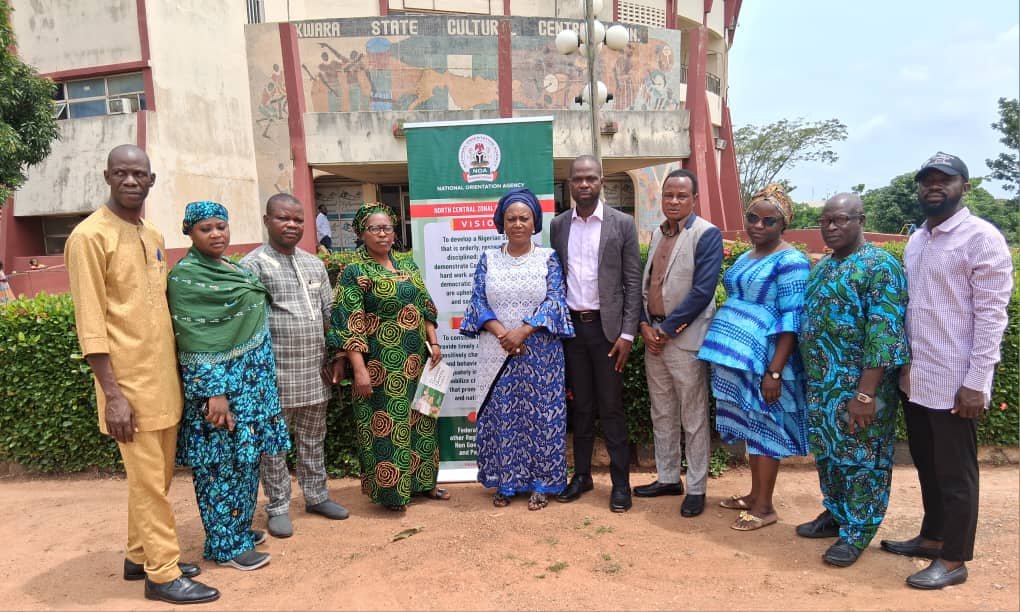
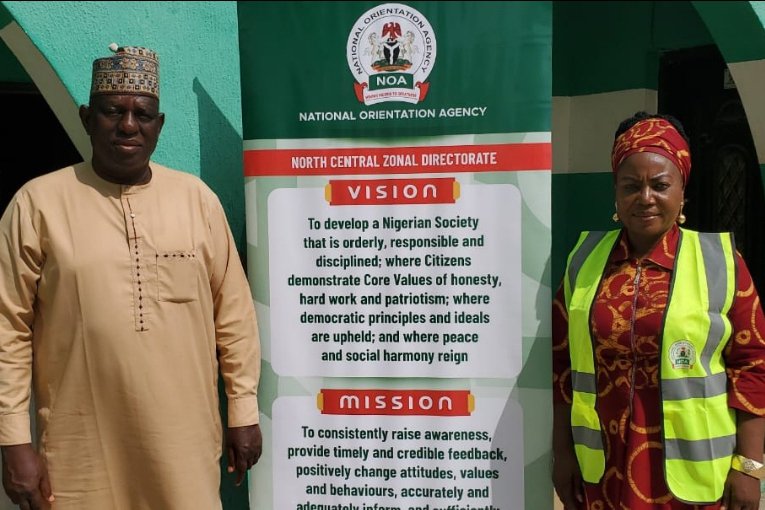
    NOA Management Team with Exco members of NURTW in Kwara


    The National Orientation Agency (NOA) has sought improved partnership with the National Union of Road Transport Workers (NURTW) in curbing insecurity across the country.


    The Zonal Director, North Central Directorate, Mrs Priscilla Gondoalour said this on Thursday while paying a courtesy visit to the Kwara Council of the union in Ilorin.


    Gondoalour said the road transport workers were major stakeholders needed to bring an end to insecurity bedevilling the country.


    She said the drivers could help reduce insecurity to the barest minimum by giving useful and timely information to security agencies because they were always closer to the people.


    ” Road transport workers are as important as doctors and teachers because 90 percent of movement worldwide is by road; few are by air, water, rail.

    “This meeting with you is because of your importance and relevance in almost every area of operation in this country and you have contact with different people daily.


    “The challenge of insecurity confronting all of us, the risk is faced more by your people on a daily basis.


    “So, we believe that partnering with you on the need to help join hands with the government to fight it out is imperative.


    “We need collective action which means that we need to be patriotic first; and your members who encounters some of these mischief makers, need to supply security agencies with timely and useful information,” the Zonal Director said.


    She said we must work collectively salvage the country from the present mess we are in, hence the need for the information to be passed across all the local governments that makes up the council.


    Mrs Gondoalour further urged members of the union to promote tolerance, have respect for the rule of law and avoid tribalism, ethnic and religious sentiments.


    In his response, the Chairman NURTW Kwara Council, Alhaji Razaq Ariwoola said tackling insecurity was now everyone’s business as we do not know who is next.


    Ariwoola said the drivers were doing their best to help security agencies but their efforts were always truncated due to disclosure of the identity of the whistleblowers.


    He said they have devised a means of reporting directly to the senior officers to safeguard the identity of their members.


    The NURTW chairman added that efforts should be doubled to eradicate drug abuse as it is an enhancer of Social vices.


    He further appealed to the judiciary to ensure that justice cannot be bought.


    “If justice can be bought, we cannot have a just society, and if the judiciary continues this way, we cannot have a crime free society,” he said.


    Ariwoola said the union will continue to enlighten its members to be security conscious. (NAN)

  • Kwara LG decries alleged unfair treatment in upgrading of traditional rulers

    Kwara LG decries alleged unfair treatment in upgrading of traditional rulers

    Kwara LG decries alleged unfair treatment in upgrading of traditional rulers


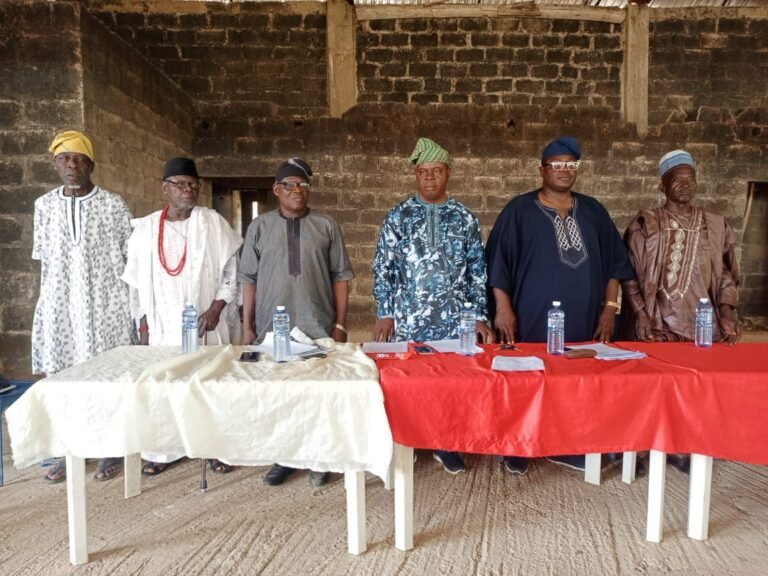
    President, Moro Descendants Development Union, Prof. Reuben Akano

    By Bushrah Yusuf-Badmus

    Moro Local Government Area of Kwara, has decried the unfair treatment by the state government in the neglect of the upgrading of their traditional rulers.


    President of Moro Descendants Development Union (MODDU), Prof. Reuben Akano, made the call while briefing newsmen on Wednesday in Moro.


    Akano said it was unjust and unfair for Kwara government to consistently exclude the local government from all grading, re-grading and upgrading of traditional institutions and rulers from 2003 till date.


    He said the Kwara State Edict under which Moro Local Government Area is forced into the ‘Emirate’ is contrary to and against the wishes of the people, as it negates the constitutional provisions of the Federal Republic of Nigeria.


    ”In the last two months, 65 monarchs in the Kwara South Senatorial District have been graded and upgraded into various classes.


    “Moro LG falls into Kwara North Senatorial District which comprises of Baruten, Edu, Kiama, Moro and Patigi local governments.


    “It is disheartening that of these five local governments, only Moro Local government area does not have a graded Chief and its own traditional council at present.


    ”The other local governments who were also co-opted into an Emirate are already enjoying grading and elevation of their traditional institutions and rulers, why is Moro different,” The president asked.


    He appealed to the state government to ensure a just and equitable relationship among the 16 local government areas in the state by correcting the ungodly imbalance and anomalies to prevent negative experiences witnessed in other places.


    “Moro people deserve their inalienable freedom and right to self-determination as a local government area.


    “The unity of the state is very impressive and should be paramount to the well being of all irrespective of status, religious, sectional and socio-political backgrounds.


    ”We appeal to Gov. Abdulrahman Abdulrazaq to kindly reconsider our rewened appeal to extend the gestures with which he treated the traditional rulers of Kwara South to the traditional rulers of Moro Local Government,” Akano said.


    He further appealed to the state government to uphold the judgement obtained in favour of the Oba of Jebba on Jan. 29, 2014 as delivered by Justice Hannah Ajayi.


    The union unanimously called for the restoration and upgrading of Ohoro of Shao and Oba of Jebba to their pre-1984 of 3rd Class status and First Class Status respectively.


    They also sought the immediate recognition and grading of the traditional rulers in Moro Local Government Areas in the state.

  • Nigeria’s credit penetration too low for entrepreneurial growth- Expert

    Nigeria’s credit penetration too low for entrepreneurial growth- Expert


    The MD/CEO CRC Credit Bureau Limited, Dr Ahmed ‘Tunde Popoola delivering KWASU’s 1st Collaborative Lecture

    By Bushrah Yusuf-Badmus


    A Financial Expert, Mr Ahmed Popoola, has said Nigeria’s credit penetration rate of 13 per cent was too low.


    He made the assertion on Monday while delivering the maiden collaborative lecture of Kwara State University (KWASU), organised by the Faculty of Management and Social Sciences (FMSS) and the Centre for Advancement and Industrial Collaboration (CAIC).


    Popoola, the Managing Director and Chief Executive Officer of CRC Credit Bureau Limited, said the penetration rate was too low to support the country’s ambition of becoming a thriving entrepreneurial economy


    Speaking on the theme: “Finance, Entrepreneurship, and the Infrastructure of Trust”, the economist called for increased access to credit facilities for entrepreneurs as a pathway to economic growth.


    He noted that out of the country’s 35.6 million registered enterprises, only about two million have access to formal credit, describing the situation as a major constraint on business development.


    “Entrepreneurship cannot thrive without an entrepreneurial economy.


    “With access to finance, enterprises are better positioned to contribute meaningfully to overall economic development,” he said.


    Popoola added that access to credit played a critical role in the prosperity of nations, as it affects individuals, businesses and governments alike.


    “Where a conducive environment for starting and running a business exists, supported by access to finance, economic prosperity is almost certain,” he said.


    The financial expert, however, stressed the importance of a unified identification system to improve access to finance, advocating the integration of multiple identification platforms into the National Identification Number (NIN).


    “We need to accelerate the fusion of tax identification numbers, passport numbers, Bank Verification Numbers (BVN), driver’s licence numbers and voter registration numbers with the NIN,” he said.


    Popoola also underscored the need to safeguard personal data, warning that while data was central to financial systems, it must be protected against misuse and unauthorised access, especially in an era of increasing digitalisation.


    He further urged the government to mandate or incentivise organisations such as telecommunications companies, power distribution firms, insurance companies and capital market operators, property developers and tax authorities to share relevant data with credit bureaus to improve credit access.


    According to him, other drivers of a strong entrepreneurial ecosystem included a robust financial services sector, sound financial structures and efficient socio-economic infrastructure.


    In his remarks, the Dean of the Faculty of Management and Social Sciences, Prof. Rahman Mustapha, said the lecture was part of efforts to bridge the gap between academia and industry.


    He described the theme as timely, particularly in an era where financial innovation, entrepreneurial drive and institutional trust were critical to sustainable development.


    Also speaking, the Vice Chancellor of KWASU, Prof. Jimoh Shaykh-Luqman, said the initiative was aimed at connecting theoretical knowledge with practical industry experience.


    “There is a lot needed by the public to understand about financing, creditworthiness and securing funding for businesses.


    “We are committed to bridging gaps between the ivory tower, industry and communities.


    “This is the only way universities can contribute meaningfully to national development,” he said

  • A1 Info.Tech Targets Training 5,000 Nigerians in Mobile Phone Building, Repair

    A1 Info.Tech Targets Training 5,000 Nigerians in Mobile Phone Building, Repair

    A1 Info.Tech Targets Training 5,000 Nigerians in Mobile Phone Building, Repair

    By Afusat Agunbiade-Oladipo

    A Non-Governmental Organisation, A1 Info.Tech says it plans to train at least 5,000 Nigerians yearly in mobile phone building, repair and related technology skills to reduce unemployment and promote entrepreneurship.

    The CEO of the Foundation, Ogbeni Issa Iyiola has unveiled plans to train 5,000 Nigerians annually in mobile phone building, repair, Artificial Intelligence (AI), coding and cybersecurity as part of efforts to tackle unemployment in Nigeria.

    Iyiola said the initiative was designed to equip young Nigerians with practical technology skills and position them for self-reliance.

    He noted that he had brought first of it kind machines equipment and tools used to build any brand of mobile phones from scratch from China.

    He said Nigeria, as a developing country, must embrace technology-driven skills to keep pace with developed nations.

    According to him, the programme aims to create a ripple effect, where trained participants would also transfer knowledge to others.

    “If we train 5,000 people and even 400 establish their own businesses, that will reduce unemployment, create jobs and boost small-scale entrepreneurship,” he said.

    He said the organisation had been running empowerment programmes for about five years and had put support structures in place to help trainees acquire tools and start businesses.

    Iyiola said beneficiaries who could not afford equipment outright would have flexible payment options, while others could work with the organisation before establishing their ventures.

    He said the training would cover all brands of mobile devices, including Apple products.

    On collaboration, Issa called for support from government and non-governmental organisations to expand the initiative, noting that the current facility was too small for the organisation’s projected target of 5,000 beneficiaries.

    He said the programme was deliberately sited in Ilorin to create grassroots impact before expanding to other parts of the country.

    “We are not chasing big cities first; we want to build from the grassroots and empower our people here,” he said.

    Issa added that the training, scheduled to begin on May 1, would accommodate students through flexible schedules, including online classes.

    He said children from age 10 could participate, adding that courses would also cover AI, coding and cybersecurity.

    He urged interested participants to access more information through the organisation’s website, a1info.tech

  • Kwara North seeks APC governorship ticket for 2027

    Kwara North seeks APC governorship ticket for 2027

    By Afusat Agunbiade-Oladipo

    Stakeholders from Kwara North Senatorial District have called on the All Progressives Congress (APC) to zone the party’s governorship ticket to the district for the 2027 general elections, citing the need for justice, equity, fairness and unity.

    The call was made on Tuesday in Ilorin at a rally tagged “Mega Rally”, organised in support of the re-election of President Bola Ahmed Tinubu and the agitation for a Kwara North governor in 2027.

    In his welcome address, the Convener of the rally and former Minister of Transport, Alhaji Bio Ibrahim, described the event as historic, noting that it marked a united front by the people of Kwara North to press their demand.

    He said the district had remained loyal and supportive of successive governments since the military era, stressing that it was only fair for the zone to produce the next governor of the state.

    Ibrahim also reiterated the zone’s support for the second term bid of President Tinubu.

    In his keynote address, the member representing Edu/Moro/Patigi Federal Constituency, Rep. Ahmed Saba, said Kwara North remained a critical bloc in the state’s political landscape.

    He dismissed insinuations of disunity among aspirants from the zone, noting that they were united in their quest and urged the president to support their ambition from among the pool of qualified contenders.

    Speaking on behalf of traditional rulers, the Emir of Lafiagi, Alhaji Mohammed Kawu Kudu, said the district had commenced consultations with other senatorial zones.

    He said meetings had been held with stakeholders in Kwara South in Ajase-Ipo, adding that the process would be concluded with a visit to the Chairman of the State Council of Traditional Rulers, the Emir of Ilorin, to seek royal blessings.

    The rally was attended by four governorship aspirants from the district, including Sen. Sadiq Umar, Alhaji Salihu Yakubu Danladi, Alhaji Tajudeen Audu and Hon. Mohammed Omar Bio.

    Traditional rulers present included the Emir of Lafiagi, Emir of Kaiama, Emir of Shonga, Emir of Okuta, Emir of Ilesha-Baruba, and the Etu of Tsaragi.