Category: General News

  • COVID-19: NAFDAC has not approved any vaccines — DG

    The Director General, National Agency for Food and Drug Administration and Control (NAFDAC), Prof. Mojisola Adeyeye, has said the agency has not approved any COVID-19 vaccines. (more…)

  • NAFDAC shuts down spices company for revalidating expired products –Official

    NAFDAC- The National Agency for Food, Drug Administration and Control (NAFDAC) says it has shutdown every warehouse and factory of Rose Ltd., a manufacturing company that produces Somgeo Brand of spices, for revalidating already expired products.
    The  warehouses, which were shutdown, are located at Petu Village, Cele 2, Bus Stop Off Ibeju-Lekki, and No. 23, Tunji Lekki, Bello Street, Penuncular Stream 2, Lekki, Lagos.
    A statement signed and issued by NAFDAC  Resident Media Consultant in Abuja, on Sunday, Mr Olusayo Akintola, identified the revalidated expired products as Curry and Thyme spices.
    Akintola said  shutting down  of the warehouse followed a tip-off, which made operatives of investigation and enforcement directorate of the agency to swoop into action.
    According to Akintola, sequel to the raid of the warehouse and factory by NAFDAC officials, it was discovered that large quantities of expired Curry and Thyme spices were stored in the warehouse with packaging materials.
    He said  the packaging materials  included labels as well as stamps that were being used to illegally revalidate the already expired products.
    NAFDAC Director General, Prof. Mojisola Adeyeye, had expressed her displeasure over the incident and had pledged to sanction the company for endangering public health.
    Adeyeye warned that there was no  hiding place for unscrupulous manufacturers and marketers, who had turned themselves to merchants of death with a view to making illicit money, stressing that unscrupulous manufacturers had sent unsuspecting Nigerian consumers to their early graves through production and sale of falsified and revalidated expired products.
    The agency would  stop at nothing to track down the illicit merchants wherever they are within the country, in its renewed efforts to rid the country of unwholesome foods, the director general said.
    ‘’We are ready to eliminate the incidence of falsified products in our markets or bring it down to the minimum to safeguard the health of our people,” she also said.
    Meanwhile, Akintola says the company staff found revalidating the expired products at the factory had been apprehended and taken to NAFDAC investigation and enforcement
    office for further interrogation, although the business owner, a lady, (names withheld) remained at large.
    From NAFDAC’s records, the head office of the company was located at 19, Adelajo Ojo Crescent, Magodo, Lagos, with registration for 16 different products for listing, under the brand name,  Somgeo.
    Other products in the brand name included,  somgeo ginger powder, somgeo garlic powder, somgeo thyme leaves and somgeo mixed spices powder amongst others, he also said, adding that the company’s registration had expired since  Dec. 5, 2017. (NAN)
    AG/CHOM/MMA
  • NAFDAC has made progress with COVID-19 intervention fund – DG

    By Aderogba George

    Abuja:  The National Agency for Food and Drug Administration and Control (NAFDAC) on Monday disclosed that it had made some progress with the  Coronavirus (COVID-19) intervention fund allocated to it by the Federal Government.

    This is contained in a statement signed by the Director of Public Affair for the agency, Dr Abubakar Jimoh, and issued to newsmen in Abuja.

    According to the statement, the Director General of the agency, Prof. Mojisola Adeyeye, made this known when she received the House of Representatives Ad-hoc Committee on COVID-19.

    The statement said that the committee was at the agency as part of its oversight function to find out how the agency was utilising the intervention fund.

    Adeyeye told the committee that the agency had been able to procure so many equipment from the N2 billion intervention fund to checkmate the pandemic.

    She said that progress had been made in the creation of COVID-19 laboratories services and regulations of vaccine.

    She said that workers of the agency had also been trained with the responsibility of texting vaccine regulation and control, adding that more training will be done to upgrade the system.

    “2020 is an unusual year where everything was almost upside-down, what has been done in terms of damage the pandemic has brought all over the world, the virus has infected a lot and about one million death worldwide.

    “The virus has constituted an extra ordinary challenge to global health. In terms of preparedness, NAFDAC has done so much, we have put our best on the regulation of vaccine.

    “In terms of use of medicine, this current NASS has acted positively for the health sector, unfortunately for us in Nigeria, we neglected the health sector for decade, but government has taken step to start bringing things back to correct the past damage.

    “For agency like NAFDAC, you cannot compromise on things necessary otherwise, you might be compromising with health of people,” she stressed.

    She said that the agency had also registered many companies, upgraded the existing laboratories for texting of vaccine at international standards.

    She said the agency was communicating with other countries to get more vaccine, adding that the World Health Organisation (WHO) recently made AstraZeneca Vaccine available to Nigeria.

    According to her, NAFDAC Vaccine Committee is also working on the scrutinisation of another vaccine to tackle the pandemic and that when the process is completed, information will be made available to Nigerians.

    She added that NAFDAC was ready to do its part in terms of vaccine approval or any drug in the outbreak of any disease, saying that what the agency needs is only support.

    She said that all the vaccines approved for the treatment of COVID-19 had gone through stringent regulatory processes from stages 1 to 3 under the “Emergency Use Authorisation”.

    The Chairman of the Ad-hoc Committee, Rep. Haruna Mshelia, earlier stated that his members were in the agency to evaluate and see how NAFDAC had utilised the intervention fund.

    He described COVID-19 as a disease that spreads fast which must not be joked with.


  • NAFDAC destroys fake drugs, unwholesome products worth billions of naira

    By

    Aderogba George

    Abuja: The National Agency for Food and Drug Administration and Control (NAFDAC) has destroyed counterfeit medical products worth billions of naira in Kano and Anambra states.

    NAFDAC made this known in a statement by the agency’s resident media consultant, Mr Olusayo Akintola, and issued to newsmen on Sunday in Abuja.
     Akintola said products destroyed by the agency were drugs, vaccines, cosmetics and expired food items, in three geo-political zones of north-west, south-east and south-south respectively.
    He noted that the NAFDAC Director General, Prof. Mojisola Adeyeye, had also warned that henceforth, there would be no hiding place for the merchants of death, who derived joy in unpatriotic acts of circulating expired products.
    The consultant said that the products were seized from manufacturers, distributors and importers, and all handed over to the agency.
    He said some of the products destroyed such as unregistered drugs, improperly stored vaccine and tramadol, were confiscated by the Nigerian Customs Service.
    He listed others as Rohypinol, intercepted on Benin Asaba expressway, and other fake medical products intercepted at different times.
    “The estimated value of the products destroyed in Kano is N613,300,290.00 while fake products worth N1, 429,580,683.00 were destroyed in Awka, Anambra State, totalling N2,042,880,973.00.
    “The products include drugs such as antibiotics, antihypertensive, antimalarial, herbal remedies, psychoactive, controlled substance and food products such as spaghetti, vegetable oil, non-alcoholic beverages, sachet water, Chocolates, Noodles.
     “Also destroyed are cosmetics such as creams, pomade, and insecticides’’, she added.
    According to NEFDAC, the destruction of the dangerous products would eliminate the risk of their reintroduction into the market.
    The agency noted that the destruction of the products was a proof of its resolve to safeguard the health of the people and ensure that only genuine, wholesome medicines were sold in Nigeria.
    NAFDAC also disclosed in the statement that a warehouse of banned, controlled, fake and counterfeit products, worth millions of naira, was uncovered in Oyi Local Government Area of Anambra.
    It said the items were awaiting destruction, pending the setting aside of a Court Order.
    It noted however, that apart from seizures and destructions, the agency had been able to secure conviction of culprits, ranging from one year to five years and options of fine.
    It said that the Agency was adopting a proactive approach by engaging political, traditional, and religious leaders in sensitising their wards on the dangers of drug abuse.
    NAFDAC pledged continuous surveillance on the products and to ensure enforcement of the regulations governing the products in Nigeria.
    The agency advised Nigerians to be wary of possible infiltration of fake COVID-19 vaccines into the country, describing diversion and falsification of medicines and vaccines as the same everywhere.
    It further urged Nigerians to be vigilant and expose anyone who might want to divert COVID-19 vaccines donated by the international donors for profiteering purposes.
    According to Akintola, Adeyeye, who was represented by Mr Kingsley Ejiofor, the Director of Investigation and Enforcement, said that operatives of the agency are all over the country sniffing around to apprehend others in the deadly business.
    She warned Nigerians to refrain from procuring COVID-19 vaccines online to avoid falling into the wrong hands of merchants of death.
    ‘“The public must be on the look out for these spurious and counterfeit vaccines and other regulated products.
    “The cooperation of the public, corporate bodies, religious leaders, and traditional rulers is needed in this effort for the agency to eradicate the menace of drug counterfeiting and substance abuse.
    The NAFDAC boss said that the products being destroyed could have had a devastating effect on the populace if not removed from the circulation.
    She commended the officers of the agency for their untiring efforts in safeguarding the heath of Nigerians and enjoined them not to relent in ensuring that counterfeiters were brought to book. (NAN)


  • NAFDAC, a customer-focused agency, says DG

    By Mufutau Ojo

    Abuja: Prof. Moji Adeyeye, the Director-General of the National Agency for Food and Drug Administration and Control (NAFDAC), says the regulatory body is now a customer-focused institution.

    Adeyeye told newsmen in Abuja on Monday that NAFDAC had over the years reviewed its structures and processes to meet the expectations of its numerous customers.

    The News Agency of Nigeria (NAN) reports that NAFDAC was officially established in October 1992 to promptly address the challenges of rising incidence of counterfeit and substandard drugs, as well as unwholesome food and other products.

    NAN also reports that the mandate of the agency include safeguarding public health by ensuring that only quality drugs, food and other regulated products are manufactured, imported, exported, advertised, distributed, sold and used in Nigeria.

    To execute its mandate, Adeyeye said the agency had digitalised its operations, especially its registration processes, in order to ensure service delivery.

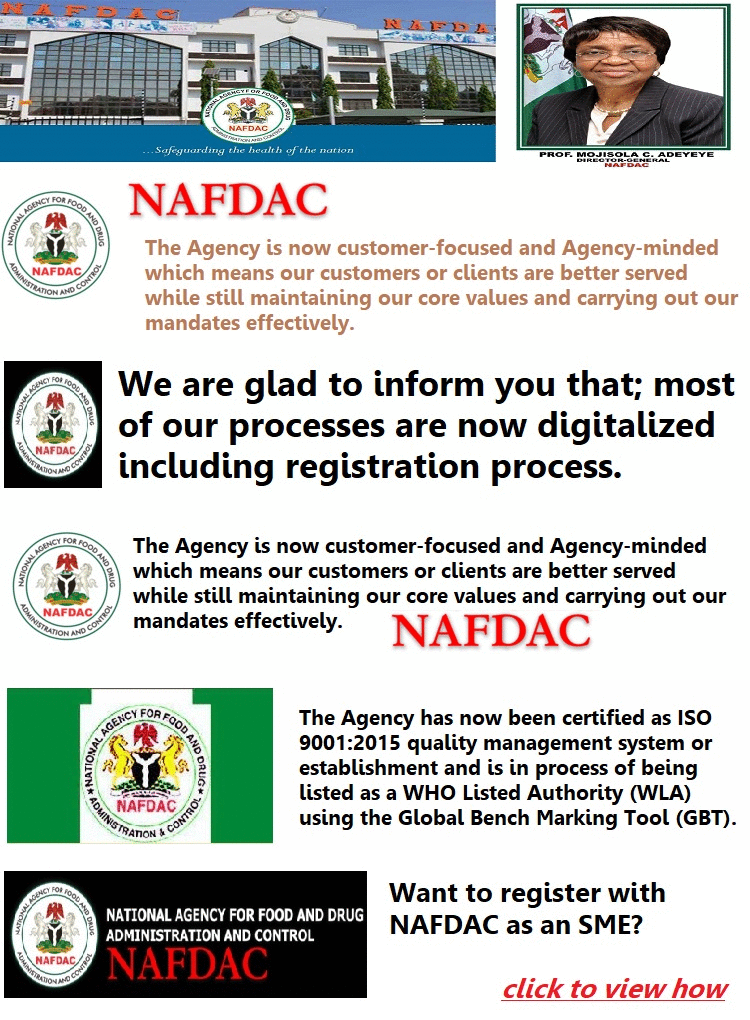
    “The agency is now customer-focused and agency-minded which means our customers or clients are better served while still maintaining our core values and carrying out our mandates effectively.

    “Most of our processes are now digitalised including the registration process.

    “The agency has now been certified as ISO 9001:2015 quality management system or establishment and is in the process of being listed as a WHO Listed Authority using the Global Bench Marking Tool (GBT)” she said.

    She, however, said some challenges were impacting negatively on the operations of the agency.

    The challenges, she said, include lack of vehicles, shortage of staff, poor remuneration, inadequate working tools such as computers and accessories as well as inadequate laboratory equipment.

    The director general also cited the nation’s porous borders through which some products were being smuggled in as some of the challenges being faced by NAFDAC. (NAN)

  • NAFDAC evolves programmes to support small businesses

    By Mufutau Ojo

    Abuja: Prof. Moji Adeyeye, the Director-General of the National Agency for Food and Drug Administration and Control (NAFDAC) says the regulatory body has evolved various policies and programmes to support small businesses.

    Adeyeye, who spoke with newsmen in Abuja on Monday, said the agency recognised the critical roles Small and Medium Enterprises played
    in the economy and deserved to be encouraged.

    She said one of the policies put in place to encourage small businesses was decentralisation of registration process to make it less cumbersome.

    She noted that “prior to 2018, all registration exercises were done in Lagos. However, having recognised the importance of micro enterprises, the agency decentralised registration of products and it is now done on zonal basis, including the FCT office.

    “Also, the number of products being registered on zonal basis has been increased from 11 to over 80 different products.

    “Guidelines and documentation requirements have been streamlined to make it easier for micro and small industries to register their products

    “Companies manufacturing similar products can use one facility, that is shared facility to reduce cost of setting up factory, while timeline for registration of products has been reduced to between 60 and 90 working days.

    “The facility requirement has also been reduced from four rooms to one standard room and a store.”

    The News Agency of Nigeria (NAN) reports that NAFDAC was officially established in October 1992 to promptly address the challenges of rising incidence of counterfeit and substandard drugs as well as unwholesome food and other products.

    NAN also reports that the mandate of the agency include safeguarding public health by ensuring that only the right quality drugs, food and other regulated products are manufactured, imported, exported, advertised, distributed, sold and used in Nigeria.

    Adeyeye recalled that NAFDAC in 2020 gave palliatives to micro enterprises in order to cushion effect of the COVID-19 pandemic

    She said the agency reduced the cost of registration by 80 per cent for small businesses while there was free registration
    for the first 200 companies that submitted application.

    The director general also said the agency waived payment of late renewal fees for three months for companies that had expired licences.

    Speaking on other initiatives to boost service delivery, Adeyeye said NAFDAC was working on becoming a WHO Listed Authority.

    “The WHO uses Global Benchmarking Tools to assess the agency and there are four Maturity Levels.

    “Currently, we are aspiring to get to Level 3 which will permit our country to manufacture vaccines because as an agency we have to do Lot release which is a requirement for vaccine production.

    “This will also improve trade because our products can compete favourably with products from advanced countries with stringent regulatory authorities.

    “Pharmacovigilance which is the science of detecting, assessing and documenting adverse events has been strengthened.

    “The agency recently launched the MEDSAFETY App for reporting adverse drug reactions.

    “For example, as the COVID-19 vaccine is being administered on people and if there are reactions, no matter how little, they report it through the App which comes to the database.

    “It eventually goes to the Upsalla Monitoring Centre in Geneva where adverse reactions are domiciled internationally. Reactions to other drugs are also reported through the App,” she said. (NAN)

  • NAFDAC impounds vehicle loaded with unwholesome medicine, vaccines in Asaba

    By Aderogba George
    Abuja: The National Agency for Food and Drug Administration and Control (NAFDAC) says it has impounded a Mercedes Truck laden with banned and unregistered medicinal products in Asaba, Delta.
    A statement signed by NAFDAC Resident Media Consultant, Mr Olusayo Akintola, said that the agency’s Director-General, Prof. Mojisola Adeyeye, made the disclosure in Abuja on Wednesday.
    The statement quoted Adeyeye as saying that the agency had resolved to ensure that only wholesome medicinal products and other regulated products were available in the markets for public use and consumption.
    The director-general said that a Mercedes truck suspected to be carrying substandard and falsified medicinal products was intercepted along Asaba –Benin road by officers of the agency’s Investigation and Enforcement Directorate, following an intelligence report.
    According to her, after thorough screening, the truck was found to contain, among other products, improperly stored Tetanus Diphtheria vaccine, and various unregistered, banned and controlled medicinal products.
    She said that part of the drugs includes Analgin Injection, CSP with Codeine cough syrup, Mepacrine HCL Tablets, Diethylcarbamazine Citrate Tablets, Dano Tetanus Vaccine, Artestunate Injection, and many others.
    Adeyeye explained that the products were evacuated, inventory were taken while the suspects with cartons containing the products made police statements and were released on administrative bail.
    According to the NAFDAC boss, further investigations revealed that the truck was conveying medicinal products purchased from Ogbo-Ogwu Bridge Head market in Onitsha, Anambra, for supply to retailers in Warri, Delta.
    “The retailer outlets who are mostly in Warri are Pendrix Pharmacy, Samtex Pharmacy, Onos Pharmacy, Chima Patent Medicine Store, Imoson Patent Medicine Store,  Sam-C Patent Medicine Store, Sunshine Patent Medicine Store and Hyunus Patent Medicine Store respectively.
    “Others are Chuks Patent Medicine Store, Solomon Patent Medicine Store, Friday Patent Medicine Store, Madam Faithmax Patent Medicine Store, Omas Pharmacy, Evans Patent Medicine Store, Chiyere Patent Medicine Store
    and Philo Patent Medicine Store, Bridge Head Market, Onitsha,” she said.
    Adeyeye, however, warned medicine merchants to always have the general wellbeing of Nigerians at heart over and above any other pecuniary consideration, stressing that there is no longer a hiding place for them.
    She also cautioned them to stop the circulation of illicit business and dangerous medicinal products capable of compromising the health of the Nigerians. (NAN)
  • COVID-19: NAFDAC approves Pfizer Biotech Vaccine for emergency use authorisation- Prof Moji Adeyeye

    By Kemi Akintokun

    Lagos: National Agency for Food and Drug Administration and Control (NAFDAC) says it has approved the Pfizer Biotech Vaccine for emergency use authorisation for COVID-19 in Nigeria.

    Its Director-General, Prof. Mojisola Adeyeye, made this known on Friday in a live/zoom media briefing in Lagos.

    Adeyeye said: “We have approved Pfizer Biotech Vaccine for possible use in the country.

    “Our COVID-19 vaccine team must carefully review it to make sure that the science behind it is well understood, and also in accordance with our own regulation.”

    She said the vaccine was approved based on different mechanisms known to the agency.

    “We used different mechanisms to approve COVID-19  vaccine, and one of it is called reliance, meaning that a more matured regulatory agency across the globe has already approved such vaccine.

    “We can use that as a basis for our own review by getting the assessment report, know the peculiarities and our COVID Vaccine Committee will then do their job.

    “We also can go ahead to review, if the World Health Organisation (WHO) has given emergency use lifting, meaning they have done their job.

    “For Pfizer biotech vaccine,  both cases are through, because more matured agencies have approved the vaccine.

    “The approval is not a full approval, it is within the period of getting people vaccinated and gathering of data about the adverse effect following immunisation,” she said.

    Adeyeye said that data gathering on vaccine was not limited to NAFDAC.

    She said that the agency belonged to an organisation called International Coalition of Medicine Regulatory Authorities( ICMRA).

    “We belong to ICMRA, which is a global gathering of regulatory agencies across the country, where we share our experiences, like that of Oxford Astrazeneca Vaccine,” NAFDAC director-general said.

    According to her, the agency’s COVID-19 Vaccine Committee has worked to ensure that post vaccination regulation is put in place.

    “Our committee started their work to ensure all the Is are dotted and the Ts are crossed to ensure that post vaccination regulatory activities such as pharmacology vigilance or safety monitoring is put in place.

    “So, it is not just the vaccination alone, it is what happens after that,” she said.

    On the storage of the Pfizer Biotech Vaccine, Adeyeye said the country has what it took to store the vaccine effectively.

    “We have the capability because the freezer temperature is now -30 degrees unlike when it was -80 to -60 degrees temperature. So, the storage is not an issue in Nigeria,” she said.

    The director-general also disclosed that the agency was reviewing the Johnson and Johnson Vaccine. (NAN)

  • NAFDAC partners Global alliance to enhance ease of doing business

    By Aderogba George
    Abuja: The National Agency for Food and Drug Administration and Control (NAFDAC) says it has commenced partnership with Global Alliance for Trade Facilitation (GATF) to put together strategies for export and import trade in Nigeria.
    A statement signed by NAFDAC resident media consultant, Mr Olusayo Akintola, and issued to newsmen on Sunday stated that the procedures was to ensure ease of doing business in Nigeria.
    The statement noted that the partnership was also aimed at achieving standardisation, harmonisation of documents and simplified trade formalities for importers and exporters.
    It said that NAFDAC Director General, Prof. Mojisola Adeyeye, reached the agreement at a virtual meeting with GATF Nigeria top officials led by its Project Lead, Mr Bernard Traynor.
    The statement added that the partnership project is being powered by GATF, an organisation that was being hosted by Centre for International Private Enterprise, International Chambers of Commerce, and the World Economic Forum.
    “The project in Nigeria is being implemented by the German Technical Cooperation popularly known as GIZ. The alliance is supported by the governments of US, Canada, Germany, Denmark and government of Australia through their respective agencies.”
    The statement quoted Adeyeye, who was represented at the meeting by Dr Abimbola Adegboye, Head of Trade and International Relations at the agency, listing measures that NAFDAC had already put in place for both import and export trade.
    Adeyeye reiterated that NAFDAC had already put in place measures to ensure that there is a seamless and more robust operational procedure with both export and import at the borders.
    She said that part of the measures was to achieve cooperation among government agencies at the borders, adding that NAFDACs focus now was to ensure smooth trade facilitation and regulation.
    According to her, operations of regulators should not pose an hinderance to trade transactions but facilitate them.
    She said that the agency was making sure that there are not so many interferences between the users of the agency facilities and the agency.
    “So, we try as much as possible to remove both human interferences under the guise of consultants, because more or less they do not facilitate trade, they tend to distort it.
    “Trade should be on basis of safety and quality, that is the only way trade could be sustained; If quality is not put into your product, It gives the country a bad name, they blacklist the company involved.
    “The consumers are the losers because they do not have value for money and their health is compromised,” she stressed.
    She stated that these are the issues that the global alliance would be addressing, adding that what would make all these visible and possible was to ensure that operations at the borders are seamless.
    According to her, If you have perishable items that are to be exported or that are to be allowed into the country and they are delayed unnecessarily or held based on premium conditions, such products could go bad, and the integrity of such product would be compromised.
    She said that anything that would make trade operations very easy both for inflow and outflow, and would make the whole process of regulation friendly and not cumbersome for importers and exporters, is what the agency aimed for.
    The statement also quoted the Project Manager of GATF, Nigeria, Mr David Okeku, explaining that being an alliance, his organisation had critical private sector partners, and series of projects currently being implemented in Kenya, Madagascar, Malawi, Zambia, Senegal, Uganda and Latin America, Asia and middle East countries’.
    ‘’How we work in the alliance is that we partner with multinationals, local businesses because we believe strongly that they will bring in their expertise and also best practices; and also bring in supply-chain companies.
    “We use them as our ambassadors globally and in-country. Local businesses also contribute in form of expertise and resources in kind towards the alliance”, the statement added.(NAN)