





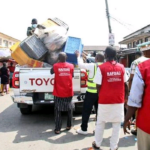



–
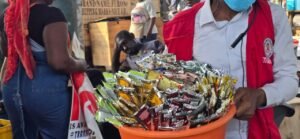
(NAFDAC Operatives confiscated banned sachet Alcohol found on sale)

(NAFDAC DIRECTOR GENERAL Prof Mojisola Adeyeye, Vows no Retreat!)
I want to categorically state once more that the ban on sub-200ml sachet and PET-bottle alcohol is not negotiable. The mop-up operation is not a one-off exercise.- Prof. Adeyeye
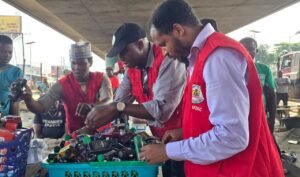
(NAFDAC Operatives on enforcement operation against illegal producers of banned alcohol in sachets and PET bottles)
– Manufacturers found still producing will have their facilities shut down. Products found in the market will be seized and destroyed. Distributors and retailers found handling these products will face sanctions – NAFDAC DIRECTOR GENERAL
.

By Biola Lawal
Abuja (FLOWERBUDNEWS): NAFDAC Director General, Prof Mojisola Christianah Adeyeye, has vowed to hunt down all persons, still producing, distributing or selling sachets alcohol and in PET bottles below 200ml across the country.
Prof. Adeyeye, who gave the warning while giving update on the ongoing nationwide enforcement of the Federal Government ban on production and sales of alcohol in sachets and PET bottles, stated that the ban would be fully enforced despite emerging threats to the lives of NAFDAC Operatives on the field.
”NAFDAC will continue this mop-up until the last sachet of banned alcohol is removed from Nigerian streets,” declared, adding:

(NAFDAC Operatives in action, enforcing the federal government ban on sachet Alcohol)
”We will continue to shut down non-compliant factories. We will continue to pursue those who attempt to evade us. And we will continue to protect the health of the Nigerian public — especially our children.”
She disclosed that NAFDAC enforcement officers were attacked at several locations while carrying out their lawful duties this past week.
She wrote:
‘:Let me share with you what happened. One of our officers was nearly stabbed. A weapon was drawn against him during a lawful enforcement operation. Only by providence was he not seriously harmed or killed. Another officer was slapped and pushed; physically assaulted while carrying out the work this Agency sent him to do.
These are not abstract reports. These are our colleagues. Public servants. Fathers, mothers, sons, and daughters.
They left their homes to enforce a Federal Government ban designed to protect Nigerian children, and they were met with violence, weapons, and physical assault from those whose only interest is the continued profit from a banned product.
An attack on a NAFDAC officer carrying out lawful regulatory duty is an attack on the Federal Republic of Nigeria. It is a criminal act. It will be investigated. It will be prosecuted. And it will not — I repeat, will not — deter this Agency from carrying out its mandate.
No commercial interest, no manufacturer, no distributor, no market association, and no individual have the right to obstruct, threaten, assault, or raise a weapon against a public officer enforcing the law of this country.
To those responsible for these attacks, know this: your actions are documented, your locations are known, and the full weight of the law is coming.
To our officers who faced this violence and continued to do their work — I want to say, on behalf of NAFDAC: we see you, we stand with you, and we will not abandon you. Your safety matters to this Agency, and we will ensure that those who laid hands on you face justice.
I want to categorically state once more that the ban on sub-200ml sachet and PET-bottle alcohol is not negotiable. The mop-up operation is not a one-off exercise.
Manufacturers found still producing will have their facilities shut down. Products found in the market will be seized and destroyed. Distributors and retailers found handling these products will face sanctions.
Anyone who attacks, threatens, or obstructs NAFDAC officers will be prosecuted.
This Agency recognises that legitimate industry has a role to play in the economy, and we remain a partner to compliant, responsible manufacturers. But compliance is not optional. Public health is not a suggestion. And the protection of Nigerian children is not a matter for negotiation with any commercial interest.
Giving details of the long process that eventually resulted in the ban. Prof. Adeyeye wrote further:
I have called this briefing today to give Nigerians a clear, factual, and unvarnished account of what the National Agency for Food and Drug Administration and Control (NAFDAC) has encountered in the last one week of intensive enforcement of the Federal Government ban on the production, distribution, and sale of alcoholic beverages in sachets and PET bottles below 200ml.
As you are aware, the production, importation, distribution, sale, and consumption of alcoholic beverages in sachets and PET bottles below 200ml has been banned.
This was not a casual decision. It was a public health decision rooted in evidence and directive from the Federal Government through the Senate Resolutions.
The following Senate resolutions made on November 6, 2025, that were communicated to SGF on December 1, 2025, to:
Urge NAFDAC not to grant further extension to the moratorium and to ensure immediate strict enforcement of the ban on sachet alcohol and alcohol in smaller (<200ml) PET bottles
Urge the Federal Ministry of Health and Social Welfare to support NAFDAC on the ban on sachet alcohol and alcohol in smaller (<200ml) PET bottles
Urge Federal Ministry of Health and Social Welfare to release the National Alcohol Policy that includes prohibition of alcohol in sachets and small volume (<200 ml) packaging
The National Alcohol Policy that contained the ban was finally signed by the Coordinating Minister of Health and Social Welfare on July 2, 2027,
Urge National Orientation Agency and NAFDAC to collaborate and intensity nationwide sensitization of dangers of alcohol in sachets and small volume bottles and consumption of the products.
On March 3, 2026, NAFDAC, National Orientation Agency and FCCPC made a joint Press briefing to make very clear the Federal Government decision that these pack sizes have been banned.
These sachet and small-pack products are cheap, portable, easily concealed, and aggressively targeted at young people. They are sold in motor parks, street corners, kiosks, and open markets (often within reach of children and adolescents).
They have fuelled underage drinking, substance abuse, addiction, and a rising burden of alcohol-related illness among our youth. The ban exists to protect Nigerians, especially our children, and NAFDAC has a duty to enforce it.
In the past week, NAFDAC enforcement teams have conducted coordinated market raids and mop-up operations across Lagos, Ogun, and several other states in the federation. The objective was simple: to identify, seize, and remove all sachet and PET-bottle alcoholic products below 200ml still in circulation.
We targeted the entire supply chain: manufacturers who continue to produce, distributors who continue to move product, and retailers who continue to sell. None of these actors can claim ignorance. The ban is public. The deadline has passed. The warning was given.
What we found at the manufacturing level is what I must now bring to the attention of Nigerians, because it speaks to the depth of defiance we are dealing with.
Following the discovery of banned products still circulating in the market, our teams revisited factories whose products had been traced to those markets.
In multiple cases, those factories were found to be still actively producing; in direct violation of the ban. These were not leftover stock.
At several of these sites, we recovered countless packaging materials, including:
Banned 100ml PET bottles, and Rolls of packaging film for sachet alcohol, some bearing production dates as recent as 23rd July 2026.
Let me repeat that. Packaging materials dated the 23rd of July 2026 were evacuated. That is four days ago. These manufacturers were producing banned products this very month, just last week, even after the ban had taken full effect and after NAFDAC had already engaged them. This is not a misunderstanding. This is deliberate, calculated defiance of federal regulation.
Some of these manufacturers went further than mere production. They resorted to active evasion. In several cases, manufacturers relocated their production machines to unregistered premises to continue production underground, out of regulatory sight. They moved equipment under cover, set up clandestine operations, and continued to flood the market with the banned product.
In other cases, manufacturers removed their signposts and company nameplates from their premises, not because they had ceased operations, but with the clear intent to disguise the facility, avoid detection and ultimately mislead our officers.
A manufacturer who removes his own signpost to hide from the regulator is not a manufacturer acting in good faith. That is the conduct of an operator who knows he is breaking the law and is taking active steps to evade accountability.
In one facility, officers found crates of finished products stacked as well as 100ml bottles positioned near the production machines. We will find these facilities wherever they are hidden, and they will be brought to book.
To the Nigerian public, we appeal to you not to purchase sachet or PET-bottle alcohol below 200ml. Do not allow these products to be sold in your markets, shops, or motor parks. Protect your children by refusing to supply these products to minors and by reporting any outlet that does.
Report any manufacturer, distributor, or retailer still producing, transporting, or selling these banned products to NAFDAC.
NAFDAC will continue this mop-up until the last sachet of banned alcohol is removed from Nigerian streets. We will continue to shut down non-compliant factories. We will continue to pursue those who attempt to evade us. And we will continue to protect the health of the Nigerian public — especially our children. (Flowerbudnews)