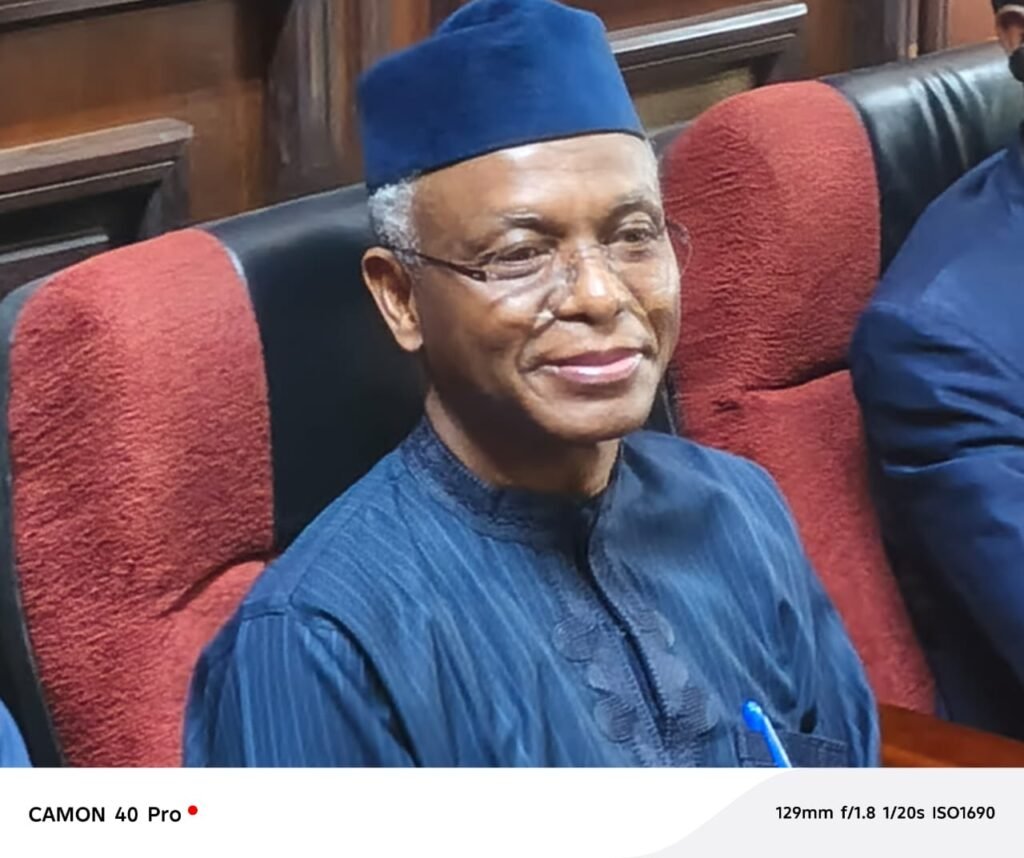
The Department of State Services (DSS) on Thursday arraigned former Gov. Nasir El-Rufai of Kaduna State for allegedly intercepting the phone conversations of the telephone line of the National Security Adviser (NSA), Nuhu Ribadu.
El-Rufai, who was arraigned before Justice Joyce Abdulmalik of the Federal High Court in Abuja on a five-count further amended charge, pleaded not guilty to all the counts.
The News Agency of Nigeria (NAN) reports that the charge is marked: FHC/ABJ/99/2026.
When the case was called, DSS lawyer, Oluwole Aladedoye, SAN, informed the court that the matter was fixed for the defendant to take his plea.
Aladedoye, however, told the court that a further amended five-count charge was filed on April 13.
The lawyer prayed the court to substitute it with the earlier three-count charge.
“We pray that the earlier charge be struck out my lord,” he said.
Responding, El-Rufai’s counsel, Oluwole Iyamu, SAN, said he had been served with the amended charge and that he was not opposing.
The judge then struck out the earlier three-count charge.
After the counts were read to the former governor, he pleaded not guilty and Aladedoye sought a three consecutive trial dates.
Iyamu, however, objected to an application for a three consecutive days for commencement of the trial.
He submitted that since the defendant had been in the custody of Independent Corrupt Practices and Other Related Offences Commission (ICPC), having access to him within the three days of the trial might be difficult.
According to him, the three days might not be in our best interest.
Iyamu also informed the court of their bail application filed on Feb. 17.
However, the further affidavit in support of the bail application was not in the court file and the judge stood down the matter for Iyamu to do the needful.
Upon resumed hearing, Iyamu moved the bail application and urged the court to grant their prayers.
Aladedoye did not oppose the bail request.
But he prayed the court to set conditions that would ensure that the defendant presents himself for trial.
Aladedoye proceeded to also move a motion seeking an order to conceal the identities of two of the five witnesses to be called by the prosecution.
He said the prosecution desires that the identities of the two witnesses should not appear in public or court records and they should be identified with pseudonyms during trial.
Aladedoye said the application was informed by the belief that should their identities be revealed, the said witnesses, who are officials of the DSS, and members of their families would be exposed to danger and could be attacked by persons sympathetic to the defendant.
Iyamu objected to the application and argued that it was the constitutional right of a defendant to know his accusers.
He further submitted that there was no evidence before the court showing that El-Rufai had any cult-like followership or posed a threat.
The defence lawyer said the defendant had dedicated his life to public service and warned that granting a blanket anonymity order could create serious prejudice against the defendant.
Iyamu also moved an application in which he is praying for an order directing the prosecution to furnish the defence with proof of evidence to prepare for trial, an application Aladedoye also opposed.
Aladedoye argued that the materials sought by the defence were documents unrelated to the processes filed by the prosecution.
El-Rufai’s lawyer also moved another application in which the defendant is praying for the quashing of the charge.
Aladedoye, however, objected to the request, arguing that the application lacked merit.
He urged the court to dimiss the application in its entirety.
Ruling, Justice Abdulmalik issued an order for a accelerated hearing of the case and adjourned the matter until May 18, May 19 and May 20 for ruling on all pending applications and for the prosecution to open its trial.
The judge also ordered that the defendant, who was brought from the custody of ICPC in relation to a separate case, should be remanded in the custody of the DSS.
She ordered that the defence lawyers should comply with the operating procedure of the DSS and that the officials of the DSS should cooperate with the defence lawyers to enable them prepare his defence.
However, after the judge made the order, Iyamu called the attention of the court to the fact that El-Rufai was brought from the ICPC’s custody.
The lawyer, who told the court that the ex-governor was in the anti-corruption commission’s detention on the order of two Kaduna courts, expressed their frustration.
Responding, Justice Abdulmalik held that it is the practice that all institutions confer among one another to sort out contentious issues.
She said since the DSS is the prosecution before her, she could only direct the secret police to afford the defendant necessary facilities to meet with his lawyers.
“I don’t have to read social media to determine my case.
“So I want the journalists here to quote me correctly.
“I use the matters before my court to determine my cases,” the judge said.
In count one the ex-governor was alleged to have intentionally and unlawfully interfered with the communication of the NSA, Mr Ribadu, which constitutes Critical National Information Infrastructure (CNII).
It said this is contained in Designation and Protection of Critical National Information Infrastructure Order, 2024 gazetted as Statutory Instrument No. 21 of 2024, as admitted by El-Rufai on Feb. 13, while appearing as a guest on Arise TV Station’s Prime Time Programme in Abuja.
The offence is contrary to Paragraph 7 (b) & (c) of the Designation and Protection of Critical National Information Infrastructure Order, 2024 and punishable under Section 5 (1) of the Cybercrimes (Prohibition, Prevention, etc) Amendment Act, 2024.