
Tag: Venezuela

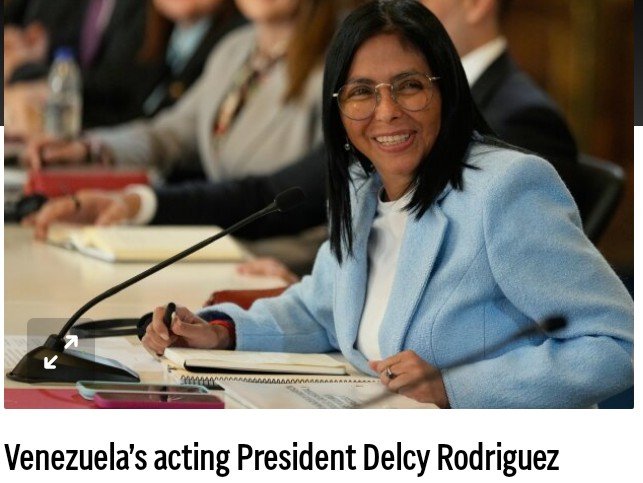
  • Venezuela’s Delcy Rodríguez remain Venezuela’s acting president after her initial 90-day limit Expired

    Venezuela’s Delcy Rodríguez remain Venezuela’s acting president after her initial 90-day limit Expired


    CARACAS, Venezuela (AP) — Delcy Rodríguez remained Venezuela’s acting president on Monday, exceeding the 90-day limit on her temporary role set by the country’s high court following the U.S. capture of Nicolás Maduro in January.

    However, it’s unclear how much longer she will keep the post as lawmakers have not taken a public vote to extend her term past last Friday’s deadline.

    According to the court order, Maduro is still officially Venezuela’s president and his “forced” absence resulting from a “kidnapping” makes it temporarily impossible for him to fulfill his duties.

    Under Venezuela’s constitution, according to an article referenced by the court, temporary absences are to be filled by the vice president — which was Rodríguez’s former role — for up to 90 days. These interim appointments can be extended by the national assembly for an additional 90 days.

  • A Call to the Streets in Venezuela

    A Call to the Streets in Venezuela


    By Ren Pluta

    World Beyond War (WBW) Latin America Organizer Gabriel Aguirre and WBW member Ren Pluta marched in the city of Mérida, Venezuela (pop ~ 200,000) Wednesday, March 4 in solidarity with between 2000 – 3000 local protesters supporting the national call to return President Maduro and First Combatant Flores to their home after their illegal kidnapping and transportation to a u.s. prison.

    The gathering was an excellent example of the efficacy of community networks that started the call to the street only the night before the march. There was no violence, and speakers included the mayor and the governor.

    Despite suffering over 1000 reported u.s. sanctions against Venezuela last year, Venezuelans managed to produce over 90% of their own food, and continue to provide healthcare and free education for their population.

    There were more than a few conversations where Venezuelan citizens openly and strongly stated that they believe that most people in the u.s. are very different than the face that Donald presents. While a number of citizens rightly hold us responsible for reconstructing our fascist-leaning government, they also mentioned they are well aware that Donald made the decision to kill people in Venezuela and kidnap the President and First Combatant without consulting Congress or the u.s. population.

    Contrary to Donald’s exaggerated claims of narco-terrorism and flooding the u.s. with fentanyl and cocaine, both the UN Office on Drugs and Crime AND u.s. counter narcotics organizations report that Venezuela isn’t a producer or exporter of fentanyl and that it plays a relatively minor role in the cocaine trade.

    These types of bombastic headlines created by Donald’s “let’s keep the u.s. population scared” minions in the media smell of the same lies that were tied to our nose rings to lead us into other wars. Remember the “surprise” incoming attack on Pearl Harbor that was picked up visually beforehand but not reported? The fake boat attack that led us into Vietnam? The non-existent weapons of mass destruction that damaged yet another generation of veterans in Iraq?

    The distinct Venezuelan, heartwarming receptions experienced from government officials, residents of a barrio, a fishing community, members of successful communes, academics, wait staff in restaurants, artists, hospital personnel, and scientists is, in my opinion, a much truer representation of Venezuelans than the false accusations being delivered by Donald and Co.

    Note: The purposeful use of the diminutive form u.s. in this article is of the author’s choice, intended to reflect their personal belief that the office of the President is not currently filled by anyone representing the majority of the u.s. population

  • U.S. military action against Venezuela lacks of respect for int’l law: UN chief

    U.S. military action against Venezuela lacks of respect for int’l law: UN chief


    UN Secretary-General Antonio Guterres on Monday voiced deep concern over the lack of respect for international law in the U.S. military action against Venezuela on Saturday.

    “I remain deeply concerned that rules of international law have not been respected with regard to the Jan. 3 military action,” said Guterres in a statement to the Security Council, read on his behalf by Under-Secretary-General for Political Affairs Rosemary DiCarlo.

    The UN Charter enshrines the prohibition of the threat or use of force against the territorial integrity or political independence of any state, the UN chief added.

    “The maintenance of international peace and security depends on the continued commitment of all (UN) member states to adhere to all the provisions of the charter,” said Guterres.

  • Venezuela Defence Minister Calls for ‘Anti-Imperialist Liberation War’

    Venezuela Defence Minister Calls for ‘Anti-Imperialist Liberation War’


    By Natalie Naidoo

    Caracas, Venezuela     –In a defiant stand against what he calls an imperialist attack, Venezuela’s Defence Minister Vladimir Padrino López has released a video message rallying the nation for an “anti-imperialist and liberation war” against the American empire.

    The statement, shared on January 3, 2026, comes amid chaos following U.S. military strikes on Venezuelan soil that targeted key installations and led to claims of President Nicolás Maduro’s capture.

    For ordinary Venezuelans waking to blackouts and uncertainty, Padrino’s words offer a call to arms but also deepen fears of a wider conflict that could worsen daily hardships like food shortages and power cuts.

    The minister, alive despite earlier false reports of his death, urged all social and political forces to activate mobilisation plans and repudiate the assault, framing it as a fight for sovereignty.

    This bold response from a key Maduro ally highlights the high stakes in a nation already strained by years of economic crisis and political division.

    As families huddle in darkened homes, wondering what comes next, Padrino’s message resonates with those who see the U.S. actions as overreach, while raising alarms about escalation in a region on edge.

    In South Africa, with our history of resisting external pressures, this story echoes calls for self-determination, reminding us how global power plays can upend lives far from the centres of decision-making.

    With no immediate U.S. response and international condemnation growing, the world watches as Venezuela braces for what could be a prolonged standoff in 2026.

    Padrino’s video, delivered with military precision, rejects U.S. claims and positions Venezuela as a defender against aggression, potentially rallying support at home but risking further isolation abroad.

    The Video Message: A Call to Arms Against Imperialism

    In the video released on January 3, 2026, Defence Minister Vladimir Padrino López appeared resolute, dismissing reports of his death as false and urging Venezuelans to rise against the “American empire.”

    He called for an “anti-imperialist and liberation war,” emphasising the need to mobilise all forces to repel what he described as an unprovoked assault.

    Padrino stressed unity, saying the Bolivarian government urges all social and political forces in the country to activate mobilisation plans and repudiate this imperialist attack.

    The message, likely recorded from a secure location amid ongoing unrest, aims to boost morale among troops and civilians.

    Padrino, a key figure in Maduro’s inner circle, has long been a vocal defender of the regime, often framing external pressures as threats to Venezuela’s independence.

    His survival counters U.S. narratives and could galvanise loyalists, but it also heightens risks if clashes intensify.

    For families in Caracas facing blackouts and street fighting, this call brings mixed feelings – pride in resistance but fear of more violence. In 2025, similar rhetoric preceded crackdowns on protests, leaving thousands detained.

    Vladimir Padrino López: A Loyal Defender in Turbulent Times

    Vladimir Padrino López, 62, has served as Venezuela’s Defence Minister since 2014, a role that makes him a pillar of Maduro’s government.

    Born in Caracas, he rose through the military ranks, graduating from the Military Academy in 1984 and holding key posts like Chief of the General Staff.

    A staunch Chavista – follower of Hugo Chávez’s ideology – Padrino has navigated coups, sanctions, and internal purges, remaining loyal through crises.

    In 2019, he rejected U.S.-backed opposition attempts to oust Maduro, helping secure the regime. His 2025 speeches often condemned “imperialist” threats, aligning with Maduro’s anti-US stance.

    Despite rumours of his death in the January 3 strikes, Padrino’s video proves his survival, a boost for Maduro’s camp.

    As a family man with a military background, Padrino embodies the blend of duty and defiance that defines Venezuela’s leadership.

    His call for war reflects deep anti-imperialist roots, shaped by Latin America’s history of U.S. interventions.

    Background: U.S. Strikes and Maduro’s Reported Capture

    The video follows U.S. airstrikes on January 3, 2026, targeting military sites in Caracas, La Guaira, Miranda, and Aragua.

    Explosions at Fort Tiuna and La Carlota airport caused blackouts and chaos. Trump claimed the strikes captured Maduro and his wife, but Maduro denied this in an address, declaring emergency and mobilising forces.

    Maduro accused the U.S. of 25 weeks of aggression in 2025, likely blockades. Street fighting in Caracas suggests clashes, with unconfirmed U.S. troop landings.

    This escalation follows Trump’s 2025 re-election threats against Maduro for alleged drug ties.

    Venezuela’s response includes activating defences, with Padrino’s message part of rallying efforts. The strikes hit a nation in crisis, with 80 percent in poverty and 7 million fled since 2014.

    Regional and Global Fallout: Condemnation and Economic Ripples

    Brazil’s President Lula condemned the strikes as crossing “an unacceptable line,” calling for a summit. Colombia’s Petro slammed “bombing Caracas,” while Mexico urged calm.

    Latin America’s outcry highlights anti-US sentiments, fearing instability.

    Russia and China backed Maduro, vowing aid. The UN warned of humanitarian woes. Oil prices jumped 5 percent, hitting importers like South Africa with higher fuel costs.

    For SA, with BRICS ties, this tests neutral stances. Our call for UNSC meetings shows commitment to peace.

    Path Ahead: Escalation Risks and De-Escalation Hopes

    With Maduro defiant and Trump firm, escalation looms. Maduro’s emergency allows curfews and military moves, potentially drawing allies. Trump may push more strikes if goals unmet.

    Mediation calls grow – Lula’s summit could de-escalate. The UN and OAS urge restraint.

    For 2026, this could redefine US-Latin relations, risking proxy war.

    Venezuelans hope for peace, but mobilisation signals uncertainty. In a connected world, this affects all – from energy to migration – calling for wisdom over force.

    🔴

  • Venezuela Gets New President

    Venezuela Gets New President


    Venezuela’s Supreme Court has ordered Vice President Delcy Rodríguez to assume office as acting president following the detention of President Nicolás Maduro by United States forces.

    The directive was issued on Saturday by the Constitutional Chamber of the Supreme Court of Justice, which said the decision was taken to ensure continuity of governance amid what it described as the “forced absence” of the president.

    According to the ruling, Rodríguez is to take over “the office of President of the Bolivarian Republic of Venezuela, in order to guarantee administrative continuity and the comprehensive defence of the Nation.”

    The court added that it would convene further deliberations to determine the appropriate legal framework for managing the situation.

    “The court will debate the matter in order to determine the applicable legal framework to guarantee the continuity of the State, the administration of government, and the defence of sovereignty in the face of the forced absence of the President of the Republic,” the ruling stated.

    Maduro was arrested early Saturday morning during an operation carried out by U.S. forces, an action that has sparked intense political and diplomatic reactions both within Venezuela and internationally.

    The Supreme Court’s move effectively places Rodríguez in charge of the country’s executive authority pending further legal and political developments.

    Meanwhile, Maduro has arrived in New York, United States, to stand trial on arms and drug trafficking charges.

  • Maduro not legitimate Venezuelan President – US Secretary of State

    Maduro not legitimate Venezuelan President – US Secretary of State


    By Adeoa Balogun
    The United States Secretary of State, Marco Rubio, has said that Venezuelan President Nicolas Maduro is not the president of the oil rich country and that his regime is not the legitimate government of the South American country.

    Rubio in a tweet on Saturday said the captured president is the head of the Cartel de Los Soles, a narco-terror organization which has taken possession of the country.

    He said the Maduro is under indictment for pushing drugs into the United States.

    The United States of America on Saturday announced drug and terrorism charges against Venezuelan President, Nicolas Maduro.This comes after US forces captured Maduro following a large-scale military strike on the South American country.

    “The United States of America has successfully carried out a large-scale strike against Venezuela and its leader, President Nicolas Maduro, who has been, along with his wife, captured and flown out of the Country.

    “This operation was done in conjunction with US Law Enforcement,” Trump announced on Truth Social.

    Trump added that he would give a news conference at 11:00 am (1600 GMT) at his Mar-a-Lago residence in Florida, where he is nearing the end of a two-week Christmas and New Year vacation.

    Eagle Online

  • Cuba condemns U.S. attack on Venezuela, demands urgent global response

    Cuba condemns U.S. attack on Venezuela, demands urgent global response


    HAVANA,  (Xinhua)/Flowerbudnews :  — Cuban President Miguel Diaz-Canel on Saturday condemned what he described as the “criminal attack” by the United States against Venezuela, demanding an urgent response from the international community.

    In a social media post, the president said that Latin America was being brutally assaulted, and called it “state terrorism against the brave people of Venezuela and against Our America.”

    Cuban Foreign Minister Bruno Rodriguez also condemned the ongoing U.S. military aggression against Venezuela on Saturday.

    In a message posted on social media, the diplomat said the bombings and military actions against Caracas and other localities in the country are cowardly acts against a nation that has not attacked the United States or any other country.


  • LatAm rallies for stronger Global South cooperation against external pressures

    LatAm rallies for stronger Global South cooperation against external pressures


    (Caracas.  Venezuela)


    (US Captured Venezuelan President and Wife)


    MEXICO CITY,  (Xinhua)/FLOWERBUDNEWS:   — Over the past year, Latin America has been seeking stronger cooperation within the Global South to address a changing political landscape marked by a revival of right-wing powers and governance challenges.

    Against the backdrop of growing external interference and hegemonic pressure, people in the region have been increasingly aware of the significance of safeguarding sovereignty and pursuing strategic autonomy. The idea of unity and cooperation in the Global South has also been gaining momentum.

    Meanwhile, China, the world’s biggest developing country, and Latin American countries have maintained frequent high-level exchanges, steadily strengthened practical cooperation across various fields, and taken solid steps to advance the building of a China-Latin America and the Caribbean (LAC) community with a shared future.

    POLITICAL PENDULUM SWINGS TO RIGHT

    In 2025, the political tensions between the left and the right in Latin America intensified, with the pendulum swinging to the right.

    In Chile’s recent election, the far-right party candidate won the presidential election. In Ecuador the presidential candidate of the right-wing party was re-elected, and Bolivia ended its nearly 20-year history of left-wing governance.

    Meanwhile, the far-right ruling coalition in Argentina has further expanded its advantage in the parliamentary elections.

    Analysts said that politics in Latin America has shifted markedly to the right as a result of the interplay of internal and external factors. Domestically, the countries that held elections this year were grappling with sluggish economic growth, limited improvements in living standards, and deteriorating public security leading up to the poll. In this context, right-wing parties have put forward targeted campaign platforms that have resonated with a frustrated electorate. Externally, the resurgence of conservative currents in the West — reflected in the return of right-wing parties to power in several countries — has produced a “demonstration effect” across Latin America.

    Nevertheless, an analysis of the election situation in some LAC countries suggests the traditional ideological division between the “left and right” has gradually weakened. Voters’ orientation has become more pragmatic, focusing more on governance capacity and practical solutions to issues such as the economy, employment, public security and people’s livelihood.

    The Economic Commission for Latin America and the Caribbean (ECLAC) predicted that the economy of the LAC would grow 2.4 percent in 2025. The industrial transformation for Latin American countries remained full of challenges due to sustained low economic growth, insufficient internal driving forces, and constraints from external factors such as the intervention by the United States.

    In 2026, Costa Rica, Colombia, Peru, Brazil and other LAC countries will hold general elections. The election results will not only influence the domestic political trends of these countries, but may also have a profound impact on the regional political landscape and geopolitical pattern.

    UNITY AGAINST INTERFERENCE

    Since the start of his second term as U.S. president, Donald Trump has intensified intervention in Latin American affairs.

    The U.S. National Security Strategy released in December advanced a “Trump corollary” to the Monroe Doctrine, calling for restored U.S. dominance in the Western Hemisphere and a readjustment of the U.S. military presence, which caused widespread alarm across Latin America.

    In recent months, the United States has deployed large-scale air and naval forces near Venezuela under the pretext of combating “narco-terrorism.” Thirty-five “drug trafficking vessels” have been sunk in the Caribbean and eastern Pacific, killing more than 115 people.

    Venezuela has accused Washington of attempting to force regime change and expand its military presence in the region. The U.S. actions have also drawn opposition from Cuba, Colombia, Brazil and other countries.

    After returning to the White House, Trump sparked controversy by renaming the Gulf of Mexico the “Gulf of America,” repeatedly threatened to “take back” the Panama Canal, implemented harsh deportation policies, re-listed Cuba as a “state sponsor of terrorism,” and openly intervened in elections in Argentina and Honduras in support of right-wing forces.

    Washington’s tariff hikes have also weighed heavily on Latin American economies. ECLAC reported that the new tariff measures significantly weaken the region’s ability to attract foreign direct investment (FDI). In the first half of 2025, newly announced FDI projects in Latin America and the Caribbean totaled just 31.37 billion U.S. dollars — down 53 percent year-on-year and 37 percent below the 2015-2024 average.

    The United States has repeatedly weaponized tariffs for political purposes. This year, it threatened higher duties on Colombia over migration and counternarcotics issues, and wielded tariff pressure over the legal case involving former Brazilian President Jair Bolsonaro.

    Confronted with unilateralism and hegemonic behavior, Latin American countries have strengthened their resistance to intervention and become more determined to safeguard regional peace and pursue development cooperation and integration.

    At the April Community of Latin American and Caribbean States (CELAC) Summit in Honduras, members called for deeper regional integration and joint responses to U.S. tariff and migration pressures. In Ecuador’s constitutional referendum in November, more than 60 percent of voters rejected the establishment of foreign military bases, signaling public opposition to possible U.S. military presence in the country.

    CHINA-LAC COOPERATION OPENS NEW CHAPTER

    In 2025, China and Latin America maintained close high-level engagement and deepened mutual trust. Heads of state of Latin American countries, including Brazilian President Lula and Grenadian Prime Minister Dickon Mitchell, have visited China, injecting strong momentum into bilateral ties.

    Multilateral and regional cooperation also advanced. China formally became an observer state to the Andean Community, a move welcomed by member countries eager to expand cooperation. As the CELAC chair, Colombia joined the Belt and Road Initiative, in an apparent bid to strengthen ties with China and diversify diplomacy.

    Eduardo Regalado, a researcher at the International Policy Research Center of Cuba, said the steady growth of China-LAC relations is a driving force for Global South self-reliance, creating trade, financial and technological pathways that benefit the developing world.

    In December, China released its third Policy Paper on Latin America and the Caribbean, laying out goals and priority areas for cooperation under new circumstances.

    The policy paper said China stands ready to join hands with Latin America and the Caribbean to promote the five programs on solidarity, development, civilization, peace and people-to-people connectivity to advance shared development and revitalization, and write a new chapter in building a China-LAC community with a shared future.

    Marcos Pires, a professor of political economy at Sao Paulo State University, said the document is widely expected to inject new vitality into China-LAC ties and expand cooperation in technological innovation, the green economy and regional governance.

    Across the region, Belt and Road cooperation has delivered tangible results.

    At Peru’s Chancay Port, South America’s first green smart port, container throughput exceeded 270,000 twenty-foot equivalent units (TEUs) in its first year of operation, while bulk cargo surpassed 1.366 million tons, making it Peru’s third-largest port. The project has become a symbol of mutually beneficial China-LAC cooperation and improved regional connectivity.

    In Cuba, all photovoltaic stations of the 35 MW Chinese-assisted solar project went online, boosting energy security and accelerating the green transition.

    People-to-people exchanges have grown stronger, injecting new vitality into cultural dialogue. China and LAC countries have jointly advanced the Global Civilization Initiative and successfully held the 8th China-LatAm civilization dialogue.

    China has granted visa-free access from June 1 to holders of ordinary passports from Brazil, Argentina, Chile, Peru and Uruguay — boosting travel and mutual understanding.

    China’s high-quality development and high-standard opening-up offer greater cooperation opportunities for Global South nations, helping Latin America advance economic transformation and sustainable development while promoting the building of a China-LAC community with a shared future, said Juan Carlos Capunay, former executive director of the Asia-Pacific Economic Cooperation (APEC) Secretariat and former Peruvian ambassador to China.


  • Russia Demands Release of Maduro After U.S. Military Strikes Venezuela

    Russia Demands Release of Maduro After U.S. Military Strikes Venezuela


    A fire at Fuerte Tiuna, Venezuela’s largest military complex, is seen from a distance after a series of explosions in Caracas on Jan. 3, 2026.STR / AFP)

    Russia’s Foreign Ministry on Saturday called for the release of Venezuelan leader Nicolás Maduro and his wife from U.S. custody after President Donald Trump announced that they were captured during military strikes on the capital city of Caracas.

    “We firmly call on the U.S. leadership to reconsider this position and release the lawfully elected president of a sovereign country and his wife,” the Foreign Ministry said in a statement, stressing the need to resolve the dramatic confrontation through diplomacy.

    In a separate message, the ministry said Russian Foreign Minister Sergei Lavrov spoke by phone to Venezuelan Vice President Delcy Rodriguez Gomez, during which he expressed his “solidarity with the Venezuelan people in the face of armed aggression.”

    Anonymous sources told Reuters that Gomez was currently located in Moscow. Russian authorities dismissed that report as “fake.”

    “Russia will continue to support the course pursued by its Bolivarian leadership to defend the country’s national interests and sovereignty,” the Foreign Ministry said. It urged restraint and warned against further escalation.

    Russia’s embassy in Caracas said it is operating as usual and remains in constant contact with the Venezuelan authorities and Russian citizens in the South American country. It did not report any Russian citizens as having been injured in the attacks.