Tag: Security

  • Kogi Govt will reclaim state’s forests from criminal elements, says Ododo

    Kogi Govt will reclaim state’s forests from criminal elements, says Ododo

    Forest
    By Opeyemi Gbemiro
    Lokoja, June 15, 2026.

    The Kogi Government will reclaim the state’s forests from criminal elements, Gov. Ahmed Ododo, has said.
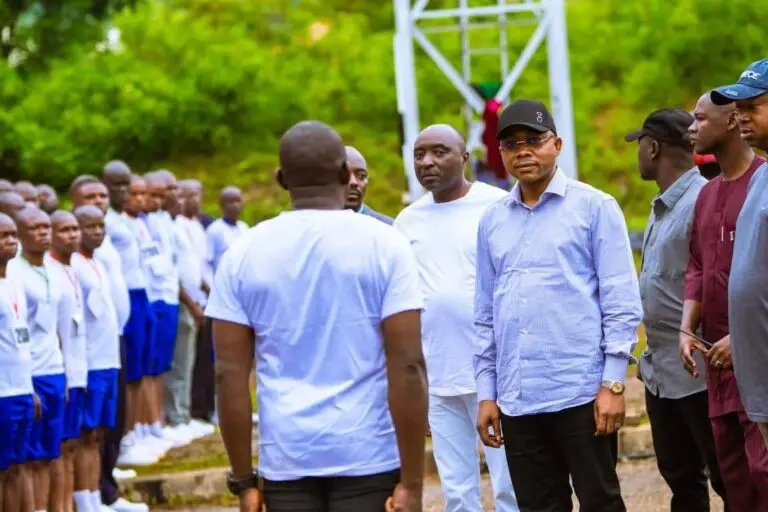
    Ododo made the declaration during a visit to the training camp of the newly recruited Forest Guard trainees on Sunday in Lokoja
    ”There will be no safe haven for terrorists, bandits and other violent criminals operating within the state.
    ”We are determined to rid Kogi of criminal elements and we will deploy all lawful resources necessary to guarantee the safety of residents and visitors,” he said.
    The governor urged the guards to discharge their responsibilities with discipline, patriotism and a strong commitment to service.
    ”The vast and largely unguarded forest areas in some parts of the state has become a major security challenge, providing hideouts for criminal groups and enabling attacks on innocent citizens.
    ”The recruitment and training of Forest Guards form a key component of the state’s security strategy is aimed at strengthening surveillance, denying criminals access to safe havens and improving the capacity of security agencies to respond effectively to threats.” he said.
    Ododo said that the initiative was part of the Forest Guard Programme approved by President Bola Tinubu and it is being implemented through the Office of the National Security Adviser in collaboration with the Department of State Services and other security institutions.
    He commended Tinubu for his commitment to strengthening national security and empowering states with innovative measures to tackle emerging security challenges.
    The governor also expressed appreciation to the National Security Adviser, Nuhu Ribadu, for his support and leadership in advancing security reforms across the country.
    Ododo further lauded the Director-General of the DSS, Adeola Ajayi, for supporting security operations in Kogi.
    He noted that the DSS was overseeing the profiling and training of the Forest Guard recruits to ensure professionalism, competence and accountability.
    The governor stressed that while his administration was committed to expanding security manpower, it remained focused on ensuring that only individuals of proven character, integrity and loyalty were entrusted with the responsibility of protecting lives and property.
    He expressed confidence in the trainees, describing them as a valuable addition to the state’s security architecture and urged them to take their training seriously in preparation for the task ahead.
    The visit to the training camp came a day after the governor inspected the first batch of Armoured Personnel Carriers procured by the state government to enhance the operational capacity and combat readiness of security agencies.
    He reaffirmed that security remained a top priority of his administration and pledged sustained investment in personnel, equipment and intelligence-driven operations to make the state safer and more conducive for investment and development.
    The governor assured residents that the government would continue to intensify efforts until all parts of the state were secured and citizens could pursue their lawful activities without fear.

  • Kogi govt. vows to sanction Churches flouting security protocols

    Kogi govt. vows to sanction Churches flouting security protocols

    Security

    By Stephen Adeleye

    Lokoja, Feb. 11, 2026 (FBN) The Kogi  Government says it will sanction  Churches found to be violating the state’s security protocols.

    The State Commissioner for Information and Communications, Mr Kingsley Fanwo, gave the warning in a statement on Wednesday in Lokoja,

    Fanwo said the government would sanction churches operating beyond 4:00 pm or in vulnerable locations without security clearance, citing credible intelligence of planned attacks by bandits.

    “The government  received intelligence of a plot to attack a church in Ijumu Local Government Area, and churches are being warned to comply with security directives to prevent attacks.

    “We have observed with deep concern that in spite of  clear security advisories, some churches still operate late into the night. This is unacceptable in the face of prevailing security challenges,” Fanwo said.

    Fanwo said security measures are in place to prevent the attack but the incident highlighted  the need for strict compliance with security directives.

    The commissioner said the decision prioritised safety, not faith.

    “Churches flouting the protocol pose  security risk. Security operatives will stop night services, focusing on prevention over emergency response.

    “We prevent crime, we don’t just respond to it,” he stated.

    He urged religious leaders to cooperate with security agencies, assuring residents of its commitment to safety and peace.

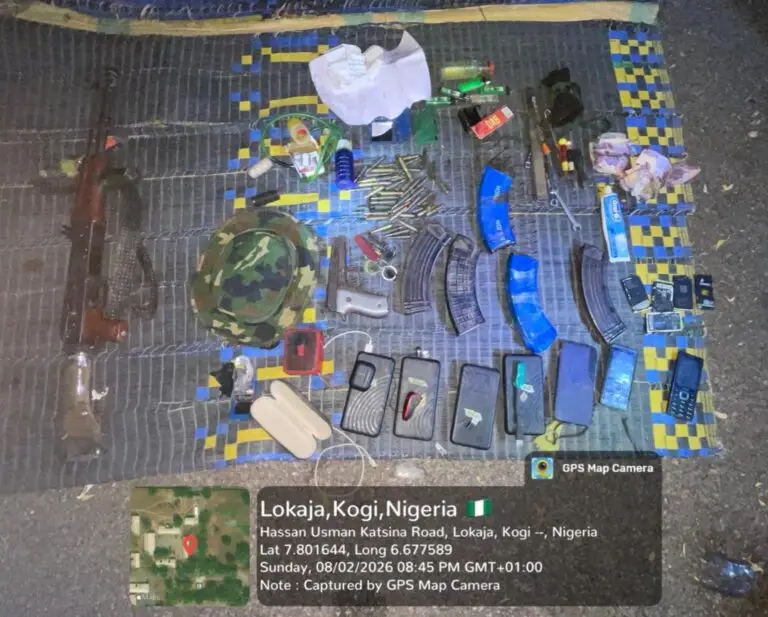
    In a related development, Fanwo said the troops of the Nigerian Army have overrun a terrorist enclave, recovering over 2,000 rounds of 7.62 x 54mm ammunition and a box of high-velocity grenades.

    Recovered Ammunition

    According to him, the operation, led by the Commander 12 Brigade Nigerian Army’, Brig. -Gen. Kasim Sidi, has significantly degraded the operational capacity of the criminal network.

    The operation, dismantled a camp linked to kingpins Kachalla Ibrahim and Shu’aibu. The camp was destroyed, denying terrorists a staging ground.

    Neutralised bandits by troops of 12 Brigade in Kogi

    Kogi State Security Adviser, Cdr Jerry Omodara (rtd), praised the military’s gallantry, saying terrorism won’t find sanctuary in Kogi .

    Fanwo gave an assurance that the state government is working with security agencies to end criminality, emphasising Gov. Ahmed Ododo’s commitment to protecting lives and property.

    “We are calling on religious leaders to cooperate fully with security agencies.

    “Our approach is not cowardice. We are mobilising security forces to overrun the criminals, and we are recording significant successes,” Fanwo said.

  • Troops rescue abducted victims, dismantle illicit activities nationwide – Army

    Troops rescue abducted victims, dismantle illicit activities nationwide – Army

    Rescue
    By Sumaila Ogbaje
    Abuja, Feb. 8, 2026 (FBN) Troops of the Nigerian Army have in the last 24 hours recorded major operational successes across multiple theatres, rescuing kidnapped victims, arresting criminal suspects and dismantling illicit activities nationwide.

    A reliable military source told the News Agency of Nigeria on Sunday that troops under Operation FANSAN YAMMA rescued four kidnapped victims during a fighting patrol at Yarsenta area in the North-West.

    The source said preliminary investigation revealed that the victims were abducted on Jan. 26 from Makera Village in Kankara Local Government Area of Katsina State and were safely recovered while wandering in the bush.

    The source added that troops had sustained aggressive patrols across Zamfara State, denying bandits freedom of action and reassuring local communities through continuous presence and intelligence-driven operations.

    According to the source, under Operation MESA, troops in Kogi, intercepted a surrendered bandit linked to notorious gang leaders, recovering a locally made gun and a mobile phone.

    In the South-South, the source disclosed that troops of the Joint Task Force arrested a suspected impostor attempting to gain access to a military formation, foiling a potential security breach.

    He said troops, in collaboration with the National Drug Law Enforcement Agency, also arrested four suspected drug peddlers in Delta, recovering quantities of cannabis and controlled substances.

    The source further revealed that troops destroyed an illegal crude oil refining site in Rivers, dismantling ovens, reservoirs and pipelines used for economic sabotage.

    He assured that the Nigerian army would continue coordinated operations to disrupt criminal networks, protect civilians and secure critical national assets.

  • Tinubu’s emergency pronouncement, continuation of efforts to review security architecture – TMSG

    Tinubu’s emergency pronouncement, continuation of efforts to review security architecture – TMSG

    Tinubu’s emergency pronouncement, continuation of efforts to review security architecture – TMSG


    ‎The Tinubu Media Support Group (TMSG) has described fresh measures announced by President Bola Tinubu in response to emerging security challenges as a continuation of his ongoing efforts to reorder and reposition the country’s security architecture.

    ‎In a statement signed by its Chairman, Emeka Nwankpa and Secretary, Dapo Okubanjo, TMSG maintained that the measures were a follow-up to decisive actions taken earlier by his government.

    ‎It said: “When President Bola Tinubu unveiled several measures after declaring a national security emergency, it was understandably received with applause with many people saying it was better late than never.

    ‎”However, we affirm that virtually all the steps in that pronouncement are follow-up actions to initial measures which many people did not pay attention to when they were first introduced.

    ‎”For the record, the President had left none in doubt about his readiness to boost the ranks of the Police as well as ensure better training facilities. Which was why long before now the Tinubu administration approved the upgrade of police training facilities across the country.

    ‎”Also, there was an approval for the recruitment of 30,000 new policemen since December 2024 but the police authorities now have a mandate to recruit an additional 20,000 personnel.

    ‎”And of course, getting more personnel into the armed forces is also a good move that will bolster the ranks of the military

    ‎”As part of the Tinubu administration’s initiative on security, the President had long before now approved the recruitment of forest guards who are now to be deployed by the Department of State Services (DSS) to protect the nation’s vast ungoverned forests against banditry.

    ‎”On State Police, this is not the first time President Tinubu would be speaking on it, despite apprehension among a section of the public. But what he now did was to rally the National Assembly to speed up the process using their legislative mandate.

    ‎”Nigerians can also easily recall that the President created a ministry of livestock development with a mandate to promote modern livestock practices. Now, after at least one year of operation, we consider it a good move to urge herders’ associations to engage with the ministry with a view to abandoning open grazing in favour of ranching.”

    ‎The TMSG said it was convinced that the students abducted in Niger State a few days ago would regain freedom without much delay.

    ‎”We are convinced that after ensuring the release of Nigerians abducted from Eruku in Kwara State and Maga in Kebbi State, respectively, the remaining students abducted from a Catholic school in Niger State would soon be released and be reunited with their parents.

    ‎”We urge Nigerians to continue to show faith in the President’s ability to handle the situation by remaining calm, and vigilant, while also cooperating with security personnel,” TMSG added.

  • COCOA PRODUCE BUYERS ASSOCIATION MEETS IN IFE SOUTH, MOVES TO CURB COCOA THEFT AND SUBSTANDARD TRADE

    COCOA PRODUCE BUYERS ASSOCIATION MEETS IN IFE SOUTH, MOVES TO CURB COCOA THEFT AND SUBSTANDARD TRADE

    By Lawal Abdullahi-Jubril

    Araromi Okeodo (Osun State): The Cocoa Produce Buyers Association of Nigeria, Ife South Local Government Chapter, held its local meeting on Tuesday, November 4, at Area 5, Araromi Okeodo, Osun State.
    The meeting took place at the residence of the chairman of Araromi Okeodo’s Produce Buyers, Mr. Mukaila Olawuyi, who also serves as the vice chairman of the association at the local government level.
    The secretary, Mr Sikiru Abioye, presented a report on the previous meeting held at Fadaka Village, Area 5,  before forwarding two key agenda items the association aims to achieve.
    A major issue discussed was the growing insecurity and rising cases of cocoa theft across villages and towns within the local government area.
    In response, the association announced several countermeasures designed to curb theft and promote transparency in the cocoa trade. These include:
    A ban on the purchase of wet cocoa beans.
    Prohibition of cocoa buying during late hours of the day.
    Stopping the use of congos for measurement instead of standard kilograms.
    Restriction on night-time transportation of dried or wet cocoa beans.
    The association also addressed the problem of substandard cocoa beans being traded in the market.
    A report from the local task force revealed the seizure of cocoa shaft purchased around several villages, allegedly to be mixed with raw cocoa beans — a practice that lowers quality and damages the reputation of local produce. Similar seizures have reportedly been made by the Osun State Task Force in various locations.
    Speaking during the meeting, Mr. Mukaila emphasized that only Grade 1 and Grade 2 cocoa beans meet the standard required by exporters and urged all members to maintain these quality levels.
    “This development will benefit the local government, the state, and the nation as a whole,” he said.
    Nigeria remains one of the largest cocoa-producing countries in the world, ranking behind Ivory Coast and Ghana in West Africa, and Indonesia globally.
    The association called on the local, state, and federal governments to support efforts in tackling insecurity and the trade of substandard cocoa. It also appealed for empowerment initiatives for youth, elderly citizens, produce buyers, and farmers to strengthen the agricultural sector. (flowerbudnews.ng)
  • CSOs cimmend Tinubu, NSO on security, back America’s disclaimer on Christians genocide in Nigeria

    CSOs cimmend Tinubu, NSO on security, back America’s disclaimer on Christians genocide in Nigeria


    Civil Society Organisations (CSOs), the *Inclusive Citizens Advancement Network (Inc-CAN)* and *Concerned Professionals Congress (CPC)* have given a thumps-up to President Bola Tinubu for leading Nigeria excellently well at the just-ended AQABA Process Heads of State high-level counter terrorism meeting in Rome, Italy.

    The CSOs in a review of the event particularly praised the delegation comprising some of the major drivers of the national security architecture, i. e, the minister of defence, Badaru Abubakar and the National Security Adviser (NSA) Nuhu Ribadu, who was accompanied by the national coordinator, National Counter Terrorism Center (NCTC), Major General Adamu Garuba Laka, and the director general, National Intelligence Agency (NIA),
    Ambassador Mohammed Mohammed.

    Also in the team were the minister of state for Foreign Affairs, Ambassador Bianca Odumegwu-Ojukwu, and other senior government officials.

    U.S President Donald Trump’s senior envoy, Massad Boulos’ dismissal of claims of Christian genocide in Nigeria which was another major positive fallout of the trip came in reaction to Republican Senator Tom Cruz’s ‘’Nigeria Religious Freedom Accountability Bill of 2025, a move to designate Nigeria as a ‘’Country of Particular Concern’’ (CPC) and impose sanctions on Nigerian officials which has already raised eyebrows among sections of the Nigerian polity.

    The swift dismissal of the contentious claims by Massad Boulos has introduced a sharp twist to the development thereby dousing the tension raised on the issue in the country.

    The concerned CSOs, in a joint statement in Abuja by Inc-CAN’s convener, Mr. Emeka Nwankpa and the Northern Regional Rapporteur of Concerned Professionals Congress (CPC), Baba Kasim Baba, hailed President Tinubu’s presentation at the event, describing it as ‘’brilliantly watertight’’ on Nigeria’s current highly impactful counter-terrorism initiatives.

    According to the CSOs, the swift dismissal by Pres.Trump’s senior advisor on Arab and African Affairs, Massad Boulous, of alleged state-sponsored Christian genocide in Nigeria threw the civil society community into a spontaneous frenzy, especially his valid assertion that terrorist attacks in Nigeria affected both Christians and Muslims equally if not more for the Muslims.

    Mr. Massad Boulous’ comments during his visit to President Tinubu on the sidelines of the Aqaba conference came amid growing calls by some U.S lawmakers urging the American government to designate Nigeria as a ‘’Country of Particular Concern’’ (CPC) over unproved genocidal claims. But the White House has yet to respond officially.

    Speaking to journalists after meeting with President Tinubu, Senior Envoy Massad Boulous maintained that terrorist attacks in Nigeria cut across ethnic and religious lines.

    ‘’Those who know the terrain well know that terrorism has no colour, no religion, no tribe. People of all religions and all trbes are dying as a result of terrorist attacks. Boko Haram and ISIS have actually killed more Muslims than Christians.

    ‘’People are suffering from all backgrounds. This is not specifically targeted at one group or the other. It’s not something that can be said to target any particular group’’, he said.

    He said that under President Tinubu, Nigeria had recorded tremendous progress in security across its diverse ethnic and religious groups that had coexisted for several decades.

    Mr. Emeka Nwankpa, in the statement by the CSOs endorsed the senior U.S presidential envoy’s assertion, describing it as a “frank and straightforward” commentary on Nigeria’s complex terrorism conundrum, noting that his assessment perfectly reflected the current reality in the country.

    ‘’The Senior U.S presidential advisor could not have put it any better. The truth is that purveyors of the genocide claims are either ignorant or dishonest or both. Nigeria’s complex security dynamics is far below the acceted United Nations definition of a genocide. There’s no correlation whatsoever.

    ‘’The mass killings being cited are not targeted against any specific religious group. Therefore drumming up claims of genocide is dumb and divisive. Besides, coming from external forces at this time that our defense forces are winning the war on terror is suspect. These are people that don’t want Nigeria’s unity. Our fellow patriotic Nigerians should be wary of them.

    ‘’They portray extreme ignorance of Nigeria’s internal dynamics where multifaceted conflicts, and not religion, are driven by criminality, ethnic rivalries, land disputes, etc.

    ‘’Since 2009, the sectarian Boko Haram has waged a relentless senseless war against the Nigerian state, not against any religion but mostly Muslims as its victims. Claims of one-sided persecution are just a simplistic narrative which the foreign commentators must understand before jumping into conclusion.

    ‘’To push these conflicts as evidence of Christian genocide as U.S Republican Senator Cruz and his cohorts in the American Congress are doing clearly distorts the reality and advertises their collective chicanery’’, Nwankpa said.

    ‘’In our view, a major danger is the often uninformed and sometimes mischievous media which present Boko Haram as fighters of Islam whereas they are a ragtag group alongside ISWAP and their bandit groups which are despised by both Muslims and Christians alike.

    ‘’Whoever opposes them, regardless of faith, is marked as enemy hence their offer mindless, violent and indiscriminate bombings of mosques, churches and killing of Muslims and Christians alike. To call this ugly spectacle as anti-Christian is pure propaganda.

    ‘’It is necessary to contextualize the issue. President Tinubu in May 2023 inherited a nation blighted by this brutal Islamist insurgency led by Boko Haram and its offshoot-Islamic State West African Province (ISWAP).

    ‘’The president’s crack team of capable military and security chiefs working with ex-EFCC chairman, NSA Nuhu Ribadu, and the NCTC national coordinator has designed and executed layers of new counter terrorism measures, and simultaneously prioritizing fights against Boko Haram in the northwest, farmer-herder conflicts nationwide, Indigenous People of Biafra (IPOB), and oil robbers in the south-south.

    ‘’Our gallant troops have sustained operational successes securing every inch of the Nigerian space through improved counter-terrorism, anti-banditry, anti-kidnapping, maritime security, and joint internal operations on the battlefield.

    ‘’The NCTC’s Multi-Agency Anti-Kidnapping Fusion Cell (MAAKFC) which was built in partnership with U.K’s National Crime Agency has made a difference as several kidnap victims are being rescued incrementally to the satisfaction of many affected Nigerian families.

    ‘’In real terms, the coordination by the NCTC-ONSA under Maj Gen Adamu Laka, in synergy with Defence Headquarters (DHQ) under Chief of Defence Staff, General Christopher Gwabin Musa leading the military chiefs, have since changed the narrative.

    ‘’We may not yet be where we want, but we are definitely not where we were. The new measures have continued to change the narrative in just a little over two years of President Tinubu in the saddle.

    ‘’There’s no perfect security anywhere, but the good news is that the country is getting safer notably the once-dreaded Abuja-Kaduna highway and the Birnin Gwari axis. Today, U.K has lifted its travel advisory to her citizens plying that axis as a result of highly improved security.

    ‘’Also, free movement of citizens, goods and services are being increasingly recorded in parts of the country where insecurity had hitherto imposed zero movement.

    ‘’This year’s AQABA meeting in Rome is viewed against Nigeria’s internal security outlook showing gradual rise, according to a recent Channels Television’s Nigeria Security Perception Index for September 2025 which indicated 50 percent respondents in Northern Nigeria and 57 percent in Southern Nigeria saying security was improving.

    ‘’Across the six geopolitical zones, the perception index rose between February and September. The North East improved from 52 to 56 percent, the South South climbed from 55 to 57 percent, while the North Central moved from 39 to 47 percent.

    ‘’The South West maintained a steady perception of 61 percent. Analysts attribute the progress to intensified coordination of operations by the nation’s security and military forces bouyed by precision intelligence-led strikes, and reductions in large-scale oil theft and mass kidnappings recorded in recent months.

    ‘’However, security forecasts for the last quarter of 2025 point to potential challenges. The Nigeria Security Outlook for Q4 2025 projects that insurgent attacks may persist in the Lake Chad Basin, while opportunistic assaults on schools, highways and religious institutions could occur.

    ‘’There are also concerns that bandit networks in the Northwest were adapting to recent military offensives. Spiked kidnap risks are envisaged in December due to anticipated increased travel and citizens’ migratory movements, with ransom kidnapping posing a key risk factor. But overall, analysts believe there’s hope in the horizon for a safer, more secure and stable polity.

    ‘’For example, the forces have neutralised over 1,600 terrorists, over 124, 000 fighters and their families surrendered, over 11,000 weapons and 252, 000 ammunitions confiscated in the northeast.

    ‘’The arrest of IPOB Commander, Ifeanyi Eze Okorienta, widely known as ‘’Gentle De Yahoo’’ has brought some normalcy to the southeast where the sit-at-home order are beginning to eclipse. More arrests of notorious criminals are still being made as several others are neutralised incrementally by our forces’’, said Nwankpa.

    Commenting, NSA Nuhu Ribadu has continued to express his satisfaction over the successes while restating President Tinubu’s commitment to ridding the country of every trace of criminality. He further disclosed that terrorism-related deaths had tumbled down from 2, 600 a month before May 2023 to a fewer than 200 today.

    In late August, he announced the rescue of 128 hostages in Zamfara State while DHQ also disclosed that security forces in 2024 killed over 3,100 terrorists, arrested 2,500 suspects, and freed more than 1,600 kidnapped victims.

    The Nigeria Police Force reported the rescue of 1,581 hostages and arresting over 30,000 suspects for various offences.

    Nuhu Ribadu further disclosed that between May 2023 and early 2025, more than 13,500 terrorists and armed criminals were neutralised, while over 124,000 insurgents and their families surrendered.

    Also, over 11,000 were rescued, and nearly 3,843 illegal refineries – key to the funding of insurgent and criminal activities – were dismantled nationwide. Significantly, the numbers point to a strategic shift to taking the fire into the enemy camp.
    Inside ONSA sources said that the new innovative MAAKFC has been a game changers in dismantling the enemy camps through the cell which collates actionable intelligence to coordinate rescue missions, track financial trails and impound same.

    Since its debut in December 2024, MAAKFC which is a crack collection of highly trained personnel of the military, para-military, intelligence, police, judicial and allied agencies, has achieved an 80% success rate in combating kidnap across the multi-million naira industry in the terror financing value chain. MAAKFC has successfully dismantled the entire architecture of the sophisticated kidnap business.

    Copious evidence of the gains are emergent, from settlements and communities in Southern Kaduna, long plagued by killings and abductions such as Birnin Gwari which is now in relative peace. Also in Zamfara State, a location once locked down by bandit warlords, the story has changed dramatically.

    The DHQ has almost concluded plans to open a another camp in Tsafe for its Operation Safe Corridor (OPSC), ten years after establishing its pioneer camp in Mallam Sidi in Gombe State for its Deradicalization, Rehabilitation and Reintegration (DRR) program for surrendered ex-Boko Haram fighters.

    In the Southeast, the unknown gunmen conundrum which had once paralysed daily business life with mind-boggling violence and Monday sit-at-home orders, have beaten a quick retreat in the volatile region owing to DHQ’s multi-pronged aggressive military operations in the zone.

    In the Northwest where banditry has killed more than 12,000 people and displaced entire farming communities, the counter-terrorism gains are also visible.

    The spectacular arrests of the Ansaru terrorist kingpins, Mahmud Muhammad Usman, the self-styled “Emir of Ansaru” his deputy Mahmud al-Nigeri (Malam Mahmuda), elimination of notorious warlords like Ali Kachalla, Halilu Sububu, and Boderi, alongside mass surrenders under the non-kinetic initiatives code-named the “Kaduna Model”, have shot down mass abductions.

    Though isolated attacks against soft targets occur as last kicks of a dying horse, the frequency and scale of kidnappings have since reduced.

    Senior Presidential Envoy Massad Boulous, an American-Lebanese citizen whose son is married to President Trump’s daughter commended President Bola Tinubu’s administration for increasing security efforts in volatile regions, noting that recent security improvements showed that the government’s measures were impacting positively.

    “The Nigerian government has recently taken additional measures and put more resources in those areas. We’ve seen some improvements in recent weeks. We appreciate those measures, and we definitely look forward to more of those,” he said.
    He praised Nigeria’s long-standing record of religious coexistence, saying that its diversity should continue to be a source of strength rather than division.

    “Nigeria is a country in which all sorts of religious groups and other groups, ethnic and tribal, are living together in harmony for centuries. The population is split 50-50 between Christians and Muslims, so this has never been a serious religious issue and should not be,” he said.

    He called for continued partnership between Nigeria and the United States to eliminate terrorism and sustain peace across all regions.

  • Democracy without Voters and Nigeria’s Insecurity Crisis

    Democracy without Voters and Nigeria’s Insecurity Crisis

    By Chidi Anselm Odinkalu

    “On matters of security, the bulk (sic) stops at the President’s table.” Bola Ahmed Tinubu, April 2014

    On 26 January 2009, Mamman Bello Ali died. He was the governor of Yobe State in north-east Nigeria. Around the same time, an anti-terrorism campaign by the government of Nigeria in Yobe State and its neighbour, Borno State, was about to make a murderous transition into a full-blown war against insurgency. As Governor Mamman Ali made his earthly transition in a Florida hospital, his deputy, Ibrahim Gaidam assumed office on the same day as the new governor of Yobe State. Today, as Minister of Police Affairs in the federal government, Governor Gaidam, whose life in politics has included a stint as a member of the Senate, has high responsibility for policing the country. He is so ineffectual in this role that few Nigerians notice his existence.

    Around 9 November 2014, a suicide bomber dressed as a student detonated himself in the middle of a school assembly at the Government Boys Secondary School in Potiskum, Yobe State. The police confirmed that the attack “left 47 people dead, including the suicide bomber. Another 79 were wounded. Dozens of students were injured so severely that medics were unable to save them.” It was a tragedy on an unspeakable scale. The blame for the attack fell on Jama’atu Ahlis-Sunna Lidda’Awati Wal-Jihad (the Islamist insurgency better known as Boko Haram). Ibrahim Gaidam was still the Governor.

    The following day, President Goodluck Jonathan’s campaign was in full swing as he sought the support of the country for his re-election in 2015 under the banner of the then ruling Peoples’ Democratic Party (PDP). The All Progressives Congress (APC), then newly formed as an opposition Alliance, was quick to take political advantage. It described Jonathan’s campaign launch as “insensitive and callous” and accused him and the PDP of “dancing on the graves of the pupils (and) all the victims of Boko Haram insurgency.” The APC took the opportunity to recall another mass-casualty bombing incident in Nyanya on the outskirts of Abuja in April 2014 and said that following that incident, “President Jonathan went dancing ‘Azonto’ in Kano less than 48 hours later.”

    From 2009 to 2014, when Islamist violence of Boko Haram in north-east Nigeria transitioned into deadly insurgency, the PDP was in power. Educational infrastructure bore a major brunt of the attacks by the group which built a brand in murderous violence by campaigning against Western education. The worst-affected states – Borno and Yobe – happened to be outside the orbit of the ruling party. In the half-decade to 2014, the violence led to at least 611 teachers reportedly killed and another 19,000 other persons forced to flee. In 2014 alone, the insurgency killed over 6,644 persons in the affected states.

    In May 2014, the United Nations Security Council listed Boko Haram as a terrorist organisation. Three years earlier, the Gaji Galtimari Presidential Committee on the Security Challenges in the North-East Zone of Nigeria had reported that the group “started as an innocuous non-violent group” around 2003.

    The rise in Boko Haram’s campaign of mass-casualty violence was both new and shocking. The response of the then-ruling government appeared slow, ponderous, and mal-adapted. It was also the political season. The escalation in the attacks and killings from the Islamist insurgency in north-east Nigeria in 2014 coincided with the run-up to Nigeria’s 2015 general elections.

    For the PDP in power at the time, it was a struggle to manage the optics of campaigning in the midst of growing carnage. The APC, then a new opposition formation, relished in its role, making political capital out of the situation. Its forceful critique of the PDP’s management of the Boko Haram insecurity, or lack of it, was central in ensuring the defeat of the ruling party in the 2015 election.

    The popular narrative of Muhammadu Buhari, the APC candidate for the presidency in 2015, as a no-nonsense soldier did more than any other thing in reassuring Nigerians that the party would bring competence to the handling of the crisis of insecurity in the country. Instead, since then, insecurity in Nigeria has metastasized under the successive presidencies of President Muhammadu Buhari and his successor, Bola Ahmed Tinubu.

    The violence, which was mostly confined in the states of the north-east a decade ago, has become hydra-headed under various nomenclatures all over the country.

    In its latest Conflict Barometer (2024) report, the Heidelberg Institute for International Conflict Research identified at least 10 sites of active, conflict-related killings in Nigeria, at least five of which fall into the highest classifications of seriousness.

    In the north-east, Boko Haram has mutated into a confederacy of mass-murder under different appellations, each seeking supremacy in an Olympiad of mass-casualty violence.

    In North-Central Nigeria, the ruling APC chose to mischaracterise as “farmer-herder” clashes, a methodical campaign of land-grabbing by people described by the government mostly as “foreigners.” Under the watch of the APC government, in 2021, the north-west overtook the northeast in mass-casualty atrocities. Unable to manage the situation in the region, the government took to labelling the perpetrators of the atrocities in the north-west as “bandits.”

    Unlike the north-east, where improvised explosive devices (IEDs) and suicide bombers were major features of the insurgency, the major items in the violence in the north-west are motorbikes and Kalashnikovs. Yet, the government cannot account for how these bikes and guns get into the hands of those who use them to habitually liquidate Nigerians on an industrial scale.

    Kaduna was central in this shift. Installed in power in 2015 in the APC Tsunami as the new Governor of strategically significant Kaduna State, Nasir El-Rufai, was voluble in promoting mass-murder as profitable, incredibly proclaiming on national television how he paid the killers of Nigerians in order to encourage them to stop killing. The casual malevolence of his proferred justification was beyond shocking: “We got a group of people that were going round trying to trace some of these people in Cameroon, Niger and so on to tell them that there is a new governor who is Fulani like them and has no problem paying compensations for lives lost and he is begging them to stop the killing.”
    Even worse, the mismanagement of insecurity under the APC government has smacked a level of indifference, cynicism, and lack of empathy that the PDP would never have imagined.

    Last week, all of this was on show. Forced by public opinion finally to re-route himself to visit victims of mass liquidation in Benue State, in Nigeria’s Middle Belt, President Bola Ahmed Tinubu first had children line up in the rain to be splashed with mud by his majestic convoy before the obligatory serenading from uniformed women living in internal displacement from the violence.

    It was right out of the manual of political narcissism jointly authored by Louis VIX and Marie Antoinette. While the country burns, the president has curiously eloped to Saint Lucia, a territory of about 179,000 persons described by the Global Organised Crime Index as “a key Caribbean transit hub for cocaine shipments bound mainly for the US, Europe or Canada.” To Nigerians concerned about the optics of all this, it is as if all he can offer is the middle finger.

    The only thing more abysmal than the indifference of the ruling APC government to the current crisis of mass-murder across the country has been the disgraceful abdication by the political opposition. Amid all the carnage, little has been heard from them. Instead, opposition politicians have been hyper-active in the political transfer season, herding into the APC.

    Those who expect the police, armed and security services, to shoot the country out of this crisis are unlikely to get their wish. The durability of Nigeria’s insecurity crisis is essentially a crisis of irresponsible political leadership.

    The security services can only implement a strategy set by the politicians. At the moment, the politicians are fixated on the 2027 elections. By then, in many parts of Nigeria, no voters may be left, and many of those in place would have been displaced from their voter cards. However, politicians do not have to care because they do not need voters to get into office. That is the original sin of insecurity in Nigeria.

    A lawyer and a teacher, Odinkalu can be reached at chidi.odinkalu@tufts.edu