Tag: NAFDAC

  • NAFDAC, NEPZA strengthen oversight in free trade zones

    NAFDAC, NEPZA strengthen oversight in free trade zones

    (Dr. Olufemi Ogunyemi, NEPZA Managing Director)


    – NAFDAC remains committed to monitoring the importation, exportation, production, and distribution of pharmaceuticals, food products, cosmetics, and other regulated consumables within the zones – Prof. Adeyeye


    By Lucy Ogalue

    Abuja:  The National Agency for Food and Drug Administration and Control (NAFDAC) and the Nigeria Export Processing Zones Authority (NEPZA) are strengthening joint oversight within Nigeria’s free trade zones.

    The collaboration focuses on pharmaceutical and consumable products manufactured by enterprises operating in the zones.

    The Director-General of NAFDAC, Mojisola Adeyeye, disclosed this during a visit to the Managing Director of NEPZA, Olufemi Ogunyemi, at the authority’s headquarters in Abuja.

    Adeyeye said the visit was aimed at deepening collaboration and partnerships that would enable NAFDAC to effectively discharge its regulatory responsibilities within the free trade zones nationwide.

    According to her, the agency remains committed to monitoring the importation, exportation, production, and distribution of pharmaceuticals, food products, cosmetics, and other regulated consumables within the zones.

    “We must view this meeting as a responsibility we have to the country to protect citizens from fake drugs and consumables infiltrating our markets from known and unknown destinations,” she said.

    The NAFDAC boss said the agency had consistently insisted on strict testing procedures and compliance with approved standards to guarantee quality control across regulated manufacturing and export industries.

    She emphasised the strategic importance of the free trade zone scheme to Nigeria’s industrialisation drive and broader economic growth objectives, particularly in manufacturing and export promotion activities.

    However, Adeyeye said stronger monitoring mechanisms were necessary to ensure the safety, efficacy, and quality of products entering Nigeria’s customs territory from the free trade zones.

    “NEPZA and NAFDAC can fix this misalignment by jointly insisting on compliance.

    “We can close this gap through excellent facility management and improved inspection across production lines,” she said.

    Responding, Ogunyemi welcomed the collaboration, describing it as critical to addressing alleged irregularities associated with medical supplies and consumable products originating from enterprises operating within the free trade zones.

    According to him, the free trade zone scheme, comprising 63 zones and more than 900 enterprises, remains a major gateway for industrial growth, investment attraction, and national economic development.

    The NEPZA managing director, however, acknowledged that regulating operations within the zones still presented significant challenges requiring stronger inter-agency collaboration and improved enforcement mechanisms.

    “We need a joint effort to address some of the irregularities. We will allow NAFDAC to perform its regulatory functions because the public’s health depends on it,” he said.

    Ogunyemi added that NEPZA remained committed to ensuring that free trade zones were not used as safe havens for illicit activities or the circulation of substandard products.

    “We fully endorse this partnership and collaboration, which has the potential to enhance the scheme’s global compliance across all production and export activities for the benefit of the country,” he said.

    The meeting also featured the confirmation of an eight-member technical committee to examine challenges affecting seamless regulatory operations between both agencies within the nation’s free trade zones.(NAN)(www.nannews.ng)


  • NAFDAC Signs MoU with FCCPC to Enhance Mechanism for Safeguarding Public Health, Consumer Wellbeing

    NAFDAC Signs MoU with FCCPC to Enhance Mechanism for Safeguarding Public Health, Consumer Wellbeing


    –  For consumers, the benefits of NAFDAC – FCCPC Partnership are clear as it will ensure simpler complaint processes, faster resolution of issues, and stronger enforcement where standards are not met.


    By Biola Lawal
    Abuja (Flowerbudnews): The National Agency for Food and Drug Administration and Control (NAFDAC) has signed an MoU with the Federal Competition and Consumer Protection Commission (FCCPC) to strengthen regulatory framework for safeguarding public health.

    Flowerbudnews reports that the Memorandum of Understanding (MoU) was signed by NAFDAC Director General, Prof. Mojisola Adeyeye and Executive Vice Chairman of FCCPC, Tunji Bello during the NAFDAC DG’s visit to FCCPC headquarters in Abuja.

    s also designed to reduce overlapping functions between both agencies

    Speaking during the signing ceremony, Prof. Adeyeye, described the agreement as a catalyst for renewed collaboration, synergy, and cooperation between NAFDAC and FCCPC in the discharge of their respective mandates.

    She noted the collaboration woas a renewed effort to also reduce overlapping functions between both agencies.
    .
    The NAFDAC Boss stressed that the MoU was also aimed at protecting consumers, safeguarding public health, and ensuring the quality, safety, and efficacy of regulated products.

    Prof. Adeyeye also emphasised the need for strong commitment to the implementation of the MoU, particularly in the areas of investigation, information sharing, and consumer protection.

    In a shared commitment, both agencies agreed to establish regulatory mechanisms that would ensure efficient and effective collaboration towards the full implementation of the agreement.

    The MoU, which is expected to run for an initial period of four years, will be subject to review and renewal by both parties.

    Also speaking at the event, the FCCPC Executive Vice Chairman commended the passion and determination of the NAFDAC Director-General, in facilitating the signing of the MoU.

    According to him, the agreement represented a deliberate step towards coordinated regulation in Nigeria’s consumer market and a stronger institutional partnership in protecting consumer rights and public interest.

    Mr. Bello noted that, while the mandates of both agencies are clearly defined by law, their functions increasingly overlap in practice.

    He explained that the agreement outlined  mechanisms for information sharing, ensuring both organisations have timely access to data required for investigations, policy development and enforcement.

  • NAFDAC DG presents 7-year scorecard, signs Africa medicines treaty

    NAFDAC DG presents 7-year scorecard, signs Africa medicines treaty

    -Africa Medicines Agency treaty, Adeyeye will strengthen collaboration and  battle against falsified drugs across Africa – Prof. Adeyeye 

    By Aderogba George

    Abuja:   The Director-General of the National Agency for Food and Drug Administration and Control (NAFDAC), Prof. Mojisola Adeyeye, on Tuesday presented the agency’s seven-year scorecard, highlighting reforms in food and drug regulation.

    Adeyeye also unveiled Nigeria’s treaty with the African Medicines Agency (AMA), aimed at strengthening regulatory systems and curbing substandard and falsified products across Africa.

    The News Agency of Nigeria (NAN) reports that the event, titled “Safeguarding the Nation’s Health, Empowering Progress,” also highlighted the Federal Government’s Renewed Hope Agenda on healthcare transformation and pharmaceutical sovereignty.

    Adeyeye said the event was to showcase NAFDAC’s progress since November 2017.

    According to her, “the overall crown of the event is the joining of force with AMA to further strengthen the system to curb the movement of substandard and falsified food and drugs within the Africa sub-region”.

    She urged Nigerians to avoid unapproved drug vendors.

    “Buy medicines from pharmacy. Get your receipts. The manufacturers are now better sensitised that they cannot just take their medicines to open market.

    “If they do, they better know the open market because we will be coming after the open market,” she said.

    Adeyeye noted improvements in compliance within the sector.

    “In terms of change, the manufacturers are already changing. We have low risk, medium risk, high risk. The high risk are becoming medium risk. The medium risk is becoming low risk, and the health of our people will be better for it”.

    She emphasised that reform is gradual and requires public cooperation.

    “In terms of substandard falsified medicines, you don’t deal with companies that are not registered with NAFDAC. Don’t buy medicines from them.

    “Please ask them to show you their registration. If it is retail, go to pharmacies where you get receipts. When you feel the medicine doesn’t work, bring it to NAFDAC, we will take it up,” she said.

    On the treaty, Adeyeye said it would strengthen collaboration across Africa.

    “If a country doesn’t have manufacturing facility, they can come to another country that has manufacturing facility to buy or do contract manufacturing.

    “We are working together as a continent to harmonise and ensure African standard, not Nigerian standard but international standard,” she said.

    Also speaking, the Director-General of AMA, Dr Mimi Darko, said the agency, backed by the African Union (AU), would benefit from Nigeria’s participation.

    “With Nigeria joining strength with AMA, we believe we will witness better administration, we will achieve our goals. Nigeria is a strong ally in the Africa continent,” Darko said. (NAN) www.nannews.ng

  • NAFDAC intensifies fight against fake drugs with digital innovation- Official

    NAFDAC intensifies fight against fake drugs with digital innovation- Official


    By Amina Ahmed
    Bauchi,The National Agency for Food and Drug Administration and Control (NAFDAC) says it’s strengthening regulatory operations through technology-driven tools and intensifying surveillance to combat substandard and falsified medicines.:

    Mr Khamis Yahaya, the Bauchi State Coordinator of the agency, said this in an interview with the News Agency of Nigeria (NAN) on Tuesday in Bauchi.

    Yahaya said that the agency had adopted several digital innovations to improve reporting, verification and tracking of regulated products.

    According to him, the Med Safety App enables users to report adverse drug reactions and post-immunisation events, even in areas with poor network coverage, as reports are automatically transmitted once connectivity is restored.

    “The NAFDAC Green Book App allows consumers, healthcare workers and other stakeholders to verify registered products by checking details such as registration status, manufacturer information, active ingredients, batch numbers and expiry dates.

    “The agency also conducts risk-based sampling and laboratory analysis, where products are collected from markets and tested in accredited laboratories.

    “The regulatory actions, including public alerts, product recalls and enforcement measures are taken when products fail to meet required standards,” he said.

    Yahaya, however, identified challenges in drug storage and transportation, particularly for temperature-sensitive medicines.

    “Some temperature-sensitive drugs are found improperly stored on shelves. Poor storage conditions and lack of cold-chain systems often lead to reduced drug potency,” he said.

    He said that the agency also monitors distribution practices, noting that unsafe transportation methods remain a major concern in the supply chain.

    “The agency conducted over 25 surveillance inspections within a single month. The exercise is continuous and mandatory, even without prior alerts.

    “It also engages in community sensitisation, targeting patent medicine vendors and other drug sellers.

    “In 2025, the agency held sensitisation programmes in Bauchi and Katagum, with over 500 participants in attendance, aimed at educating sellers on proper handling of medicines and encouraging compliance with regulatory standards,” he said.

    The NAFDAC coordinator said that the agency also works closely with the media to educate consumers on fake and substandard products.

    “Empowering consumers remains a key strategy. Public awareness has significantly improved in recent years, with more people now able to check expiry dates and verify product authenticity,” he said.

    Yahaya noted that the agency recorded notable progress in 2024 and 2025, including improved awareness and reduced circulation of falsified medicines.

    He attributed the success to sustained enforcement, technology deployment and public engagement.

  • Workers Day: NAFDAC DG Commends Nigerian Workers’ Dedication, Professionalism

    Workers Day: NAFDAC DG Commends Nigerian Workers’ Dedication, Professionalism

    (NAFDAC DIRECTOR GENERAL, Prof Mojisola Adeyeye at a public function)


    By Biola Lawal
    Abuja (FLOWERBUDNEWS) The Director General of the National Agency for Food and Drug Administration and Control (NAFDAC), Prof. Mojisola Adeyeye has rejoiced with Nigerian Workers’ on the occasion of the year 2026 global workers day celebration.

    In a public statement to mark the International occasion, Prof. Adeyeye commended Nigerian Workers’ dedication, resilience, and professionalism across all sectors.

    The NAFDAC Boss lauded the workers further, saying;
    ”we rocognise the vital role you play in driving development, safeguarding public health, strengthening our economy.”

    ”At NAFDAC, we remain committed to upholding standards that ensure safe, high-quality, and well-regulated products, supporting a healthier and more productive workforce,” Prof. Adeyeye stated.

    Particularly commending NAFDAC staffers, Prof. Adeyeye declared; ”to every worker contributing to a safer and stronger Nigeria, we say thank you.”

    The Workers Day is globally competitive marked on 1st May of every year to acknowledge and appreciate the contributions of workers to humanity worldwide.


  • NAFDAC inaugurates Kano task force to tackle fake drugs, unsafe foods

    NAFDAC inaugurates Kano task force to tackle fake drugs, unsafe foods


    By Ramatu Garba

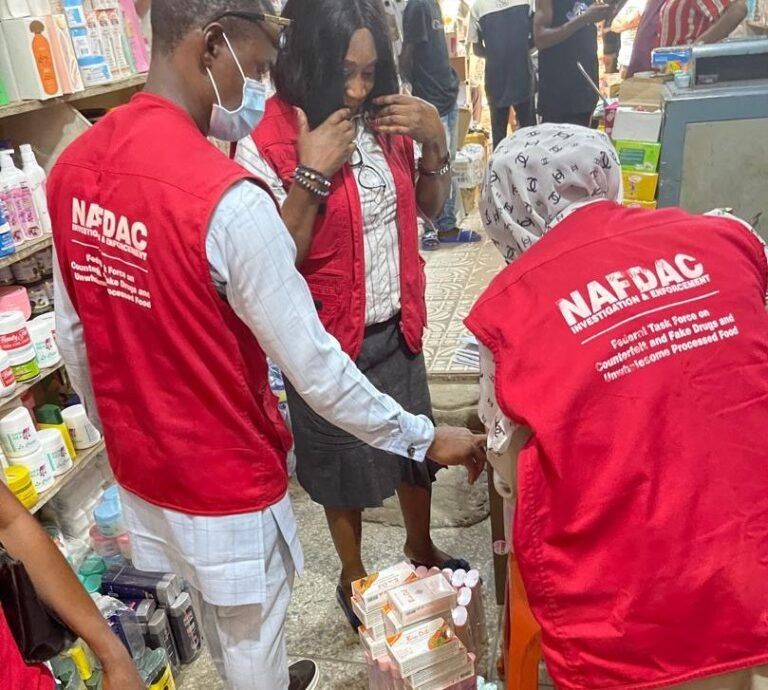
    Kano:   The National Agency for Food and Drug Administration and Control (NAFDAC) has inaugurated a Kano State Task Force Committee to combat fake, counterfeit and unwholesome processed food products and drugs.

    Director-General of NAFDAC, Prof. Mojisola Adeyeye, speaking at the inauguration on Tuesday in Kano, said the initiative was a strategic move to strengthen enforcement against substandard regulated products and protect public health across Kano.

    Adeyeye, represented by the NAFDAC Director, North-West Zone, Kaduna, Mr Fraden Nantim-Mullah, said the task force operated under the agency’s Investigation and Enforcement Directorate as a federal operational arm.

    She warned that counterfeit drugs and unsafe foods posed serious public health risks, undermined confidence in the healthcare system, and threatened national development and economic stability if not addressed decisively.

    According to her, Kano’s status as a major commercial hub made it vulnerable to the manufacture, importation, and distribution of substandard and falsified products across local and regional markets.

    She said the task force would conduct intelligence gathering, surveillance, enforcement operations, seizure of illegal products, arrests, prosecution of offenders, and public sensitisation to reduce circulation of fake products.

    Adeyeye added that the initiative was backed by the Counterfeit and Fake Drugs and Unwholesome Processed Foods Act, empowering enforcement agencies to take decisive legal action against offenders nationwide.

    She urged members to carry out their duties with integrity, professionalism, and courage to safeguard public health and ensured compliance with national regulatory standards in the state.

    Kano State Secretary to the Government, Umar Farouk-Ibrahim, said the reconstitution of the task force was necessary to address rising drug abuse and counterfeit products affecting communities.

    He said drug addiction remained a serious social challenge, noting that youths constituted more than 60 per cent of the state’s population and were most affected by illicit substances.

    He warned that recent reports of families seeking rehabilitation for children reflected the urgent need to disrupt supply chains of fake drugs and unwholesome products across the state.

    Farouk-Ibrahim assured government support for the task force, urging members to resist inducement and remain committed to enforcing regulations without compromise or interference from vested interests.

    He announced Mr Kamilu Mudi-Salisu as chairman of the committee, with members drawn from security, justice, health, and regulatory agencies to strengthen coordinated enforcement efforts across Kano.

    NAFDAC’s Director of Investigation and Enforcement, Dr Martins Iluyomade, said Kano remained a critical hub in Nigeria’s fight against counterfeit medicines, especially anti-malaria and other essential drugs.

    He warned that many counterfeit medicines contained no active ingredients, describing the situation as a silent but deadly threat causing avoidable deaths across communities in Nigeria.

    Iluyomade revealed that eight containers of cloned medicines were recently intercepted, with Kano identified as their intended destination for distribution within local markets.

    He called for sustained collaboration among federal and state authorities, warning against pressure from vested interests that might attempt to frustrate enforcement operations.

    Chairman of the task force, Mr Mudi-Salisu, pledged commitment to reducing fake drugs and unsafe foods, urging public cooperation and reporting of suspicious activities across communities.

    He said the task force was empowered to conduct raids, seize illegal products, seal premises, and prosecute offenders in line with existing national laws and regulations.(NAN)(www.nannews.ng)

  • NAFDAC Stakeholders Laud Prof Adeyeye, says her Policy Initiatives Enhanced Local Drug Production, Quality and Safety

    NAFDAC Stakeholders Laud Prof Adeyeye, says her Policy Initiatives Enhanced Local Drug Production, Quality and Safety


    (NAFDAC Director General, Prof. Mojisola Adeyeye)


    By Biola Lawal
    Flowerbudnews: NAFDAC Stakeholders have commended Prof. Mojisola Adeyeye, noting that her leadership has strengthened Nigeria’s pharmaceutical sector through policy initiatives that promoted quality, safety, and local capacity development

    The encomiums were heaped on Prof. Adeyeye by the stakeholders during the commissioning of Sam Pharmaceuticals Manufacturing Facility in Lagos.

    Stakeholders at the event noted that NAFDAC’s 5+5 Policy has been instrumental in driving increased local manufacturing, contributing to a rise in domestic pharmaceutical production.

    They further acknowledged that the Agency’s regulatory reforms and commitment to global best practices had enhanced investor confidence and supported industry growth.

    On her part. Prof. Adeyeye noted that the commissioning of the Sam Pharmaceuticals Ltd’s manufacturing facility is ”a significant milestone in advancing local pharmaceutical production in Nigeria.’

    The NAFDAC Boss reaffirmed her Agency’s commitment to fostering a robust and self-sufficient pharmaceutical sector.

    She said that NAFDAC would continue to work hard to , ensure the availability of safe, effective, and affordable medicines for Nigerians.

    Prof. Adeyeye emphasised that sustained collaboration between regulators and industry players remained critical to achieving national drug security and improved healthcare outcomes.


  • NAFDAC HELD MEETING WITH STAKEHOLDERS AND PARTNERS ON REDUCTION OF SODIUM IN PRE-PACKAGED FOODS REGULATIONS 2026

    NAFDAC HELD MEETING WITH STAKEHOLDERS AND PARTNERS ON REDUCTION OF SODIUM IN PRE-PACKAGED FOODS REGULATIONS 2026


    By Sayo Akintola

    The Director General of the National Agency for Food and Drug Administration and Control NAFDAC, Prof Mojisola Adeyeye has cautioned Nigerians against excessive sodium intake to avoid diet-related non-communicable diseases such as hypertension, cardiovascular diseases, and stroke which she said are on the rise globally and within Nigeria.

    Prof Adeyeye gave the admonition at a stakeholders’ engagement on the draft NAFDAC Reduction of Sodium in Pre-Packaged Foods Regulations 2026 where she noted that excessive sodium intake has been identified as one of the leading dietary risk factors contributing to these conditions.

    According to her, the World Health Organisation has continued to emphasize sodium reduction as one of the cost-effective strategies for improving population heath and preventing premature deaths from non-communicable diseases.

    In Nigeria, Prof Adeyeye said, changing dietary patterns, rapid urbanisation, and increased consumption of processed and pre-packaged foods have significantly contributed to higher sodium intake among our population.

    She added that recognising this emerging public health concern, the Federal Government – through the Federal Ministry of Health and Social Welfare and NAFDAC – has taken proactive steps to address this challenge.

    She maintained that the Reduction of Sodium in Pe-Packaged Foods Regulations 2026 is a key component of broader strategies to promote healthier diets and prevent non-communicable diseases, adding that these regulations aim to establish maximum sodium limits in selected categories of processed and pre-packaged foods, ensure clear and transparent labelling of sodium content, and encourage product reformulation by food manufacturers so that consumers can make healthier dietary choices.

    The NAFDAC boss, however, pointed out that, regulations alone cannot achieve the desired impact without the active participation of all stakeholders, stressing that the food industry especially plays a central role in reformulating products to reduce sodium content while maintaining safety, quality, and consumer acceptability.

    At the same time, she emphasized that regulators, researchers, public health advocates, and consumer organisations must work collaboratively to ensure implementation, monitoring and compliance.

    Cardiovascular Unit, University of Abuja that was present at the Meeting has worked closely with the FMOH&SW and NAFDAC on sodium reduction is in support of the regulations.

    Partners such as Network for Health Equity and Development NHED resolve to Save Lives and Corporate Accountability and Public Participation Africa CAPPA who were present and supported the stakeholders’ engagement underscored the importance of reducing sodium intake as a means of preventing non-communicable diseases.

    She added that the stakeholder engagement therefore provides an invaluable platform to:Present and clarify the key provisions of the proposed regulations.Obtain constructive feedback from industry and other stakeholders.Identify practical strategies for implementation. Strengthen collaboration in advancing healthier food environments in Nigeria.

    At NAFDAC, DG explained, ‘we recognise that regulatory reforms must be evidence-based, transparent, and inclusive. Our goal is not to disrupt industry operations, but to work with all partners to create a food system that supports both public health and sustainable economy.

    ’Prof Adeyeye stated that the reduction of sodium in our food supply is not merely a regulatory obligation – it is a national health priority, adding that ‘by taking decisive action today, we are protecting future generations from preventable diseases and improving the overall wellbeing of Nigerians.’

    The Director, Food Safety and Applied Nutrition (FSAN), Mrs Eva Edwards, corroborated the DG’s position as she stated that non-communicable diseases (NCDs) remain a major public health concern in Nigeria, with cardiovascular diseases accounting for a significant proportion of morbidity and mortality.

    For adults, she disclosed that the World Health Organization recommends a daily sodium intake of less than 2 grams, equivalent to 5 grams of salt (< 1 teaspoon of salt daily).

    She however, revealed that available data indicate that the average salt consumption in Nigeria is approximately 10 grams per day, about twice the WHO daily recommendation, adding that this excessive intake poses a serious risk to public health, particularly in the context of the increasing consumption of processed and ultra-processed foods, which are major contributors to dietary sodium intake.

    ‘Pre-packaged foods constitute a substantial and growing proportion of daily dietary intake, especially in urban settings. While these foods provide convenience and accessibility, they also contribute significantly to excessive sodium consumption, driving the scourge of cardiovascular diseases,’ adding that It is therefore imperative that deliberate and evidence-based measures are implemented to reduce sodium levels in these products.

    While sodium is essential for normal physiological functions such as nerve transmission, fluid balance, and muscle function, she warned that the quantity required by the body is minimal, noting that current consumption levels far exceed physiological needs, thereby increasing the risk of hypertension, stroke, heart disease, and kidney-related conditions.

    She disclosed that evidence from the National Multi-sectoral Action Plan for the Prevention and Control of Non-Communicable Diseases (2019–2025) indicates that mean sodium intake in Nigeria ranges from approximately 2.85 g/day to 10 g/day – highlighting the urgent need for targeted regulatory and public health interventions.

    ‘The National Multi-sectoral Action Plan for the Prevention and Control of Non-Communicable Diseases further identifies unhealthy diets as a major risk factor for non-communicable diseases and notes the ongoing dietary transition towards increased consumption of processed foods high in sodium, sugar, and trans fats.’In recognition of this growing public health challenge, and as part of efforts to reduce sodium intake, Mrs Edwards stated that the Federal Ministry of Health and Social Welfare (FMoH&SW) initiated the development of the National Guidelines for Sodium Reduction, which provides specific sodium benchmarks for various food categories.

    She said this is aimed at promoting the reformulation of processed foods and encouraging the production of healthier options aligned with national health goals.She emphasised that the draft NAFDAC Reduction of Sodium in Pre-Packaged Foods Regulations therefore incorporates a phased sodium reduction strategy, beginning with an initial 15% reduction target and progressing toward the national target which is aligned with the WHO global target of achieving a 30% reduction in population sodium intake by 2030. According to Mrs Edwards, the Sodium Reduction Regulations represent a strategic regulatory response to meet the national target and address the public health concern of high sodium intake, stressing that the objective is to guide the food industry towards gradual product reformulation and the promotion of healthier food environments, without compromising product quality or consumer acceptance, ultimately to protect the health of consumers.

    Noting that government alone cannot achieve this, Mrs Edwards stated that it requires the collective effort of policymakers, regulators, the food industry, public health advocates, academia, and consumers.The Director General rounded up the meeting by emphasizing the importance of the stakeholders meeting stating that inputs received are used to further edit the draft regulations before the document goes to the NAFDAC Governing Council for further assessment.

    Thereafter, the regulations are given additional review by FMoH&SW and Ministry of Justice before gazetting. Meanwhile, the food industry is made aware of the development of the regulations and the expectations in the planned phased reduction of sodium content in processed foods as means of prevention of non-communicable diseases such as hypertension and other heart diseases in the population.


    (SAYO AKINTOLA is NAFDAC Resident Media Consultant)

  • Photo News: Dazzling Images from NAFDAC Stakeholder Engagement on Dangers of Excessive intake of Sodium

    Photo News: Dazzling Images from NAFDAC Stakeholder Engagement on Dangers of Excessive intake of Sodium


    (NAFDAC DIRECTOR GENERAL PROF MOJISOLA ADEYEYE actively participating in the stakeholders engagement)

    (Participants at the NAFDAC stakeholders engagement)

    (Participants stood for national anthem, pledge)


    (NAFDAC DG, Prof. Adeyeye in group photograph with participants)

    (Participants in a group photograph)


    By Biola Lawal
    Lagos (FLOWERBUDNEWS): The Director General of the National Agency for Food and Drug Administration and Control (NAFDAC)

    held an interactive Parley with its stakeholders on the need for reduction of sodium, especially, in prepacked foods.

    The all-important engagement was personally attended by the NAFDAC Director General,


    Prof. Mojisola Christiana Adeyeye, who used the occasion to caution Nigerians

    against excessive intake of sodium to prevent premature deaths from non- communicable diseases.

    She had disclosed that excessive intake of sodium has been confirmed as one of the major factors

    responsible for diet-related non-communicable diseases, such as

    hypertension, cardiovascular diseases, and

    stroke which are on the rise globally and within Nigeria