Tag: Akpabio

  • I never promised return tickets to APC senators who lost at primaries–Akpabio

    I never promised return tickets to APC senators who lost at primaries–Akpabio


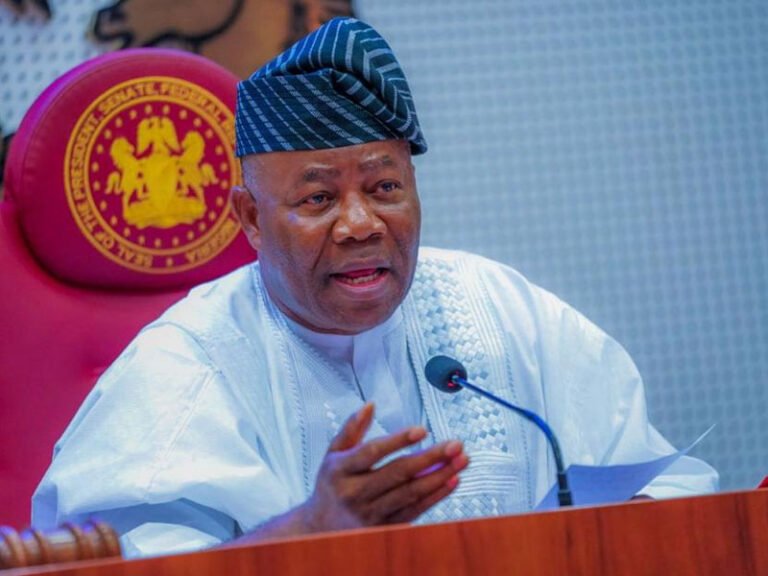
    The Senate President, Sen. Godswill Akpabio, has debunked reports that he promised to secure return tickets to senators who lost tickets at the All Progressives Congress (APC) primary elections.

    Akpabio made the clarification on Saturday in a statement issued by his Special Adviser, Media and Publicity, Hon. Eseme Eyiboh in Abuja.

    The Senate president said contrary to the reports, he only empathised with the senators who were affected negatively by the outcome of their respective primary elections.

    The clarification was said to have been occasioned by reports in sections of the media suggesting that the president of the Senate promised to secure senatorial tickets for senators who lost their party primaries.

    The statement reads: “The attention of the Office of the President of the Senate has been drawn to misleading reports circulating in sections of the media suggesting that the President of the Senate has promised to secure senatorial tickets for senators who lost their party primaries.

    “We must categorically assert that this report does not reflect the position of the President of the Senate. For the record, Senator Akpabio has neither made nor authorized to be made such a promise.

    “What the President of the Senate actually said, in the course of interacting with his colleagues, was to empathize with senators who were affected negatively by the outcome of their primary elections.

    “He assured them that the leadership of the All Progressives Congress, APC, is actively working to address all issues arising from the primaries and that the final list of candidates will be released in due course in line with the party’s constitution and electoral guidelines.

    “Senator Akpabio remains committed to party discipline, due process, and the internal mechanisms of the APC for resolving disputes.

    “He will not interfere with the autonomous processes of the party or make commitments that are outside the purview of the National Assembly leadership.

    “The office also notes another report quoting a distinguished Senator on the need for the Senate to probe the military over recent security incidents.

    “While legislative oversight is a constitutional responsibility of the National Assembly, Senator Akpabio’s position is that this is not the opportune moment for a public probe of the Armed Forces.

    “At a time when our troops are engaged on multiple fronts against terrorism, banditry and other threats to National Security, subjecting the military to a public legislative inquisition could undermine their morale and operational focus.

    “The Senate President believes strongly that support, collaboration and closed-door engagements with security agencies are more productive at this critical time.

    “Oversight will be exercised responsibly, without creating distractions that embolden adversaries or divert attention from the urgent task of securing Nigeria and its people”, he said

    Akpabio called on the media and the public to disregard sensational and inaccurate misrepresentation of his remarks and to always seek clarification from his office before publication.

  • Oshiomhole: Akpabio keeps selling himself as a leader who prefers partnership over division

    Oshiomhole: Akpabio keeps selling himself as a leader who prefers partnership over division


    By Rt Hon Eseme Eyiboh

    A recent video of Senator Adams Oshiomhole praising Senate President Godswill Akpabio has put the spotlight back on the 10th National Assembly. In the clip, Oshiomhole called Akpabio’s leadership exceptional. He said the Senate President has brought politicians from opposition parties into the APC without threats, pressure, or public fights.

    According to Oshiomhole, people who used to be fierce opponents are now joining the APC willingly because of the atmosphere Akpabio has created. He even joked that Akpabio deserves a Guinness World Record for pulling off these political shifts so smoothly and seamlessly.

    The comment has elevated the positive perception of the 10th Senate and sparked conversations around the institutional integrity of the 10th Senate. For Akpabio’s admirers, it shows his skill at building bridges, cooling down political tension, and getting people to work together. Critics may see it as a typical political praise that comes with power and authority. But beyond the buzz, one thing is clear: the 10th Senate leadership has become one of the most talked-about institutions since this government started.

    Since taking office in June 2023, Akpabio has positioned himself as a leader focused on unity and stability. In his first in speech as Senate President, he said his election was a collective win, not a personal one. He promised to lead with fairness and integrity, put teamwork first, and keep national interest above party lines. He admitted that disagreements are normal in democracy, but said the Senate must move past division to focus on lawmaking, oversight, security, and the economy. This demonstrated commitment has occasioned multiple vote of confidence on Akpabio’s leadership by the 10th Senate.

    That message mattered because Nigerians were already worried about governance, the economy, and deep political divides. Akpabio promised that the 10th Senate would work with the executive but still do its job as a check on power. He called it “a Senate for all Nigerians” and described his approach as “Servant leadership” and “Uncommon leadership.” Those phrases have stuck.

    This style has brought calm to the Senate. Unlike past assemblies marked by internal fights and clashes with the Executive arm, this Senate has kept a working relationship with President Bola Tinubu’s administration. For many analysts, this cooperation is more necessary right now than ever, with inflation, insecurity, unemployment, and debt all weighing on the country.

    Several leaders have publicly backed Akpabio’s approach. Edo State Governor, Monday Okpebholo, praised his transformational and development-focused leadership. Deputy Speaker Benjamin Kalu called him visionary and patriotic, saying he has strengthened the National Assembly. Akpabio has also received several awards for legislative integrity and institutional leadership to add verve to his leadership pedigree.

    At the International arena, Senator Allwell Heacho Onyesoh credited him with helping Nigeria regain visibility in the Inter-Parliamentary Union, calling it a diplomatic win. Many say this shows the Senate leadership is thinking beyond Abuja.

    Akpabio has repeatedly stressed inclusiveness. In many of his speeches, he has spoken about more roles for women, support for persons with disabilities, youth empowerment, and pushing innovation and technology. He has argued that Nigeria’s future depends on preparing young people for a knowledge-based economy and making laws that support technology, entrepreneurship, and revenue sources beyond oil.

    This is evidently seen in his home state (Akwa Ibom State). The working relationship between Akpabio and Governor Umo Eno is having a clear effect on Akwa Ibom’s politics and economy. Both men have pushed for inclusive politics, and that has helped calm tensions in the state. Leaders, stakeholders, and ordinary citizens now feel like they have a place in how the state is run. That has made it easier for people across party lines to work together on projects that move the state forward.

    One big result is the growing support for Governor Eno’s administration. Instead of stoking division or personal rivalries, Akpabio has publicly backed the governor’s development plans. That has taken some heat out of state politics and given people more confidence in government. For many residents, it now feels like governance is a team effort, not a fight for personal power.

    Akpabio’s backing has also put Akwa Ibom more firmly on the federal radar. As Senate President, he has the clout to draw national attention and opportunities to the state. That has led to better cooperation between Akwa Ibom and the federal government on roads, human capital programmes, and economic projects. The calm between both leaders has also made investors and development partners more comfortable. Stable politics make it easier for them to commit.

    Governor Eno’s government is seeing the benefits of that stability. His policies on rural development, job creation, agriculture, and social welfare are getting wider public support because political leaders are not pulling in different directions. This symbiotic relationship is the first in the annals of Akwa Ibom State since creation

    These ideas line up with President Tinubu’s “Renewed Hope” agenda. The government has pushed through fuel subsidy removal, exchange rate changes, and fiscal reforms to stabilize finances and attract investment. Officials say these moves are necessary for long-term growth, regardless of the hardship for many Nigerians.

    That’s why the National Assembly’s role matters now more than ever. The Senate has to pass laws that support reforms, but also keep oversight to make sure policies actually help citizens. Akpabio has said the Senate will protect national interest while backing policies that can drive recovery.

    Even with all the praise coming his way, Akpabio often shifts credit to President Tinubu. He frames himself as part of a team, not the sole force behind stability. He has praised Tinubu’s push to rebuild investors’ confidence and restore trust through the Renewed Hope Agenda.

    He points to ongoing projects like the Lagos-Calabar Coastal Highway and the Lagos-Maiduguri corridor as signs of long-term planning. These roads show a serious effort to connect the country and fix years of neglect in transport infrastructure.

    Akpabio has also highlighted the creation of development commissions across the geopolitical zones. He says this shows the government is trying to make every region feel carried along. In a country often split along ethnic and regional lines, that message resonates.

    On security, he has backed the military’s operations against terrorism, banditry, and other crimes. With kidnapping, insurgency, and communal violence still major concerns, his public support for the administration’s approach reinforces the image of the Senate and presidency working together.

    One striking part of his recent comments was his mention of early endorsements for Tinubu ahead of 2027. He said the support isn’t random but tied to what he sees as real governance results.

    Senator Oshiomhole’s comments also show a strategy in Nigerian politics that party strength is not just about winning elections. It’s about pulling in influential figures from other parties. Defections signal shifting power, and Oshiomhole’s remarks frame Akpabio as a unifier who expands the party through persuasion, not confrontation.

    Still, Akpabio keeps selling himself as a leader who prefers partnership over division. His speeches push dialogue, teamwork, and putting Nigeria first. He reminds lawmakers that even though they came in on different platforms, they are all representing one country.

    Whether you agree with his politics or not, Akpabio is now one of the deepest and most thoughtful figures in Nigeria’s political space. He has kept strong ties in the Senate, stayed aligned with the presidency, and earned public endorsements from major players. That has solidified his position and sustained the sobriquet “uncommon transformer”.

    Rt Hon Eseme Eyiboh is the Special Adviser,Media/Publicity and Official Spokesperson to the President of the Senate

  • Suspension: Lawyer faults media reports on Akpabio’s cross appeal against Natasha’s suit

    Suspension: Lawyer faults media reports on Akpabio’s cross appeal against Natasha’s suit


    Senate President , Sen. Gadswill Akpabio


    An Abuja-based lawyer, Dayo Fadugba, has faulted the media reports on the cross appeal filed by the Senate President, Senator Godswill Akpabio, against part of the judgment of the Federal High Court on the suspension of Senator Natasha Akpoti-Uduaghan.

    Some sections of the media had reported that Senator Akpabio had approached the Supreme Court over the legal battle arising from the suspension of Kogi Central Senator, Mrs Akpoti-Uduaghan.

    They said the development followed a recent judgment of the Court of Appeal which struck out the Federal Government’s brief of argument in the appeal linked to Akpoti-Uduaghan’s suspension.

    Reacting to the report suggesting Akpabio’s brief of argument was dismissed, Fadugba, in a statement, described it as untrue.

    He said that what was refused by the Court of Appeal was a request to exceed the prescribed number of pages for briefs of argument and not the brief of argument itself.

    The statement reads: “The referenced jaundiced reportage purporting to analyse proceedings at the Court of Appeal in the matter connected with the suspension of Senator Natasha Akpoti-Uduaghan is a glaring example of speculative journalism, factual distortion, and advocacy masquerading as news.

    “It is necessary, in the interest of accuracy and the integrity of judicial reporting, to set the record straight.

    “The report is gravely flawed in its presentation of the factual posture of the appeal. It falsely suggests that Senate President Godswill Akpabio personally suffered a “major blow” at the Court of Appeal and that he is now “escalating” the matter to the Supreme Court in reaction to that supposed setback.

    “This narrative is inaccurate and misleading. The reportage fails to correctly identify who appealed, what was appealed against, and the precise issues before the Court. Such basic errors betray either gross incompetence or deliberate misrepresentation.

    “Contrary to the emphatic assertions of the reporter, the official record of proceedings of the Court of Appeal does not state that any brief of argument was struck out. At no point did the court make an order striking out a brief, whether of the “Federal Government” or any other party (the Federal Government was never a party in the suit).

    “The assertion that a brief was struck out exists only in the imagination of the reporter and not in the pronouncement of the court. Journalism must report what the court did, not what the journalist wished the court had done.

    “The Rules of the Court of Appeal expressly permit a party to seek leave of court to exceed the prescribed number of pages for briefs of argument.

    “In this case, leave was indeed sought. Where such leave is refused, the settled and just course is not to shut out the affected party, particularly a cross-appellant with a justifiable explanation, but to: Direct compliance with the page limit within a specified time; or grant an adjournment to enable proper compliance, especially where justice demands hearing all sides on the merits.

    “To portray a refusal of leave (assuming one occurred) as a terminal procedural defeat is legally unsound and deliberately deceptive.

    “The reporter’s language is laced with conjecture, triumphalism, and partisan interpretation clearly designed to create a false impression of victory for one side and defeat for the other. Courts of law do not deliver judgments to satisfy political paymasters.

    “Any report suggesting that a procedural issue amounts to a “major blow” to Senator Godswill Akpabio, GCON, is nothing more than wishful thinking dressed up as news.

    “What is most troubling is that the report reads less like an objective account and more like a legal brief prepared on behalf of Senator Akpoti-Uduaghan. The journalist has arrogated to himself the role of the court, announcing orders that were never made and consequences that never arose. This is not reporting; it is advocacy by stealth.

    “The insinuation that any “blow” has been dealt to the case of the Senate President is entirely unfounded. There has been no adverse substantive determination against him, no striking out of any brief on record, and no judicial pronouncement capable of justifying the celebratory tone of the report.

    “Any rejoicing founded on this article is therefore premature, misplaced, and built on falsehood.

    “The report by Opr.news under reference stands condemned by its own inaccuracies, speculative conclusions, and partisan slant.

    “Courts speak through their records and rulings, not through the conjectures of journalists pursuing personal or political agendas.

    “Responsible journalism demands restraint, fidelity to facts, and respect for judicial processes.”

  • The Akpabio Synthesis: An Uncommon Statesman at 63

    The Akpabio Synthesis: An Uncommon Statesman at 63


    By Rt Hon Eseme Eyiboh mnipr

    Nigeria is a country that produces noise faster than it produces true heroes. Politics here moves at a velocity that forgives very little and forgets even less. To survive is one thing. To matter is another. To matter for nearly two decades at the highest levels of public life is an achievement that demands more than charisma.

    It demands outcomes. It demands consistency. It demands a mind trained to govern in the morning and negotiate in the evening, without losing the delicate balance between ambition and humility.

    On 9 December 2025, Senator Godswill Akpabio GCON turned 63. The moment offered more than ceremonial cheer. It invited serious reflection on a figure whose trajectory captures both the turbulence and the possibilities of modern Nigerian leadership.

    His journey from Commissioner in Akwa Ibom State to Governor, to Minister, and now President of the Senate is well known. What is less appreciated is the coherence that binds these roles together. It is a coherence built on transformation in one arena and stability in another. It is what one might call the Akpabio Synthesis.

    This synthesis blends the force of developmental leadership with the finesse of legislative management. It combines the boldness of a builder with the restraint of an institutionalist. It reflects an understanding that countries rise not merely on the strength of ambition but on the quality of those who convert ambition into infrastructure, and infrastructure into institutional legitimacy.

    A Governor Who Re-Imagined a People’s Possibilities

    To appreciate Akpabio’s national weight, one must return to Akwa Ibom between 2007 and 2015. His governorship was not a routine tenure. It was a deliberate confrontation with underdevelopment. Where many states adopted incrementalism, he embraced transformation as a governing philosophy. That philosophy became the Uncommon Transformation Agenda.

    Education was the anchor. Free and compulsory schooling from primary to senior secondary levels—regardless of state of origin or religion—backed by the construction of over 700 model classrooms, ensured that children from the poorest homes could begin life with a fairer chance. Teacher training colleges were revived, curricula modernised, and enrolment surged. The message was simple: education is the foundation of citizenship.

    Healthcare followed the same logic. The state constructed 22 hospitals, expanded primary healthcare access, and built the Ibom Specialist Hospital as a hub for advanced medical treatment. Free maternal and child delivery services reduced mortality and reinforced the dignity of families across rural communities. In a country where the journey to a clinic can mean the difference between life and loss, such interventions carry moral weight beyond statistics.

    Infrastructure was the battlefield on which Akpabio waged his most visible campaign. Uyo transformed from a quiet local government capital into a modern urban centre. Flyovers, wide boulevards, dualised highways, and interconnected rural roads rewrote the physical map of the state. The Ibom International Airport became a node of commerce and mobility, while the Ibom Power Plant strengthened the state’s energy backbone. Water schemes across all 31 local government areas expanded public utility access. Industrial parks and sporting facilities, including the world-class stadium in Uyo, broadened the state’s profile from obscurity to emerging economic relevance.

    Naturally, some critics whispered about cost. But history answers critics better than rhetoric. The infrastructure still exists. The hospitals still stand. The schools still function. The airport still operates. The power plant is running. The roads connect.

    To be clear, a leader is ultimately judged by whether he leaves his people better than he met them. On this metric, Akpabio’s record is a matter of physical evidence—res ipsa loquitur: the facts speak for themselves.

    Beyond concrete, however, he rebuilt confidence. He governed with moral clarity, grounded in a constant invocation of divine grace. This is not a footnote to his story. In Nigeria’s cultural context, where public life is interpreted through both the material and the spiritual, his emphasis on grace conveyed humility and cultural legitimacy. It elevated his leadership beyond performance and connected it to a deeper communal belief in providence.

    A Senate President Who Prioritises Stability Over Spectacle

    If the governorship was Akpabio’s era of bulldozing underdevelopment, the Senate Presidency has been his era of consensus-building. These are different competencies. One is muscular; the other diplomatic. One pushes; the other persuades. Yet both require a disciplined understanding of how to move a society from inertia to progress.

    When the 10th Senate elected him President in 2023, Nigeria was navigating economic strain, political tension, and public impatience. The legislature—often prone to theatrics—required steadying. Akpabio brought equilibrium to a chamber of 109 competing ambitions. He restored rhythm to legislative work. He presided with firmness but without unnecessary heat. He prioritised national objectives over political brinkmanship.

    Under his gavel, productivity rose. More than 96 bills were passed within two years, with about 58 assented to. These are not random numbers. They reflect a legislature aligned with the national reform agenda while maintaining its constitutional oversight role.

    Major economic legislation emerged, including tax harmonisation frameworks designed to improve revenue predictability. Social sector reforms expanded access to tertiary education through a revitalised student loan system. Regional development commissions received renewed momentum, fostering equity across geopolitical zones. Security-related laws strengthened military and policing capacity. Anti-corruption and public finance legislation reinforced transparency and accountability.

    These outcomes were not accidental. They required a Senate President capable of managing egos without humiliating them, negotiating with the executive without surrendering institutional integrity, and maintaining national focus without stoking unnecessary conflict. The skill was not in shouting. The skill was in steering.

    The Senate Presidency under Akpabio has been a study in calm and strategic leadership. It has shown that stability is not the enemy of progress. It is its thermostat—the quiet force that prevents governance from overheating and ensures reforms endure.

    A Statesman Formed by Grace and Tempered by Experience

    What, then, is the essence of Akpabio at 63? It is a man who has moved from executive power to legislative authority without losing balance. It is a leader who understands that Nigeria needs both builders and statesmen. It is a public figure who views leadership as a covenant with the people, shaped by faith, experience, and service.

    His story is not without controversy. No consequential leader escapes scrutiny. Yet when the balance sheet of contribution is examined honestly, the conclusion is unmistakable. He has built. He has stabilised. He has led with purpose.

    He embodies, perhaps more than many of his contemporaries, the idea that Nigeria’s future lies in leaders who combine conviction with competence, vision with execution, and spirituality with responsibility.

    A Birthday in the Service of the Republic

    As Nigeria marks Godswill Akpabio at 63, the nation salutes not merely the man but his journey. It salutes the governor who transformed a state. It salutes the Senate President who steadied the legislature. It salutes a life that has become a reference point in the debate about what genuine leadership can achieve in Nigeria.

    His story reminds us that the work of nation-building is neither linear nor effortless. It is sustained labour undertaken by those willing to think boldly, act decisively, and serve faithfully. Nigeria’s next decade demands such leaders—leaders who can build new infrastructure and strengthen existing institutions, inspire hope without losing discipline, and understand that grace, in the quiet hours of power, is both a calling and a responsibility.

    At 63, Godswill Akpabio stands as one such leader. The chapters of his life remain open. The responsibilities before him remain weighty. But the foundation he has laid—in concrete and in law, in state and in nation—secures his place in Nigeria’s unfolding story.

    May the grace you invoke continue to strengthen the work you do for a country still striving to become the best version of itself. In the biography of our time, you will remain a model and a source of inspiration to many.

    Happy birthday, Mr President of the Senate.
    Happy birthday, the uncommon statesman.
    Happy birthday, Uko Akwa Ibom.

    Rt Hon Eseme Eyiboh mnipr is the Special Adviser on Media/Publicity and official Spokesperson to the President of the Senate

  • Senator Godswill Akpabio: 63 Years of Enduring Impact

    Senator Godswill Akpabio: 63 Years of Enduring Impact


    By Rt Hon Eseme Eyiboh mnipr

    On this ninth day of December, in the year 2025, as the nation stirs to its familiar rhythm, a man stands quietly at the crossroads of personal milestone and public memory. Senator Godswill Obot Akpabio, GCON, marks his 63rd year on earth—another turn on the wheel of time for a figure whose shadow has long stretched across the public life of Nigeria.

    He was born in Ukana Ikot Ntuen, Essien Udim—one of those villages where the future rarely announces itself with trumpets, but where the soil has a way of preparing men for the long, hard disciplines of service. His childhood was shaped by the steady lessons of Methodist Primary School, the formative rigour of the Federal Government College, Port Harcourt, and later the University of Calabar, where he earned a law degree that would become less a credential than a compass.

    Before politics found him—or before he found politics—Akpabio walked several honest roads: teacher, lawyer, partner, corporate executive. These were not glamorous roles, but they were instructive. They taught him something about the dignity of work, the stubbornness of hope, and the slow grind through which a man discovers his convictions.

    Then came public office—a chapter not whispered into existence, but written in the bold script of infrastructure, reform, and unyielding ambition. As Governor of Akwa Ibom State from 2007 to 2015, he presided over the kind of transformation that does not happen quietly. Roads carved through old terrains; bridges defeated rivers long thought unconquerable; an airport rose from the red earth; a stadium stood like a declaration that the people had reclaimed their sense of possibility. And in classrooms and hospitals, thousands felt the soft but decisive undertones of free education and accessible healthcare. They called him “The Uncommon Transformer,” not because the phrase was fashionable, but because it was true.

    His path then led to the 9th Senate of the Federal Republic, where he got swift the recognition of his peers in the main opposition Peoples Democratic Party (PDP), who made him the Minority Leader of the Senate. Characteristic of Akpabio – whose name has come to connote excellence – he played the role admirably until the need for a better deal for his constituents made him to defect to the ruling All Progressives Congress (APC).

    Akpabio was to take a break from the Senate following his appointment as a Minister of Niger Delta Affairs, where he confronted a region often defined by contradiction—rich in resources, poor in infrastructure; blessed with talent, burdened by history. And yet, under his watch, a symbol of bureaucratic paralysis finally gave way: the long-delayed NDDC Headquarters was completed and inaugurated, its doors swinging open after nearly two decades of excuses.

    Back in the Senate and now as President of the 10th Senate, Akpabio’s leadership is marked by something rarer than rhetoric: steadiness. The kind of steadiness that can hold a chamber together in times of partisan whirlwinds; that can encourage cooperation with the Executive without surrendering oversight; that can restore a sense of rhythm to national budgeting after years of drift. In just two years, the Senate under his watch has moved decisively—reforming education laws, modernizing taxation, strengthening regional development, and pushing for genuine autonomy for local governments.

    Twice, his colleagues have risen—unprovoked—to pass a vote of confidence in him. In politics, such gestures are not born of sentiment; they are earned by the invisible arithmetic of trust.

    On the global stage, he achieved what had eluded Nigeria for six decades: a seat on the Executive Committee of the Inter-Parliamentary Union. It was more than an election; it was a restoration of presence, a reminder that nations are not only heard when they speak loudly, but when they speak with clarity and purpose.

    The honours that have followed him—from “Best Governor in Africa” to “Man of the Year,” from national decorations to continental recognition—are footnotes, not the story. The story is simpler, older, and more enduring: a man who has spent much of his life in the public square, pushing institutions toward competence, and people toward hope.

    And so, on this 63rd birthday, the occasion invites not celebration but reflection—reflection on a life that suggests that public office, when handled with vigour and imagination, can still be a noble calling. It is also an invitation to look forward. For the work of nation-building is never finished, and the ideals that have guided Senator Godswill Akpabio—unity, inclusiveness, good governance, and development—remain as necessary today as when he first stepped into the arena.

    As Edward R. Murrow would say, “This is not the end of the story. Only another nightfall on the long road of a man still in service to his country”.

    •Rt. Hon. Eseme Eyiboh is Special Adviser, Media / Publicity & Official Spokesperson for The President of The Senate.

  • Genocide: Senate President, Akpabio, denies comment on Trump, Nigerians’ interests

    Genocide: Senate President, Akpabio, denies comment on Trump, Nigerians’ interests

    The President of the Senate, Sen. Godswill Akpabio, has denied making a statement attributed to him by an online platform, Rant HQ, asking President of the U.S , Donald Trump, to mind his business in the ongoing allegations of killings of Christians in Nigeria.

    Sen. Akpabio, in a statement by Hon Eseme Eyiboh, his Special Adviser on Media and Publicity on Monday in Abuja, challenged the publishers of the platform to produce evidence of the statement.

    The Senate president described the publication as untrue and mischievous.

    “Our attention has been drawn to a malicious and completely fabricated post published by a platform called Rant HQ, falsely attributing a reckless and imaginary statement to the President of the Senate, His Excellency, Distinguished Senator Godswill Obot Akpabio, GCON.

    “The post — which reads, ‘The killing is taking place in Nigeria not in USA, Trump should focus on US. Nigerians are not complaining about the killings, we are fully satisfied with the condition of Nigeria’ — is a total falsehood, a product of mischief, and a desperate attempt to incite misunderstanding between Senator Godswill Akpabio and U.S. President Donald Trump, as well as between Nigeria and its international partners.

    “For the avoidance of doubt, the Senate President never made such a statement — not publicly, privately, in writing, or in conversation.

    “We challenge the publishers of this falsehood to produce a single shred of evidence to the contrary.

    “The accompanying photograph, which shows the Senate President at an official event alongside other Senators, has been deceptively used to lend false credibility to a fabricated quote that was never uttered by him.

    “Senator Akpabio is a statesman of global repute and a respected advocate of international friendship, diplomacy, and mutual respect among nations.

    “He holds President Donald Trump in high regard as a historic figure and a leader of a great nation.

    “He would never comment on internal matters of the United States, nor issue any statement that falls within the exclusive domain of Nigeria’s Executive arm of government or the nation’s foreign policy establishment.

    “This malicious post is, therefore, a clear act of digital recklessness and a deliberate attempt to sow confusion, tarnish reputations, and inflame unnecessary diplomatic sentiments.

    “We urge the public to ignore this falsehood in its entirety.

    “We warn Rant HQ and others who trade in misinformation to desist from peddling unverified and fabricated stories just to chase online traffic. Freedom of expression is not freedom to lie.

    “The Office of the President of the Senate remains committed to transparency, truth, and responsible communication — both in Nigeria and on the international stage,” he said.

  • The Trials and Triumphs of a Resilient Nigeria’s 10th Senate

    The Trials and Triumphs of a Resilient Nigeria’s 10th Senate


    By Eseme Eyiboh

    In the unfolding story of Nigeria’s democracy, the Senate remains one of its most enduring symbols of institutional resilience and national balance. Beyond the spectacle of debates and the colour of political persuasion, it is the grand arena where the destiny of the nation is shaped, refined, and defended through rules, order, and reason. It is the one chamber where passion must bow to procedure and where leadership must blend authority with decorum.

    Under the current stewardship of Senator Godswill Akpabio,GCON the Nigerian Senate has again shown that discipline is not the enemy of democracy but its lifeblood. In a political climate often prone to impulsive rhetoric and theatrical defiance, the Senate’s commitment to its Standing Orders has reaffirmed the solemn truth that democracy thrives only when its institutions are respected and its rules upheld.

    At a time when political tempers can easily flare and institutional boundaries are tested, the Senate has chosen the steadier path of order. Its resilience is not borne out of the absence of conflict but from the maturity to resolve such tensions through due process. It is this adherence to procedure that transforms the Senate from a mere congregation of political actors into a citadel of constitutional governance. The Tenth National Assembly has therefore become more than a legislature; it has risen to become the custodian of Nigeria’s democratic rhythm, ensuring that the music of governance remains in tune even when discordant notes arise.

    ● The Architecture of Order

    Every functioning democracy stands or falls by the strength of its institutions. Rules are the unseen architecture that hold those institutions together, shaping not only how decisions are made but also how power is exercised and limited. The Nigerian Senate’s Standing Orders are not ceremonial relics from the past. They are the living constitution of the institution, carefully designed to preserve fairness, consistency, and the sanctity of the legislative process.

    The discipline of parliamentary conduct is a universal marker of political civilisation. In the United Kingdom’s House of Commons, the authority of the Speaker is absolute and unchallenged, ensuring that debates proceed with respect and precision. No member, regardless of party or popularity, may openly defy the Speaker’s ruling without consequences.

    In Canada’s Parliament, even the fiercest partisans understand that procedure is sacred. Heated disagreements are channelled through decorum, not chaos. Similarly, in Australia, the Senate’s ability to hold the executive accountable depends not on the whims of politics but on the meticulous enforcement of rules that keep legislative integrity intact.

    Without a doubt, Nigeria’s Senate belongs in that global fellowship of parliaments that recognise chaos as the heart of anarchy and order as the soul of democracy. Its insistence on upholding internal discipline and protecting the authority of its leadership is, therefore, neither personal nor punitive.

    It is institutional self-preservation. When the chamber asserts that it will not be held hostage by the disruptive instincts of any single member, it is affirming the primacy of collective responsibility over individual grandstanding. This is how strong legislatures endure: not by silencing dissent, but by ensuring that dissent respects the bounds of procedure.

    In many ways, the Akpabio-led Senate has re-introduced a tone of seriousness into the conduct of legislative affairs. The presiding officer’s calm firmness, coupled with his inclusivity, has reminded both senators and citizens that freedom within order is the truest form of democracy.

    Leadership of this sort does not seek applause; it seeks stability. By upholding its Standing Orders, the Senate has reclaimed its moral authority and demonstrated that rules, properly enforced, are not instruments of oppression but shields against institutional decay.

    ● A Record of Uncommon Legislative Action

    To judge a legislature by its distractions is easy, but to measure it by its legislative work is wiser. By that measure, the Tenth Senate has already left an imprint that few in Nigeria’s democratic history can rival. In barely two years, the Senate has processed over 90 bills, with more than 50 receiving presidential assent. To be clear, these are solid, impactful achievements; they are substantive interventions in the nation’s economic, social, and security architecture.

    Among them are landmark reforms such as the Nigeria Tax Administration Act and the Joint Revenue Board Act, which harmonise tax collection across the federal, state, and local governments, thereby reducing duplication and boosting fiscal efficiency. These laws lay the groundwork for a more coherent revenue system that can fund Nigeria’s development priorities sustainably.

    The Electricity Act (Amendment) has opened the power sector to decentralised innovation by placing generation and distribution within concurrent legislative jurisdiction, allowing states to take greater ownership of electrification drives.

    Equally significant is the Student Loans (Access to Higher Education) Act, which has established the Nigerian Education Loan Fund, a mechanism designed to democratise access to tertiary education and build the nation’s human capital. Through this law, thousands of young Nigerians from modest backgrounds can now dream beyond financial constraints.

    In matters of national security, the Senate has enacted the Control of Small Arms and Light Weapons Act and reformed the Defence Industries Corporation to modernise local arms production and improve oversight. It has strengthened the Police Act and advanced the legal framework for community policing, ensuring that law enforcement is both professional and accountable. Social welfare has not been neglected either. The Senate’s approval of an increased national minimum wage reflects its sensitivity to the economic pressures faced by ordinary citizens.

    Beyond these legislative milestones, the Senate has exercised its oversight powers with renewed vigour. Ministerial nominees have faced rigorous scrutiny, and budgetary processes have been more transparent than in previous sessions. Committee reports are now subjected to fuller debate, while public hearings are reclaiming their role as forums of accountability rather than ceremonial formality.

    This spirit of constructive collaboration with the executive, balanced by a firm assertion of institutional independence, has restored public confidence in the Senate’s purpose and performance.

    Senator Akpabio’s leadership style has been pivotal in this transformation. Combining political experience with procedural discipline, he has stabilised the chamber and inspired cooperation across party lines. The result is a Senate that legislates with urgency but without recklessness, that debates with passion but within the boundaries of respect. It is a model of legislative management that other emerging democracies might do well to emulate.

    ● Discipline as Democracy’s Anchor

    In any democracy, the question is never whether there will be dissent. Instead, it is always about how it will be handled. The real measure of a democratic institution is how it handles internal turbulence. The Tenth Senate has faced its fair share of provocations and personality clashes, yet it has consistently chosen the path of principle over populism.

    When it insists that rules must be followed and that leadership must be respected, it is not acting out of pride but out of duty. Every time the Senate enforces its Standing Orders, it sends a message that Nigeria’s democracy is strong enough to discipline itself.

    In the world’s most respected parliaments, members who flout rules face swift consequences. In the British House of Commons, suspension or expulsion is not rare when a member’s behaviour undermines parliamentary dignity.

    In Canada, contempt of Parliament remains one of the gravest offences, warranting public apology or even exclusion. Nigeria’s Senate has every right to apply similar standards, for to allow disorder in the name of political freedom is to invite the slow death of the institution itself.

    There is a reason democracies that survive for centuries place such premium on decorum. Discipline is the invisible thread that connects authority to accountability. A Senator who disregards procedure may think he is exercising personal liberty, but in truth, he is unravelling the very order that gives that liberty meaning. The Senate, as the upper chamber of Nigeria’s legislature, bears the burden of showing restraint even when provoked and firmness even when misunderstood.

    Under Akpabio’s guidance, that balance has largely been achieved. His steady hand has preserved the Senate’s institutional dignity while ensuring that disagreements, inevitable in a plural polity, never degenerate into institutional disrespect. His colleagues, through their support, have shown that the Senate’s unity is not fragile but founded on shared commitment to the republic’s greater good. This collective resilience is what distinguishes a mature legislature from a mere gathering of political actors.

    As democracy worldwide faces disillusionment, with parliaments in many countries besieged by populist anger and public cynicism, Nigeria’s Senate stands out as a stabilising force. Its insistence on rule-based conduct, its robust legislative output, and its respect for leadership all reinforce the idea that democratic governance is not sustained by emotion but by discipline. In times of uncertainty, Nigerians can look to their Senate as a beacon of institutional steadiness, where procedure triumphs over impulse and order over anarchy.

    ● A Legacy of Institutional Maturity

    Every democratic generation must reaffirm its faith in its institutions. For Nigeria, the Senate remains one of the surest proofs that despite imperfections, the system endures. It is the forum where politics matures into policy and ambition yields to service. Its current trajectory under Akpabio’s stewardship shows that a disciplined legislature can coexist with vibrant debate, and that leadership tempered by wisdom can guide even the most divided chamber towards a common purpose.

    The trials of the Senate are many: public scepticism, partisan rivalry, and the ever-present temptation of populist showmanship. Yet its triumphs are greater still. By choosing law over noise, the Senate has shown that Nigeria’s democracy can heal itself from within. Each bill passed, each order enforced, and each moment of collective restraint strengthens not just the chamber but the republic it represents.

    The true triumph of the Senate lies in its rediscovery of itself as a body governed by rules, led by example, and anchored in service to the nation. In doing so, it has become a model for the continent and a reassurance to Nigerians that the spirit of democracy, though tested, remains alive and well.

    As the nation moves through uncertain times, the Senate’s resilience will remain a cornerstone of Nigeria’s democratic stability. Its fidelity to order and leadership not only safeguards the present but also lights the path for future generations. For, in the end, it is not the noise of politics that defines a nation’s greatness but the calm persistence of its institutions. In that regard, the Nigerian Senate stands triumphant, disciplined, dignified, and resolutely democratic in all terms.

    •Rt. Hon. Eseme Eyiboh mnipr is the Special Adviser on Media/Publicity and official Spokesperson to the President of the Senate.

  • Akpabio back from London, dismisses rumours of ill health

    Akpabio back from London, dismisses rumours of ill health

    President of the Senate, Senator Godswill Akpabio, has returned to the country from London early this Monday morning, dispelling rumours of ill health.

    Some social media reports had claimed that Akpabio was critically ill and admitted in a London hospital.

    But the Senate President dismissed the rumours as the imagination of the purveyors.

    “There’s nothing like such. I’m fit as a fiddle. I only stopped over in London for a short vacation,” Akpabio said.

    Recall that the Senate President had attended the Sixth World Conference of Speakers of Parliament in Geneva between July 29 and 31st after which he headed to London to rest after a hectic legislative year.

    The Senate President, who touched down at the Nnamdi Azikiwe International Airport at 4.00am Monday, was received at the Presidential Wing by senators, aides and Nigerians from different walks of life.

    Fielding questions from journalists on arrival, the Senate President promised Nigerians robust legislative engagements on resumption.

    He further justified the presence of a strong Nigerian delegation at the International Parliamentary Union in Geneva, assuring the people of more derivatives of democratic governance and effective collaboration with the other arms of government.

  • AN OPEN LETTER OF NATIONAL EMERGENCY  To:  (1). The President of the Senate of the Federal Republic of Nigeria,

    AN OPEN LETTER OF NATIONAL EMERGENCY To: (1). The President of the Senate of the Federal Republic of Nigeria,


    By  Sylvester Udemezue (udems)


    AN OPEN LETTER OF NATIONAL EMERGENCY

    To:

    (1). The President of the Senate of the Federal Republic of Nigeria,
    National Assembly Complex,
    Three Arms Zone,
    Abuja, FCT, Nigeria.

    (2). The Speaker, House of Representatives of the Federal Republic of Nigeria,
    National Assembly Complex,
    Three Arms Zone,
    Abuja, FCT, Nigeria.

    Cc:
    His Excellency,
    Asiwaju Bola Ahmed Tinubu,
    The President and Commander-in-Chief of the Armed Forces,
    Federal Republic of Nigeria
    Presidential Villa,
    Aso Rock, Abuja


    RE: THE FARMERS-HERDSMEN CRISIS IN NIGERIA: A CALL FOR URGENT CREATION OF TWO SPECIAL STATES EXCLUSIVELY FOR FULANI HERDSMEN AND SETTLERS WHO DO NOT YET HAVE STATES OF THEIR OWN IN NIGERIA*

    *By Sylvester Udemezue*
    (Proctor, The Reality Ministry of Truth, Law and Justice)

    Your Excellencies,

    *INTRODUCTION*

    With the utmost sense of national duty and patriotic urgency, I write this open letter on behalf of The Reality Ministry of Truth, Law and Justice (TRM), an independent, public-interest law advocacy initiative committed to the promotion of peace, law, justice, and security in Nigeria. This communication arises from the grave, prolonged, and worsening humanitarian and security crisis resulting from violent clashes between farmers and herdsmen across the country, a crisis that now amounts to a national emergency. It has become the most destabilizing factors threatening the peace, unity, and the very corporate existence of our beloved nation. The points I set out to respectfully make herein are broken into parts, as follows:

    (A). *THE UNRELENTING DEVASTATION CAUSED BY HERDER-FARMER CLASHES IN NIGERIA*

    1. From the Middle-Belt to the South-East, South-West, South-South and even parts of the North, Nigeria has suffered immeasurable human, economic, and social losses due to recurring conflicts between itinerant Fulani herdsmen and sedentary farming communities. Entire villages have been razed, crops destroyed, families displaced, and hundreds of thousands of lives lost.

    2. In Benue, Plateau, Nasarawa, Taraba, Enugu, Ebonyi, Ogun, Delta, Edo and Oyo States, among others, communities have been burned to ashes, food security disrupted, and local economies destroyed. In Agatu and Logo LGAs of Benue State, for instance, repeated herdsmen attacks have decimated communities, leaving hundreds dead. In Southern Kaduna, endless cycles of violence claimed countless lives. In Oyo State, the community of Igangan was overrun, its residents slaughtered in a night raid. In Enugu State, the story is not different.

    3. These are not isolated incidents. The National Emergency Management Agency (NEMA), international observers, and civil society organizations have documented the scale of the tragedies. According to reports by the Global Terrorism Index, Nigeria has repeatedly ranked among the top five most terrorized countries globally, with herder-farmer conflicts cited as one of the deadliest forms of violence.

    4. Yet, despite multiple policy pronouncements and peace-building efforts, the crisis remains unresolved, mainly because its root cause, namely open grazing and the absence of a sustainable, organized settlement framework for herdsmen, has not been decisively addressed.

    (B). *OPEN GRAZING IN THE 21ST CENTURY IS AN ARCHAIC PRACTICE IN NEED OF URGENT RETIREMENT*

    1. Open grazing (that is, herdsmen moving with their cattle across vast terrains, cutting across farmlands, highways, and communities) is a relic of the pre-industrial age. It is unproductive, unsustainable, and dangerous. Today, countries across Africa and the world have moved toward ranching, paddock grazing, and modern livestock farming:

    (i). Botswana has become a major exporter of beef to the EU through structured ranching.

    (ii). Kenya and South Africa have integrated livestock systems that maximize yield and minimize conflict.

    (iii). Brazil and Argentina have transformed cattle farming into profitable, export-driven industries with minimal violence.

    (iv). Even India, despite its massive cattle population, manages grazing through organized systems to avoid communal strife.

    2. In contrast, Nigeria continues to lose lives and resources due to a practice that has outlived its usefulness. Roads are blocked, farmlands are destroyed, and communities live in fear, all because a minority still insists on driving cattle from Sokoto to Bayelsa on foot.

    (C). *THE PECULIAR CASE OF THE FULANI HERDSMEN: BETWEEN FACT AND EXPLOITATION*

    1. It is well known that a significant segment of Nigeria’s Fulani herdsmen population either do not possess fixed states of origin or are transnational nomads with uncertain immigration status, making it difficult to monitor and govern their movement. More troubling, however, is the growing national security threat posed by violent actors who masquerade as herdsmen. While many Fulani herdsmen are law-abiding citizens genuinely engaged in cattle rearing, terrorist groups such as Boko Haram, ISWAP, and armed bandits have exploited the herdsmen identity as a disguise to infiltrate rural areas, attack, maim, kidnap, kill, destroy, and occupy:

    (i). In Zamfara, Sokoto, Kaduna, Katsina, Kebbi, Adamawa, Nasarawa, Niger, and Kebbi, Oyo, Ondo, Enugu, Delta , Edo, and Ebonyi States, among others, armed bandits posing as herdsmen have launched sustained terror campaigns.

    (ii). In the North Central and Middle Belt, these disguised actors move under the pretense of cattle rearing only to execute well-coordinated massacres and abductions.

    (iii). Leah Sharibu and hundreds of others were abducted and trafficked by groups initially believed to be cattle herders.

    2. Terrorists now exploit the mobility, rural penetration, and ambiguity of identity associated with herdsmen to carry out insurgent activities, destroy communities, and establish unlawful control over territories.

    (D). *A PRACTICAL, PERMANENT, PEACEFUL SOLUTION IS TO CREATE SPECIAL STATES FOR HERDSMEN*

    1. In light of the foregoing, The Reality Ministry of Truth, Law and Justice (TRM) proposes the immediate establishment of two special states (or designated autonomous regions within existing states) in the North West or North East, where:

    (i). All Fulani herdsmen and other nomadic livestock settlers without a permanent Nigerian state of origin may be voluntarily resettled.

    (ii). The federal government would channel substantial resources to rapidly develop these states with ranches, veterinary services, irrigation systems, security architecture, housing, schools, health and other infrastructure necessary for a sustainable pastoral economy.

    (iii). Investment incentives and modern livestock training would be offered to encourage herdsmen to abandon open grazing in favour of settled, profitable, and dignified livestock production.

    2. This proposal is not a political weapon or a tribalist scheme, but a non-ethnic, non-discriminatory national strategy for sustainable peace and economic transformation.

    (E). *BENEFITS OF THIS PROPOSAL*

    1. *National Security:* Establishing structured, secure settlements will drastically reduce insurgent access, prevent infiltration, and isolate terrorists disguising as herdsmen.

    2. *Economic Prosperity:* Modern ranching will increase productivity, boost GDP, attract foreign investment, and reduce pressure on rural land.

    3. *Peace and Integration:* With reduced herder-farmer friction, ethnic tensions will decline, and communities will enjoy greater harmony.

    4. *Constitutional Equity:* Every Nigerian group deserves territorial inclusion and developmental identity. Fulani herdsmen are no exception.

    5. *Improved Inter-Ethnic Relations:* Clearly defined territorial settlements will reduce suspicion and hostility, replacing them with understanding and mutual respect.

    6. *Counterterrorism and Stability:* This initiative would cut off one of the major operational channels for bandits and terrorist groups, thereby enhancing Nigeria’s counter-insurgency efforts.

    7. *International Credibility:* The world will take Nigeria more seriously when we demonstrate foresight in solving complex, protracted domestic challenges.

    (F). *CONCLUSION: A MATTER OF URGENCY AND SURVIVAL*

    1. Let us not wait for the next massacre, the next reprisal attack, or the next international embarrassment. The farmer-herdsmen crisis has become a tool of terror, an enabler of insurgency, and a bleeding wound in our national body. Nigeria cannot afford to ignore the ticking time bomb that is the herder-farmer-terrorist triad. History will not be kind to us if we fail to act boldly now. We therefore respectfully call on the National Assembly of the Federal Republic of Nigeria to:

    (i). Initiate constitutional and legislative frameworks for the creation of two special states or autonomous zones for Fulani herdsmen and nomadic settlers.

    (ii). Mandate the Federal Government to commit significant budgetary allocations towards rapid infrastructural development of these areas.

    (iii). Proscribe open grazing by national law and replace it with enforceable ranching policies tailored to these newly created states.

    2. Your Excellencies, Nigeria stands at a defining moment, one that demands not only political will, but constitutional fidelity, moral clarity, and courageous leadership. The farmer-herdsmen crisis has escalated into a nationwide emergency with far-reaching humanitarian, economic, and security implications. It now threatens the very foundations of our constitutional order and national cohesion. This is not a matter of convenience; it is a constitutional and moral duty. Section 14(2)(b) of the Constitution of the Federal Republic of Nigeria, 1999, clearly mandates that the security and welfare of the people shall be the primary purpose of government. This obligation cannot be met through delay or indifference. Any further hesitation risks undermining the unity and survival of the Republic.

    3. Accordingly, we respectfully urge the National Assembly to initiate and support urgent legislative and policy measures: the creation of special states or designated settlements for nomadic pastoralists, and the nationwide prohibition of open grazing. These are not discretionary policies; they are strategic imperatives for national stability. Let peace, justice, and security become lived realities for all Nigerians, not abstract ideals. This is a time for foresight and principled action, a time to place the long-term survival of the nation above every other interest.

    4. The reality is unavoidable: while we may postpone confronting it, we cannot escape the consequences of ignoring it. The signs of collapse are already present, and worsening. Let this be the turning point, from rhetoric to resolve, from paralysis to progress. Let us act now to save lives, secure the Republic, and preserve the promise of a peaceful, united Nigeria for generations to come.

    Long live the Federal Republic of Nigeria.
    Long live Peace, Unity, and Justice.

    Yours sincerely,
    Sylvester Udemezue (udems),
    Proctor, The Reality Ministry of Truth, Law and Justice (TRM) [A Nongovernmental, Nonaligned, Nonprofit Public Interest Law Advocacy Group]
    *Tel:* 08021365545 | 08109024556.
    *Email:* TheRealityMinister@Gmail.Com.)