
Author: Flowerbud News

  •  PRESS RELEASE BY DIRECTOR GENERAL, NATIONAL AGENCY FOR FOOD AND DRUG ADMINISTRATION AND CONTROL, PROF MOJISOLA CHRISTIANAH ADEYEYE

     PRESS RELEASE BY DIRECTOR GENERAL, NATIONAL AGENCY FOR FOOD AND DRUG ADMINISTRATION AND CONTROL, PROF MOJISOLA CHRISTIANAH ADEYEYE


     PRESS RELEASE BY DIRECTOR GENERAL, NATIONAL AGENCY FOR FOOD AND DRUG ADMINISTRATION AND CONTROL, PROF MOJISOLA CHRISTIANAH ADEYEYE

    SURVEY ON UNDERAGE DRINKING AND ABUSE OF ALCOHOL: ACCESS TO ALCOHOL AND FREQUENCY OF CONSUMPTION

    [Study Sponsored by The Distillers and Blenders Association of Nigeria (DIBAN) in Collaboration with NAFDAC.  Conducted by Research and Data Solutions Ltd, Abuja]

    Alcohol is one of the most widely used substances of abuse among youths and it is a growing public health concern in Nigeria (Olujide et al, 2019). Several studies on alcohol indicate that within the last few decades, there has been a rapid increase in alcohol availability, production, importation, and consumption across all age groups in Nigeria (Victor et al, 2018).  The availability and easy access to alcohol have been identified as a contributory factor to the increasing alcohol consumption among minors.

    Given this, the Distillers and Blenders Association of Nigeria (DIBAN) in collaboration with the National Agency for Food and Drug Administration and Control (NAFDAC) conducted a survey in 2021 on Underage Drinking and Abuse of Alcohol in Nigeria. DIBAN sponsored the study which was conducted by Research and Data Solutions Ltd, Abuja.

    The overall objective of the research was to undertake a national survey of consumers and retailers of alcohol beverages and wines, and to determine the extent of alcohol abuse among underaged persons in Nigeria. The study was conducted between June and August 2021

    A total of 1,788 respondents in six states across the six geo-political zones of the country were approached (Table 1) and included in the survey after they agreed to participate in the quantitative survey, using a multiple-choice questionnaire. Both the data collectors and enumerators were trained for the survey.  The sample size required to generate sound statistical inferences from the survey was calculated to be 1,712 based on the following parameters: Z-score of 1.96 for 95% confidence level (α=0.05) at 80% statistical power (β=20%).

    Respondents who were less than thirteen (13) years of age were referred to as minors while those who were thirteen (13) to seventeen (17) years of age were referred to as underaged.   Those eighteen years and above were referred to as adults.

    Zone State Sample size
    North East Gombe 147
    North West Kaduna 385
    North Central FCT 127
    South East Anambra 264
    South West Lagos 539
    South South Rivers 326
    Total   1,788


    Sample size for quantitative survey

    In addition, qualitative information was obtained from 161 persons who participated in the qualitative survey. A total of 14 Focus Group Discussion (FGD) sessions were conducted among male and female minors and the underaged in study states, and two sessions in each state, with the exception of Lagos state where four (4) FGD sessions were conducted. Similarly, 21 Key Informant Interviews (KII) sessions were conducted with male and female retailers of alcoholic beverages and shop owners: three (3) sessions were held in each state except for Lagos state, where six (6) KII sessions were held. In total, 140 persons participated in the FGD sessions while 21 persons participated in the KIIs sessions, See the table below.

    Sample size for qualitative data collection

    Zone State KII sessions Persons FDG sessions Persons Total samples
    North East Gombe 3 3 2 20 23
    North West Kaduna 3 3 2 20 23
    North Central FCT 3 3 2 20 23
    South East Anambra 3 3 2 20 23
    South West Lagos 6 6 4 40 46
    South South Rivers 3 3 2 20 23
      Total 21 21 14 140 161


    Selection and Sampling of respondents for data collection

    Respondents for the quantitative data collection were identified in communities from study Local Government Areas (LGAs) and randomly sampled in households, retail points of alcoholic beverages, Bars and restaurants, motor parks, and schools. In all cases, consent was obtained from each participant before the commencement of the data collection process. Experienced and trained data collectors used the KoboCollect data collection App to collect quantitative data from consenting respondents.

    Similarly, FGD participants were minors and underaged children, purposively selected from communities in study LGAs. In addition, retailers of alcoholic beverages were identified in the communities and purposively selected for the KII session.

    Access to alcohol by minors and underaged

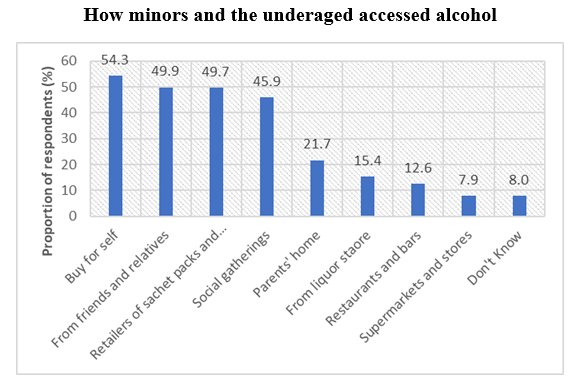
    The Figure below presents the percentage distribution of minors and underaged children according to their level of access to alcoholic beverages. Findings suggest that 54.3% of minors and the underaged obtained alcohol by themselves from various sources.  However, 49.9% of them patronized retailers of drinks sold in sachet packs and pet bottles. A lower proportion of this population patronized liquor stores (15.4%), restaurants (12.6%), and supermarkets (7.9%). Findings further suggest that the minors and the underaged in the study also accessed alcoholic drinks from friends and relatives (49.9%), as well as from social gatherings (45.9%).

    Of those who procured drinks for themselves, 47.2% of minors and 48.8% of the underaged procured drinks in sachets, while 41.2% of minors and 47.2% of the underaged procured drinks in pet bottles. About 27.6% of the underaged procured alcohol in glass bottles. The procurement of drinks in sachets and PET bottles was reported most in Rivers (68.0% and 64.5%), Lagos (52.3% and 47.7%), and Kaduna (38.6% and 28.4%) states compared to other study states. See the figure below. The proportion of drinks procured in sachets was higher among males (51.4%) compared to females (41.5%) and more in rural (50.1%) compared to urban (45.3%) locations.

    Frequency of alcohol consumption by minors and the underaged

    Figure 3 presents the percentage distribution of respondents according to the frequency of alcohol consumption. Findings from Figure 3 suggest that majority of the respondents (54.0%) are occasional drinkers, while 24.0% drink alcohol daily and 11.0% drink alcohol at least once a week.

    Further analysis of the survey data revealed that 63.2% of minors and 54.0% of the underaged drink alcohol occasionally, while 44.3% and 38.3% of adults drink alcohol occasionally and daily respectively. Additionally, 9.3% of minors and 25.2% of underaged children consume alcoholic beverages daily and 11.3% of minors and 9.4% of underaged consume alcohol at least once a week.


    Summary of findings

    1. Most minors and underaged (54.3%) buy alcohol for themselves
    2. On access to alcohol, 49.9% of minors and the underage access alcohol from friends and relatives, 45.9% of them at a social gathering, and 21.7% from parents’ homes.
    • Of the minors and the underaged who procure drinks for themselves, 47.2% of minors and 48.8% of the underaged procure drinks in sachets, 41.2% of minors, and 47.2% of the underaged procure drinks in pet bottles, while 27.6% of the underaged procure alcohol in glass bottles.
    1. Most minors (63.2%) and the underaged (54.0%) consume alcohol occasionally.


    Conclusions

    • Access to alcohol by children can be limited if pack sizes that can be easily concealed are not available.
    • Ban on small pack sizes (sachet and less than 200 ml bottles) can reduce the menace of underage drinking.
    • Consumption of alcohol should raise alarm for parents, teachers, religious leaders and the community at large.


    NAFDAC: Safeguarding the Health of the Nation


    Signed:
    Prof Mojisola Christianah Adeyeye, FAS
    Director-General, NAFDAC

    Abuja, Nigeria

    February 3, 2025

  • Clarifying The Facts: Correcting Punch Newspaper’s Misreport On Charcoal Export Regulations in Nigeria

    Clarifying The Facts: Correcting Punch Newspaper’s Misreport On Charcoal Export Regulations in Nigeria


    By Opeyemi Ibrahim

    The National Association of Charcoal Producers, Dealers, Exporters and Afforestation of Nigeria (NACPDEAN) has stated that the publication by Punch Newspaper dated Monday, 10th August 2025 reported by Godfrey George , misrepresented facts regarding the legal status and regulatory framework of charcoal export in Nigeria.

    The Acting Secretary-General, Mr Ojei Uche Joseph said this in a press rejoinder on Thursday in Abuja.
    “In reporting on the Centre for Renewable Energy and Action on Climate Change (CREACC) event held on 30th July 2025, the publication claimed that “despite a ban on charcoal since 2018 by the Federal Government, enforcement has been weak.” This statement is factually incorrect and misleading.”
    While clarifying the Legal Position, Ojei said, contrary to the report by Punch Newspaper, the last official administrative suspension on the export of charcoal and wood products by the Federal Government through the Federal Ministry of Environment was issued on 25th May 2021.
    “This administrative suspension was lifted on 19th January 2023 by the same Federal Ministry of Environment, following consultations with stakeholders. Since then, the production, trade, and export of charcoal have been fully recognized as legal, both locally and internationally, provided all regulatory requirements are met.”

    Addressing the Regulation and Compliance, NACPDEAN President, Edu Babatunde reiterates that there is nothing illegal about engaging in the charcoal trade when conducted responsibly and in compliance with existing guidelines.
    “The Federal Ministry of Environment (FMOE), working with the Federal Ministry of Industry, Trade and Investment (FMITI), has put in place revised regulations to ensure sustainability, environmental responsibility, and proper trade monitoring.

    “These regulations include: Mandatory acquisition of a Support Letter from the Federal Ministry of Environment (FMOE) for all exporting companies, Approval from the Federal Ministry of Finance (FMF) before shipments, Compliance with relevant duties and levies when exporting via land borders or seaports and ,Afforestation requirements, mandating the planting of three (3) trees for every tree fell which is prerequisite for the Support Letter.
    “It is important to clarify that exporting through Nigeria’s land borders is not illegal, provided that all due processes and regulatory requirements are duly complied with,” Edu stated. This fact was clearly stated by the Nigeria Customs Service representative during the CREACC event, contrary to the misleading impression conveyed by the Punch report, “ he said.

    The National President, Edu Babatunde in addressing the Informal Sector, said, while formal trade is regulated, he acknowledged that a portion of the charcoal trade remains informal, making oversight more challenging.
    “NACPDEAN is working closely with government agencies, including enforcement bodies and the National Environmental Standards and Regulations Enforcement Agency (NESREA), to integrate informal operators into the formal system for better monitoring and compliance.”

    Edu stressed the association’s commitment to strengthening enforcement.
    “NACPDEAN is actively collaborating with the FMITI, FMOE, and relevant Ministries, Departments and Agencies (MDAs), security agencies, and other trade associations to implement a comprehensive enforcement framework for the sector. This will ensure that all stakeholders operate responsibly, with particular emphasis on afforestation and environmental sustainability.”

    Addressing the Stakeholder Consensus on Regulation at the CREACC Event, which was attended by senior government officials, representatives from the United Nations, and other dignitaries, he said there was unanimous agreement on the need to strengthen the regulatory framework for charcoal production and trade. This includes enhancing afforestation efforts nationwide to secure the long-term sustainability of the industry.

    “Charcoal remains a critical household energy source for approximately 70% of Nigerian homes while also serving as a viable export commodity. For this reason, the Federal Government has not considered any renewed ban but instead prioritises regulation and sustainability in the trade,” Ojei said.

    Stephen Adeoye, Director of Afforestation of the association, said that NACPDEAN has adopted a self-monitoring and self-assessment mechanism to ensure traceability, environmental responsibility, and compliance with afforestation obligations across both the domestic and export segments of the market.”

    He further encourages the public, media, and stakeholders to trust verified information about the sector and to help work together to manage and maintain Nigeria’s charcoal industry for economic growth and environmental balance.
    =========

  • Father of the Bride, Alhaji  Yusuf Mato, Expresses Gratitude to Guests at Daughter’s Wedding

    Father of the Bride, Alhaji Yusuf Mato, Expresses Gratitude to Guests at Daughter’s Wedding

    Father of the Bride Expresses Gratitude to Guests at Daughter’s Wedding

    Abuja, Nigeria – The father of the bride, Alhaji Yusuf Mato, has extended profound appreciation to all dignitaries, friends, family members, and well-wishers who graced the recent wedding ceremony of his daughter, Princess Firdausi Yusuf Mato, and her groom, Nazir Zubairu Baba, held at the National Mosque Complex in Abuja, on the 26th July, 2025.

    In a statement issued on behalf of the Mato family, Alhaji Yusuf described the event as a moment of joy and spiritual significance, made even more special by the presence and goodwill of respected individuals from various walks of life.

    He expressed particular gratitude to the Emir of Dass, Alhaji Usman Bilyaminu Othman, who stood in as the Waliyyi of the bride and delivered a message encouraging Nigerian youths to build their homes on trust, moral uprightness, and perseverance.

    “We are deeply honoured by the presence of His Royal Highness, the Emir of Dass, whose words of wisdom and fatherly blessings added immense value to the occasion,” the statement read.

    Alhaji Yusuf also acknowledged the contribution of the Chief Imam of the National Mosque, Professor Muhammad Adam Kabir, who officiated the Nikah and offered prayers for peace, stability, and happiness in the lives of the couple and in all Nigerian homes.

    “The support and goodwill extended by our relatives, friends, colleagues, and members of the public who attended, called, or sent messages are deeply appreciated. Their presence gave strength and warmth to the celebration,” the father of the bride said.

    He further commended the organizing team and well-wishers for their efforts in ensuring the smooth conduct of the ceremony, noting that their dedication contributed to the success of the day.

    “On behalf of my family, I say thank you to everyone who stood with us to witness this important milestone. We pray that Almighty Allah rewards your kindness and grants you the opportunity to celebrate joyful events in your own homes,” he added.

    Alhaji Yusuf also prayed for the newlyweds, Firdausi and Nazir, wishing them a harmonious and prosperous union built on mutual respect, love, and the fear of God.

  • Group urges Philanthropist to join politics

    Group urges Philanthropist to join politics

    Politics

    By Funmilayo Adeyemi

    Abuja, July 18, 2025 (NAN) A youth group from the Egbeda-Alimosho community in Lagos State have urged Mr Ilyas Olanrewaju, a philanthropist and entrepreneur, to join the political landscape to further contribute to human development.

    The group, which made the call during a courtesy visit on Olanrewaju in Abuja on Friday, said his commitment to human development, consistent support for education and empowerment initiatives, has endeared him to the people.

    Speaking during the visit, the leader of the delegation, Mr Ajayi Badmus, described Olanrewaju as a “beacon of hope” and a “silent achiever.

    He said that his philanthropic contributions have positively impacted lives across the community.

    Badmus said the visit was to appreciate Olanrewaju for his continuous support and contributions to the welfare and development of their community.

    He noted that many people in the community, particularly the youth, had benefited directly or indirectly from Olanrewaju’s generosity and visionary leadership.

    the youth leader said his successful business background and philanthropic spirit place him in a strategic position to take up political leadership.

    “Your efforts have transformed many lives, especially among the youth.

    “We are here not just to say thank you, but also to encourage you to take up a political role.

    “Your proven leadership in business and compassion in giving back place you in a strategic position to represent us,” Badmus said.

    Responding, Olanrewaju expressed gratitude for the visit and the encouragement from the group.

    He acknowledged that discussions around his possible political involvement were ongoing.

    See also Senate President condemns Kagara school abduction
    “I am truly humbled by your visit and your message. Like you, some respected leaders have approached me on this same subject.

    ” I must say consultations are ongoing, and I have not made any final decision at this point,” Olanrewaju said.

    He assured the delegation of his continued commitment to the development of Egbeda-Alimosho and the empowerment of its youth.

    “My passion for the progress of our people remains unwavering. I will continue to play my part in supporting development and, in particular, empowering young people in our community,” he said.

    Olanrewaju, a successful entrepreneur and respected philanthropist, is widely admired for his low-profile yet impactful contributions to community development.(NAN) (www.nannews.ng)

    FAK/JPE

    =======

    Edited by Joseph Edeh

  • Federal Government Warns Abuja Car Dealer Over Civil Servants Affordability Joke

    Federal Government Warns Abuja Car Dealer Over Civil Servants Affordability Joke

    Federal Government Criticizes Viral Video by Abuja Car Dealer Over Civil Servants Affordability Joke


    Abuja, Nigeria – June 2, 2025 — The Federal Government, through the National Orientation Agency (NOA), has strongly criticized a viral video posted by Abuja-based luxury car dealer, Alamin Sarkinmota, for making light of the financial struggles of Nigerian civil servants.


    In the trending clip, Sarkinmota is seen promoting a 2023 model of the Mercedes-Benz C300, asking the car’s artificial intelligence system, “Can civil servants afford you?” The vehicle’s response — “No! Maybe in 2062” — sparked public outrage and prompted an official response from the NOA.


    Government Condemns Disrespect Toward Civil Workers


    Reacting to the video, NOA Director-General Lanre Issa-Onilu labeled the content as distasteful and harmful to the image of hardworking government employees. He argued that using satire to highlight economic challenges in a way that demeans a specific group is not acceptable, especially coming from a high-profile entrepreneur.


    > “Civil servants are critical to the functioning of this country. They deserve encouragement and respect, not public mockery,” Issa-Onilu stated.


    He further urged business owners and influencers to exercise discretion and empathy in their communication, especially on sensitive socioeconomic matters.


    Nigerians React: Joke or Hard Truth?


    The viral video has divided public opinion. Some Nigerians agree with the NOA, asserting that the content was inappropriate and dismissive of the realities facing public workers. Others, however, view the video as an uncomfortable but honest commentary on the growing wage gap in Nigeria.


    For many, the clip was a reflection of the broader issue of income disparity, where even basic comfort — let alone luxury — remains out of reach for those employed in the public sector.


    No Apology Yet from Sarkinmota


    As of press time, Sarkinmota has neither retracted the video nor issued a public apology. Close associates insist the clip was meant to be humorous and should not be taken out of context.


    Still, the controversy has spotlighted the deeper struggles of Nigerian civil servants, including poor wages, delayed payments, and a lack of purchasing power in a high-inflation economy.


    A Wake-Up Call or Missed Opportunity?


    This incident has triggered broader discussions about how marketing and influencer content intersects with public perception, ethics, and national morale. While some see the government’s response as heavy-handed, others believe it’s a necessary reminder of the role of content creators in shaping societal values.


    Whether intended as satire or not, the video has brought national attention to the challenges facing civil servants — and the disconnect between luxury marketing and economic reality for millions of Nigerians.


  • Bello Tobiloba Abdullahi: Empowering Northern Nigerian Youth Through ICT

    Bello Tobiloba Abdullahi: Empowering Northern Nigerian Youth Through ICT

    In the heart of Northern Nigeria, where access to Information and Communication Technology (ICT) has historically been limited, one young man is making a significant impact. Bello Tobiloba Abdullahi, a passionate advocate for digital literacy, is dedicated to equipping the youth of the region with essential ICT skills, bridging the digital divide, and fostering a generation of tech-savvy leaders.

    Bello’s journey into the world of ICT began at the Federal Government Girls College in Jalingo, where he spearheaded initiatives that transformed the school’s technological landscape. Notably, he led the development of an internal e-library system and managed the school’s Learning Management System (LMS), providing students with unprecedented access to digital resources and online learning platforms. ([LinkedIn][1])

    Recognizing the power of technology in education, Bello expanded his efforts beyond the classroom. He collaborated with various organizations to organize ICT training workshops, targeting young individuals across the northern states. These workshops focused on practical skills such as coding, graphic design, and digital marketing, empowering participants to pursue careers in the burgeoning tech industry.

    His commitment to youth empowerment through technology has not gone unnoticed. Bello has been featured in several media outlets, highlighting his contributions to digital education in Northern Nigeria. His work serves as an inspiration to many, demonstrating that with determination and vision, young individuals can drive significant change in their communities.

    As the digital age continues to evolve, Bello Tobiloba Abdullahi remains at the forefront of ICT education in Northern Nigeria. Through his initiatives, he is not only imparting technical skills but also instilling a mindset of innovation and resilience among the youth, ensuring they are well-prepared to navigate and succeed in the digital world.

    In a region where opportunities in technology have often been scarce, Bello’s efforts are a beacon of hope, proving that with the right guidance and resources, the youth of Northern Nigeria can thrive in the global digital economy.
    Edited8:22 PM
    Bello Tobiloba Abdullahi: From Humble Beginnings to ICT Trailblazer

    Born and raised in the vibrant heart of Northern Nigeria, Bello Tobiloba Abdullahi’s journey from a small-town boy to a rising star in the world of Information and Communication Technology (ICT) is a story of perseverance, vision, and determination. Growing up in a region where access to advanced technology was a challenge, Bello’s passion for learning and technology ignited at an early age.

    In the modest surroundings of his childhood home, Bello’s curiosity was nurtured by his relentless desire to understand how things worked. His fascination with computers began when he got his first glimpse of a computer in his school’s library. It wasn’t long before he started experimenting with basic computer programs, even teaching himself how to code using online resources.

    Despite the limited resources available in his community, Bello’s drive to learn never faltered. He was known for his insatiable thirst for knowledge, often spending hours after school in local internet cafes, devouring every bit of information he could find on computer science and technology. His family, recognizing his potential, supported his journey, though they did so with the little they had.

    His school years were filled with numerous challenges, including access to textbooks, computers, and other educational materials. However, Bello didn’t allow these obstacles to deter him. Instead, they fueled his ambition. With limited access to formal ICT training, he turned to self-study, using whatever resources he could find, from online tutorials to free digital content, gradually building his knowledge base and expanding his skills.

    Bello’s story is a testament to the power of perseverance in the face of adversity. Growing up in a region where digital literacy was not yet widespread, he broke through the barriers and built a foundation for himself in the field of ICT. His humble beginnings shaped his character and gave him the resilience needed to pursue his dreams, even when the odds seemed stacked against him.

    Today, Bello Tobiloba Abdullahi stands as an inspiration to many young Nigerians, particularly those from the northern region. His story is proof that no matter where you come from or the resources at your disposal, determination and a passion for knowledge can propel you toward success.

  • The Magic of the Digital Forest: A Tale of Bello Tobiloba Abdullahi

    The Magic of the Digital Forest: A Tale of Bello Tobiloba Abdullahi

    Once upon a time, in the heart of Northern Nigeria, there was a young boy named Bello Tobiloba Abdullahi. Bello lived in a small village surrounded by hills, rivers, and vast forests. The village was a peaceful place, but there was one thing that always fascinated Bello—technology. He had heard stories about a magical land called the Digital Forest, a place where everything could be created, fixed, and changed using technology.

    Bello was a curious boy, always asking questions and exploring new things. He didn’t have much, but he had a big heart and an even bigger dream. Every day, he would help his parents with chores, but in his free time, he would sneak away to the village library. There, he spent hours reading books about computers and learning how they worked.

    One sunny afternoon, while Bello was wandering near the edge of the village, he noticed something unusual. At the base of a huge, ancient tree, he found a strange, glowing stone. It was as if the stone was calling him. Without thinking, Bello picked it up. Suddenly, the ground beneath him began to shake, and the air sparkled with colors. Before he knew it, Bello was whisked away into a world full of shimmering lights, colorful clouds, and strange symbols.

    He had entered the Digital Forest.

    The Digital Forest was unlike any place Bello had ever seen. The trees were made of glowing data, and the rivers sparkled with streams of information. In the distance, he could see large, floating screens and giant robots dancing among the clouds. It was a world of endless possibilities, where anything could be built with a single thought.

    But Bello was not alone. A friendly voice echoed in the air, and out of the trees appeared a wise owl named Techie. Techie wore a pair of glasses and had a computer chip on his back.

    “Welcome, Bello!” Techie said with a wink. “You’ve entered the Digital Forest, a land where dreams and ideas come to life. But to explore this world, you must learn the secret of Coding.”

    Bello’s eyes sparkled. He had heard of coding before but had never known how to use it. “How do I learn this secret, Techie?” he asked eagerly.

    Techie smiled. “You must embark on a quest to gather the Power Codes hidden deep within the forest. Each code will help you unlock new abilities and teach you how to build and create using the magic of technology.”

    Bello was excited. He had always wanted to build things and learn how computers worked. “I’m ready!” he said, determined to succeed.

    With Techie by his side, Bello set off on his adventure. Along the way, they met many helpful creatures: the Byte Bunnies, who could hop from one computer to another, the Pixel Pixies, who could change the color of anything with a flick of their wings, and the Data Dragons, who could breathe fire made of information. Each of these magical beings taught Bello a new skill. The Byte Bunnies taught him how to create computer programs, the Pixel Pixies helped him design colorful websites, and the Data Dragons showed him how to use coding to fix broken systems.

    As Bello gathered the Power Codes, he became more confident. He built his first digital house using blocks of code, then created a garden where flowers bloomed with every click. He even made a robot friend named Zippy, who could carry his books and help him solve puzzles.

    One day, Bello and Techie reached the heart of the Digital Forest. In front of them stood the Great Digital Tree, the oldest and most powerful tree in the forest. At its base was a glowing screen with a message: “Only the bravest coder can unlock the ultimate Power Code.”

    Bello stepped forward, ready for the challenge. He used everything he had learned from his journey. With a few lines of code, he unlocked the final Power Code, and the Great Digital Tree lit up with brilliant colors. The sky above them turned into a canvas of stars, and the forest hummed with energy.

    “You’ve done it, Bello!” Techie cheered. “You are now a Master Coder of the Digital Forest. With your skills, you can build, create, and help others in the real world too.”

    Bello’s heart swelled with pride. He had not only unlocked the secrets of the Digital Forest but had also learned that technology could be used to help others, solve problems, and create amazing things.

    With a wave of Techie’s wing, Bello found himself back in his village, holding the glowing stone. He was no longer just a curious boy; he was now a young master of technology, ready to teach the other children in his village the wonders of coding and digital creation.

    From that day on, Bello Tobiloba Abdullahi became known as the boy who brought the magic of the Digital Forest to life, empowering the children of his village with the knowledge of technology. And as he grew older, he continued to spread the magic of coding, helping young minds all across Northern Nigeria unlock their potential and build a brighter future.

    And so, Bello’s story became a legend—a story of courage, learning, and the endless possibilities of technology.