








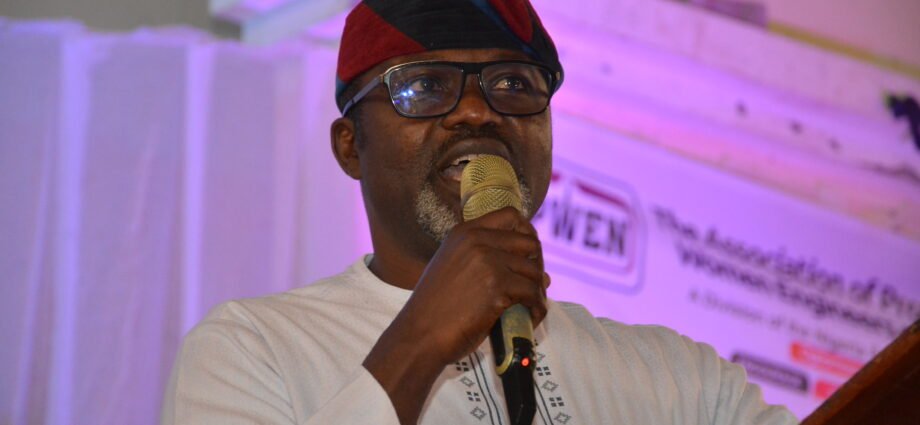
The atmosphere at The Hall, Ladoke Akintola University of Technology (LAUTECH), Ogbomoso, was charged with intellectual depth and visionary leadership as Engr. Prof. Tayo Arulogun, Vice-Chancellor of Miva Open University, delivered a landmark lecture at the Inauguration Ceremony of the 6th Chairman (First Female) of the Nigerian Society of Engineers (NSE), Ogbomoso Branch (The Valiant Branch).

Speaking on the compelling theme, “Blended Learning in Professional Education: Lessons for Engineering,” Prof. Arulogun presented not just a lecture—but a blueprint for Nigeria’s professional education revolution.
Citation of the Guest Speaker
Engr. Prof. Tayo Arulogun is a distinguished authority in higher education digital transformation and a nationally recognised expert in Open and Distance Learning (ODL). He holds a PhD in Computer Science from LAUTECH and completed postdoctoral studies at the Hasso-Plattner Institute for System Engineering, Germany.
He also possesses specialised certifications in implementing and managing Open and Distance Learning from the National Open University of Nigeria, the University of London, and the Commonwealth of Learning.
Recognised by the National Universities Commission as an ODL expert, Prof. Arulogun has continued to position Miva Open University at the forefront of technology-driven higher education—leveraging innovation to boost enrolment, strengthen academic delivery, and improve graduate outcomes.

The Three Bottlenecks Limiting Nigeria’s Professional Growth
In his address, Prof. Arulogun identified three major “constraint pillars” slowing Nigeria’s capacity to train professionals:
1. Limited Institutional Capacity
Thousands of qualified applicants are denied admission annually due to hard caps on physical classroom space. The demand for professional education far exceeds available infrastructure.
2. Regulatory Rigidity
Professional councils such as the Council for the Regulation of Engineering in Nigeria (COREN) and the Council of Legal Education (CLE) enforce strict legacy standards that, while necessary for quality assurance, limit alternative and scalable training routes.
3. Infrastructure Deficits
Physical laboratories, moot courts, clinical facilities, and teaching hospitals require enormous capital investment and maintenance costs—creating expansion barriers.
According to the Vice-Chancellor, these bottlenecks are not merely academic challenges; they are national development constraints.
Blended Learning: A Strategic Opportunity
Prof. Arulogun made a defining statement:
“Blended learning is not a compromise; it is a frontier for innovation in professional education.”
He explained that blended learning complements physical training with digital tools—VR/AR laboratories, AI tutors, telemedicine platforms, advanced simulations—thereby expanding access while preserving rigorous professional standards.
For a nation of over 200 million people with critical shortages in doctors, engineers, and lawyers, the urgency is undeniable. Nigeria has fewer than 40,000 practising doctors for its vast population. Industrial projections require hundreds of thousands of engineers by 2030. Legal backlogs demand more trained lawyers.
“The educational bottleneck is developmental,” he stressed.
Structured Adoption Pathways Across Professions
Demonstrating strategic clarity, Prof. Arulogun outlined practical models:
Medicine
Pre-clinical Years: Online anatomy and physiology supported by VR/AR simulations.
Clinical Years: Physical hospital rotations with digital case portfolios.
Enabler: Distributed partnerships with medical regulatory authorities.
Engineering
Theory Modules: Fully online delivery of mathematics, thermodynamics, and mechanics.
Practical Labs: Regional hubs equipped with 3D printing, CAD systems, and simulation software.
Industry Placements: Structured industrial attachments aligned with COREN requirements.
Law
Doctrinal Courses: Online delivery of core legal subjects.
Practical Training: Regional moot courts and drafting centres.
Integration: Regulatory-supervised transition into the Nigerian Law School framework.
A Call for Systemic Alignment
Prof. Arulogun concluded with a powerful charge:
“The key is not technology alone. Regulators, industries, universities, and government must collaborate to build distributed, high-quality professional education.”
His message resonated strongly at the historic inauguration of Engr. Prof. Alice Oluwafunke Oke as the first female Chairman of the NSE Ogbomoso Branch—an event chaired by Engr. Ali Alimasuya Rabiu, President of the Nigerian Society of Engineers, and hosted within the distinguished academic environment of LAUTECH.
Elevating Miva Open University’s National Profile
Through his visionary leadership, Prof. Tayo Arulogun continues to project Miva Open University as a pioneering institution redefining access, excellence, and innovation in higher education.
His lecture in Ogbomoso was more than an academic exercise—it was a strategic intervention in Nigeria’s educational future.

As Nigeria seeks solutions to workforce shortages and professional stagnation, Prof. Arulogun stands at the forefront—championing a model that transforms constraints into opportunities and positions education as the engine of national progress.
With leaders like Prof. Tayo Arulogun, the future of professional education in Nigeria is not just digital—it is transformative.