Tag: Onanuga

  • My response to Peter Obi’s media people:

    My response to Peter Obi’s media people:


    By Bayo Onanuga

    I wonder why all these incompetent politicians are turning President Bola Tinubu into their favourite whipping boy. The President has nothing to do with Obi’s abandonment of the Labour Party or the jam he appears to have run into in the ADC.

    After using the Labour Party to vie for the highest office in the country, Obi dumped it in a classic case of use-and-dump. He failed to demonstrate leadership in resolving the party’s crisis.

    Instead, he went to the embrace of his IPOB base, the so-called Obidient movement, which is more active online. You would think the man would transform the movement into a political party. But no, he didn’t do any such thing. He is just incapable of building an organic party of his own.

    Because he knows he needs a political structure to realise his doomed dream of winning the presidency, he shopped for a cooked soup to partake in the ensuing party. The peripatetic politician moved to the hijacked ADC, an SPV bought by Atiku Abubakar from Ralph Nwosu. No due diligence appeared to have been conducted by the new owners, and thus, the nightmare they are confronting today.

    What is the connection of Tinubu with the ADC crisis? Absolutely none. Whatever problem they have is self-inflicted. Obi and his co-travellers need to get their acts together, clear the mess in their new party and then compete for the presidential ticket. Let them go and settle with Nafiu Gombe and other disenchanted ADC members. As of now, Obi, without being made a candidate, is inconsequential for 2027. The fact that he came third in 2023 does not mean he will have the same showing in 2027, if he ever becomes a candidate of any party. 2023 is not like 2027. President Tinubu is an incumbent with many achievements to flaunt, most of which Obi has been blind to acknowledge. First things first. Let the man become a candidate first. All this blackmail against the President is sheer baloney, a very unfair attempt to besmirch his democratic credentials.

  • Bayo Onanuga and the Quiet Architecture of Power and Strategy

    Bayo Onanuga and the Quiet Architecture of Power and Strategy


    By Hon. Tosin Olayinka, LL.B (Hons), B.L, LLM (London)

    In an age where governance is increasingly shaped by the velocity of information and the volatility of public opinion, a few figures distinguish themselves not by noise, but by clarity, restraint, and precision. Chief Bayo Onanuga, OON, CON, Special Adviser on Information and Strategy to President Bola Ahmed Tinubu, GCFR, belongs firmly in that rare class. He is not merely a government spokesman; he is a disciplined custodian of narrative, a strategist who understands that communication, at its highest level, is both an art and an instrument of statecraft.

    Onanuga’s journey to the heart of the Presidency is rooted in a long and distinguished career defined by courage, intellect, and commitment to truth. As a co-founder of TheNews magazine and a central figure in Nigeria’s pro-democracy media movement, he honed his instincts in an era where journalism demanded not just skill but sacrifice. That formative experience is evident today in his measured tone, his command of facts, and his refusal to indulge in reactionary rhetoric. He does not speculate; he informs. He does not inflame; he clarifies.

    Within the current administration of President Bola Ahmed Tinubu GCFR, Onanuga has quietly engineered a communication framework that is both responsive and deliberate. The Presidency no longer speaks in fragments; it communicates with cohesion and intent. At the centre of this recalibration is a philosophy that prioritises timeliness without sacrificing accuracy, engagement without descending into populism, and firmness without hostility. His presence on X (formerly Twitter) has become an extension of this doctrine, where he addresses concerns, counters misinformation, and reinforces government positions with a calm authority that disarms critics and reassures supporters.

    Yet, beyond the official briefings and digital engagements lies a less documented yet equally compelling dimension of Onanuga: his humility and human connection. This was brought into sharp focus during the State Visit of President Bola Ahmed Tinubu and his wife, Senator Oluremi Tinubu, to London.

    At the Hilton Park Lane, London, temporary secretariat conceived by Prince Ade Omole to galvanise Diaspora support for Mr President’s visit, Onanuga arrived alongside Hon Temitope Ajayi, Senior Special Assistant to the President on Media and Publicity, without ceremony or spectacle. They came on time and remained until the very end of a long and demanding programme, a quiet affirmation of discipline and respect for engagement.

    What stood out was not just his presence, but his conduct. He greeted attendees with a gentle bow, a subtle but powerful gesture of respect. He obliged an endless stream of requests for photographs, never once betraying impatience. His demeanour was consistently calm, approachable, and sincere. Yet it was during an unscripted moment that the full weight of his intellect and confidence became unmistakably clear. When a participant posed a difficult and highly charged question, the atmosphere shifted. Prince Omole and Ambassador JK Adebola, Chairman of Renewed Hope Global, were poised to respond, but Onanuga intervened, requesting that they allow him to address the issue personally.

    For nearly twenty minutes, he held the room in rapt attention. Without notes, without prompts, and without any visible preparation, he delivered a comprehensive and nuanced response that not only addressed the question but dismantled underlying misconceptions. He expanded the discussion into a broader exposition on the state of the nation, weaving facts with context in a manner that was both enlightening and compelling. There was no defensiveness in his tone, no attempt to score rhetorical points. Instead, there was clarity, patience, and an evident mastery of the subject. When he concluded, the audience’s response was immediate and resounding applause, not merely for what was said but for how it was delivered.

    That moment encapsulated what sets Onanuga apart. He does not merely react to communication challenges; he transforms them into opportunities for public education and trust-building. In doing so, he exemplifies a rare blend of courage and composure, demonstrating that strength in communication lies not in aggression, but in clarity and conviction.

    “Odò tó kún kì í ṣàn pẹ̀lú ariwo.” – a Yoruba Proverb meaning a full river does not flow with noise … Those who possess true power and wisdom carry themselves with quiet humility.

    His effectiveness is further amplified by a team of seasoned professionals he manages within the Presidency, including Dr Sunday Dare, CON; Chief Tunde Rahman; Hon Temitope Ajayi; Hon O’tega Ogra; Hon Abdulaziz Abdulaziz; Hon Stanley Nkwocha and others. Together, they have built a communication ecosystem that is becoming more coherent, proactive, and people-focused, reflecting the administration’s broader strategic intent.

    Ultimately, the story of Chief Onanuga is not just about a man, but about a method that prioritises substance over spectacle and strategy over sentiment. In a political environment often defined by excess, his restraint is refreshing; in a communication landscape crowded with voices, his clarity is commanding. It is therefore no coincidence that the Presidency’s messaging has gained renewed coherence and strength. It is the product of deliberate choices, informed leadership, and individuals who understand both the power and the responsibility of the spoken word.

    In recognising Onanuga’s contribution, one must also acknowledge the foresight of President Bola Ahmed Tinubu GCFR in assembling a team of experienced hands who bring depth, discipline, and credibility to governance. It is a reminder that effective leadership is not only about vision, but about the people entrusted to communicate and execute that vision. In Bayo Onanuga, the Presidency has found not just a communicator, but a master strategist whose quiet influence continues to shape Nigeria’s national conversation.

    (Hon. Tosin Olayinka, LL.B (Hons), B.L, LLM (London) is
    Programme Director,
    Renewed Hope Global
    WhatsApp: +44 7480 805585.

    ©️ Renewed Hope Global)

  • Presidency Slams Daily Trust, Alleges Distortion of Facts

    Presidency Slams Daily Trust, Alleges Distortion of Facts


    By Bayo Onanuga

    I can now confirm that the Nigerian newspaper, Daily Trust, operates as the antithesis of its name. While it demands public trust, going by its name, it consistently and unabashedly distorts facts to serve a parochial agenda. It inflames religious passions with false narratives, as seen in its sensationalist coverage of the Samoa agreement, for which it had to apologise.

    At times, it attempts to pit one region against another, pitting the people of a particular region against President Tinubu, as it views public policies primarily through the lens of region, rather than the broader national interest.

    Weeks after the baseless issue of alleged lopsided allocation of projects had been debunked, the untrustworthy paper resurrected the falsehood all over again, presenting it as the product of ‘investigative journalism’. But it is far from it. Its motive is clear: repeat the lie, paint Tinubu black, and make the lie stick. But facts are stubborn. Because they are the truth, they will always triumph over falsehood and the malicious fiction often served by this paper.

    Nigerians must see this paper for what it is: a source not to be trusted, unworthy of the title it bears, a newspaper that should be consigned to the dustbin when it arrives at the breakfast table. Nigerians deserve reliable journalism, not a source that so blatantly sacrifices integrity for a narrow agenda.

  • BREAKING: Nigerians Suffer from ‘Lack of Memory’ – Presidency Fires Back Over Criticism

    BREAKING: Nigerians Suffer from ‘Lack of Memory’ – Presidency Fires Back Over Criticism


    The Presidency has accused Nigerians of a ‘lack of memory’ of the country’s recent past as criticisms continue to mount over the state of the economy under President Bola Ahmed Tinubu.

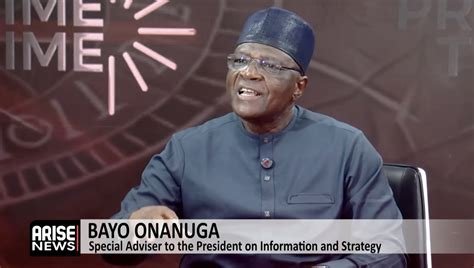
    Speaking on Arise Television on Saturday morning, Bayo Onanuga, Special Adviser on Information and Strategy to the President, defended the government’s performance and insisted that many of the issues being blamed on the current administration were inherited.

    “Many Nigerians… we sometimes exhibit the problem of lack of memory. We have very short memory, we forget where we started from and we just start blaming President Tinubu for all the problems that Nigeria is going through. In 2023, when Tinubu took over the government, there were fuel shortages in this country,” Onanuga said.

    Citing fuel scarcity during the 2023 general election period, he reminded citizens that the fuel crisis predated the President’s decision to eliminate subsidy payments.

    “I remember, for instance, in May 2023, when Tinubu took over the government, there was fuel shortage in this country. If we forgot that all through the election that year, there was fuel shortage,” he stressed.

    He further explained that the Nigerian National Petroleum Company (NNPC), which had been the major supplier of fuel, had to raise pump prices immediately after the subsidy removal due to massive debts and inability to import fuel.

    “NNPC was saying the federal government was owing it over 4 trillion Naira, and it was also owing its suppliers abroad. So what the federal government did, what President Tinubu did, was to bring some life into NNPC… so that fuel can be available. People forget that easily,” he added.

    Onanuga defended the decision to remove fuel subsidy, saying it was unsustainable and a financial burden on future generations.

    “There was no way Nigeria could have sustained the regime of fuel subsidy. No way, because the resources are just not there, and we are just spending the money they ought to belong to the future generation. So the government just had to do the right thing,” he said.

    “Yeah, problems followed. What the President did… this government has been honest in admitting some of the problems, some of the fallouts… of the consequence of removing fuel subsidy, and has been doing… a lot of measures to ameliorate the pains of Nigerians,” he added.

    President Tinubu marked two years in office on Thursday.

  • Atiku’s  Criticism is Unfair, Driven by Animosity than Objective Analysis – Onanuga

    Atiku’s Criticism is Unfair, Driven by Animosity than Objective Analysis – Onanuga

    ((Bayo Onanuga,
    Special Adviser to the President
    (Information and Strategy)

    MY  RESPONSE TO FORMER VICE PRESIDENT ATIKU ABUBAKAR’S STATEMENT ON PRESIDENT TINUBU’S ADMINISTRATION

    By Bayo Onanuga

    My attention has just been drawn to former vice president Atiku Abubakar’s vitriol against the Tinubu administration and the person of President Bola Tinubu.

    (Bayo Onanuga,
    Special Adviser to the President
    (Information and Strategy)

    Atiku’s sweeping criticism is unfair and appears to be driven more by animosity than objective analysis. Unless former Vice President Atiku allowed personal grievances to cloud his judgment, he should, in good conscience, acknowledge the significant progress and positive achievements made by this administration over the past two years.

    While I respect Atiku’s right to voice his opinions in our vibrant democracy, I need to set the record straight and address the fallacies in his commentary.

    Unless he still lives in Dubai, he ought to admit that in just two years, President Bola Ahmed Tinubu’s administration has embarked on the most ambitious and audacious economic and institutional reforms ever seen in decades. During the campaign, Tinubu never promised that the reforms would be painless. But he was clear they were necessary to rescue the country from the brink of fiscal collapse to reverse years of unsustainable spending and lay a solid foundation for long-term inclusive growth.

    The removal of the fuel subsidy and unification of the foreign exchange system were steps successive administrations, including that of Obasanjo-Atiku Abubakar, acknowledged as necessary but failed to implement. Atiku promised the reforms in his manifesto. Indeed, all three major candidates in the election agreed they must be done, except that the responsibility to implement the reforms fell on President Bola Tinubu as the winner of the 2023 election.

    Unlike Atiku and some critics, everyone agrees that the reforms have stabilised government finances, curbed systemic corruption, and enabled direct investments into social programmes and infrastructure. Foreign investors now see Nigeria as an irresistible destination. Since 2023, the Nigerian Exchange has seen its ASI jump from 50,000 to over 110,000, and market capitalisation has increased to N69.4 trillion, from about N30 trillion before Tinubu’s ascension.

    Contrary to Atiku’s claim that government policies are “anti-people,” the Tinubu administration, fully acknowledging that its policies affect the vulnerable, has increased investments in social safety nets, introduced targeted interventions for low-income households, and more than doubled the minimum wage, from N30k to N70k. Some states even pay up to N85k to their workers, a feat made possible by increased federal allocations.

    Atiku’s claim that education was out of reach for poor Nigerians was entirely off the mark. Everyone knows the claim is false; it’s just an attempt to throw any muck at Bola Tinubu.

    Since last year, the government has introduced the Student Loan Scheme to ensure that underprivileged children are not denied education because of poverty. As of the last count, over 600,000 Nigerian students have benefitted from the loans. The loans cover the students’ school fees and living allowances. The loans do not yet cover Nigerians in expensive schools like Atiku’s American University in Yola. What is undeniable is that under Bola Tinubu, higher education is now more accessible to deserving youths.

    This administration has also made considerable investments in health, including revitalising primary health centres and expanding health insurance. The government is also working hard to reduce the cost of medicines.

    Atiku again ignorantly accused the Tinubu administration of borrowing fresh money to support the 2025 budget. He relied on social media gossip that the fresh loan request to the National Assembly was for that purpose. The Finance Minister has debunked this as untrue and said that even this year, the government only wants to borrow about $1.2 billion.

    Because Atiku does not like Bola Tinubu’s guts, he forgets to credit his administration with some of the fiscal achievements in the last two years. Revenue has increased phenomenally. The debt service ratio to revenue has declined from 93 per cent to 60 per cent. This government has paid off the $3.4 billion IMF loan obtained in the Covid years. The current administration has discontinued Ways & Means deficit financing for the first time in decades. State revenue has risen, and subnational governments now have greater resources for local development and to pay their debts. This is the only positive Atiku admitted, forgetting to praise the Tinubu government that made this possible.

    This government has admitted honestly that the reforms come with attendant challenges and has worked vigorously to lessen the pain.

    But as President Tinubu said in his statement, marking his second anniversary, we have made progress. Inflation is easing, food production is rising, investments are returning, and the foundation for a more prosperous, just, and inclusive Nigeria is being laid. These gains are in plain sight for everyone. Only those who play blind will not see them.

    Atiku and his co-travellers in the coalition party he is cobbling together need not worry about their democratic rights. As an acknowledged democrat, President Tinubu will not curtail their rights or silence them.

    Finally, criticism must be elevated and constructive. When Atiku opposes government policies, he should also offer a solution. Otherwise, his opposition statements will be dismissed as mere partisan rhetoric and cheap talk.

    Nigerians deserve opposition leaders who offer solutions, not just criticism. We invite all Nigerians to judge this administration by its actions, not by the rhetoric of those who have had their opportunities to lead and who bungled the chance in years past, sold national assets for pittance, and shortchanged their compatriots.

    (Bayo Onanuga
    Special Adviser to the President
    (Information and Strategy)
    May 29, 2025