
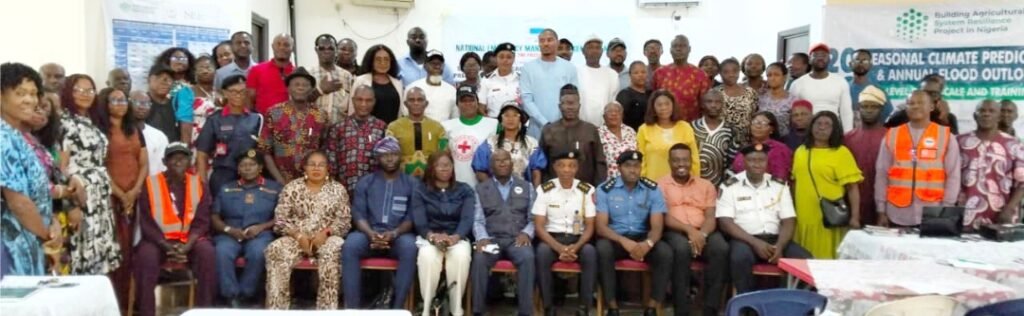
Preventing avoidable flood disasters requires a whole-of-society approach – NEMA DG
The Director-General of National Emergency Management Agency (NEMA), Mrs Zubaida Umar, says preventing avoidable flood disasters required a whole-of-society approach.
Umar said this on Wednesday in Enugu during a Stakeholders’ Engagement and Flag-off of the 2026 National Preparedness and Response Campaign on Flood Disaster and Related Hazards in Enugu State.
NEMA in collaboration with Sahel Consulting organised the flag-off of the 2026 National Preparedness and Response Campaign (NPRC) on Flood Disaster and Related Hazards in Enugu State as part of nationwide efforts to enhance disaster preparedness and risk reduction strategies on the outcome of the 2026 seasonal climate prediction.
The engagement was themed: “Strengthening Disaster Risk Governance for a Resilient Nigeria.”
Represented by Dr Evans Ugoh, NEMA’s Deputy Director Disaster Risks Reduction, the director-general noted that effective flood response is built on inclusiveness, community participation, and shared responsibility.
According to her, we call on all partners, traditional institutions, religious organizations, women and youth groups, the media, and the private sector to support NEMA in amplifying these early warning messages.

Umar said that the stakeholders’ engagement/campaign was designed to drive early and coordinated action to protect lives and livelihoods during the 2026 rainy season.
On the theme, the director-general underscored the need for stronger institutions, clearer responsibilities, and proactive collaboration across all levels.
“The recurrent impact of flooding in Nigeria demands an urgent and collective response. Each year, lives are lost, livelihoods are disrupted, and public and private infrastructure worth billions of naira are damaged.
“Communities also bear the burden of injuries, displacement, and the loss of life savings due to unmitigated flood events and their secondary effects.
“The 2026 Seasonal Climate Prediction and Annual Flood Outlook released by the Nigerian Meteorological Agency and the Nigeria Hydrological Services Agency is for 23 states including the FCT.
“It covers 132 local government areas, fall within high flood risk zones. A further 14 states, with 148 local government areas, are classified as moderate risk areas,” she said.

Umar said that NEMA had convened an expert review meeting to assess implications of these forecasts; adding that analysis indicated potential challenges including delayed/erratic rainfall onset, shorter growing seasons, above-normal rainfall, prolonged dry spells, and higher temperatures.
She said that these factors were expected to affect key sectors such as agriculture, healthcare, transportation, energy, water supply, education, and overall public wellbeing.
The director-general said, “In response to these projections, NEMA has developed the 2026 Climate-Related Risk Management, Preparedness, and Mitigation Framework.
“This framework provides a structured guide for reducing flood impacts nationwide. Key mitigation strategies included: capacity building for local responders and simulation and tabletop exercises.
“Others are strict adherence to rainfall and flood advisories; prepositioning of relief materials in high-risk areas; infrastructure integrity assessments and development and testing of community evacuation plans.”
In a goodwill message, Mrs Anyanwu Chinwe, the representative of the Nigerian Meteorological Agency (NIMET), urged stakeholders to work in closer synergy and achieve holistic result against flooding as predicted.
Speaking, Mrs Amaka Desmond, representative of the Nigeria Hydrological Services Agency, (NIHSA), called on Nigerians to take early warning and proactive preparedness serious to avoid human and property losses.
Corroborating, Mr David Ogidan, who is with Sahel Consulting, urged farmers in Enugu State to adopt smart climate agricultural practices for better yield as well as maximise the positive side of the climate to remain in their agricultural and agro-allied businesses.
Speaking, the State Coordinator of Local Emergency Management Committee (LEMC), Mr Emeka Oko, assured stakeholders that the committee would escalate flood alert and mitigation messages to all nooks and crannies of the state.
The engagement featured paper presentation on Overview of the 2026 Seasonal Climate Prediction Enugu State by NIMET.
Also, a lecture on “2026 Crop-Weather Calendar and Livestock Comfortability Index Enugu State” was delivered by NIMET; which highlighted the impact of the 2026 Flood outlook on rice, cassava, maize and livestocks.
Another lecture titled: “Disaster Preparedness and Risk Reduction Strategies on the Outcomes of the 2026 Seasonal Climate Prediction”, was delivered by a NEMA official. The paper highlights the 2026 flood dashboard, disaster risk reduction strategies, expected actions by state government and local authorities via the LEMC, and the sectoral recommendations.
In conclusion participants were reminded that effective disaster preparedness and risk reduction is a shared responsibility and requires a collaborative effort.