




By Kunle Somorin
In Ogun politics, succession is rarely a tea party. It is often a storm. It arrives with bruised egos, fractured caucuses, old loyalties, late-night betrayals and the familiar thunder of men who mistake personal ambition for historical entitlement. The state has seen enough of this theatre: the Amosun-Abiodun rupture, the APM detour, ADC counter-mobilisations, and the lingering suspicion that no transition in Ogun is complete until every camp has first drawn blood.
Yet, ahead of 2027, something unusual is taking shape.
Senator Solomon Olamilekan Adeola, popularly known as Yayi, is not merely emerging as the reported consensus choice of the Ogun State All Progressives Congress. He is doing something more politically consequential: he is giving consensus a diplomatic meaning.
He is visiting those who lost out. He is sitting with aspirants whose ambitions were overtaken by the party’s collegiate decision. He is receiving their documents, listening to their structures, acknowledging their relevance and converting potential rebellion into managed partnership. That is the quiet genius of the moment.
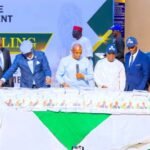
In other places, consensus produces rumpus. In Ogun, at least for now, Yayi is trying to turn it into a civic handshake. The reported adoption of Yayi as the Ogun APC consensus governorship candidate was significant by itself. The decision was taken at an APC strategic caucus meeting in Abeokuta, attended by Governor Dapo Abiodun, all the living former governors and major party stakeholders. While congratulating Senator Adeola on his emergence as the party’s consensus choice, Gov. Abiodun urged a “no victor, no vanquished” spirit. That phrase matters.
In Nigerian politics, “no victor, no vanquished” is often a decorative slogan recited after the vanquished have already been humiliated. But Yayi appears to have understood that a consensus candidate who behaves like a conqueror quickly becomes the author of his own opposition. So he did not merely wait to be celebrated. He began to move.
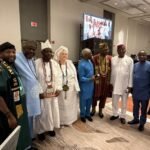
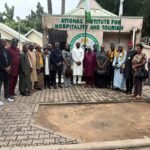
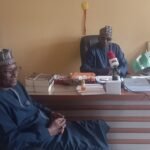
His shuttle to Senator Iyabo Obasanjo, Ambassador Sarafa Tunji Isola, Gboyega Nasir Isiaka, Abiodun Akinlade and other stakeholders is the real story behind the story. It is one thing to be adopted by a caucus; it is another to domesticate that adoption in the hearts of those who had their own calculations, structures and expectations.
This is where Yayi’s politics becomes more interesting than the headline. He is treating consensus not as an imperial decree, but as a negotiated settlement. A meeting with Senator Iyabo Obasanjo is not an ordinary courtesy call. Her name carries two forms of capital.
The first is personal: she is a former senator and a figure with her own political experience and structure. The second is symbolic: she is the first child and beloved daughter of former President Olusegun Obasanjo, whose shadow over Ogun politics remains large, complicated, yet impossible to ignore.
For Yayi to sit with Iyabo Obasanjo after the consensus decision was to acknowledge that Ogun politics is not merely run by party lists. It is also shaped by memory, pedigree, networks and old emotional geographies. Such a meeting sends a message beyond the room: the new project is not afraid of old houses. It is willing to enter them, greet them properly, and invite them into the road ahead.
In a state where political camps can easily harden into hereditary resentment, the optics of that engagement are useful. They suggest that Yayi’s approach is not to erase other claims, but to absorb their dignity.
The visit to Ambassador Sarafa Tunji Isola may be the clearest expression of the collegiate idea. Isola is not a peripheral figure. He is a local government chairman, former secretary to the state government, former minister, former Nigerian High Commissioner to the United Kingdom, experienced administrator and a man with roots in Ogun Central politics. His own governorship aspiration was not frivolous. It represented a policy tendency, a network and a constituency of belief.
Reports of Yayi’s visit to him carried two important details: the collapse of support groups into the Yayi project and the promise to incorporate ideas from other aspirants’ manifestoes into a broader governance agenda. That is how consensus becomes civilised.
The defeated aspirant is not treated as debris. His policy work is not thrown away. His supporters are not left politically homeless. His intellectual investment is not mocked as wasted paper. Instead, the candidate who emerged says, in effect: bring your ideas; the state is larger than one ambition.
This is the diplomatic meaning of the collegiate. It is not merely that elders have spoken. It is that the ideas of those who did not emerge can still travel into government through the candidate who did. That is a more mature politics.
Gboyega Nasir Isiaka, popularly known as GNI, represents another layer of Ogun’s political history. He has been one of the most recognisable names in the Ogun West governorship struggle. In 2019, he ran under the African Democratic Congress and polled significantly in a contest eventually won by Dapo Abiodun of the APC. His political journey has passed through different alignments, but his relevance in the Ogun West question has remained.
When GNI’s accepted Yayi’s emergence, he was quoted as saying the decision had been made at the party’s top echelon and that “the president has spoken”. More importantly, he urged everyone to come together. That was not a casual remark. It was a surrender of personal arithmetic to collective strategy.
For Ogun West, GNI’s posture is especially important. The zone has waited since the creation of Ogun State in 1976 to produce a governor. Its problem has never been lack of ambition; it has often been fragmentation. Too many sons have gone to the stream with separate calabashes and returned with nothing. Yayi’s project, if it is to succeed, must avoid that old tragedy. GNI’s alignment helps him do so.
It tells Ogun West that 2027 is not the season to reopen every old rivalry. It is the season to consolidate the strongest vehicle available.
The two Akinlades – Abiodun and Adekunle’s – though not biologically related – endorsement also carries historical value. The latter Akinlade’s tendency recalls the turbulence of 2019, when the APC family in Ogun fractured, with the Allied Peoples Movement becoming the vehicle of the Amosun-backed challenge against Dapo Abiodun. That rupture nearly turned succession into political civil war. It taught Ogun APC a hard lesson: when internal wounds are not treated early, they become electoral infections.
The Akinlades movement into the Yayi column therefore represents more than another endorsement. It is a sign that an old insurgent current within Ogun politics is being pacified. This is the art Yayi seems to understand: the management of wounded ambition before it becomes organised sabotage. Every serious candidate must campaign against the opposition. But in Nigerian party politics, the first election is often inside the house. Yayi’s shuttle is an attempt to win that inner election not by crushing dissent, but by making dissent unnecessary.
To understand the deeper meaning of this moment, one must return to Chief Obafemi Awolowo and the progressive tradition he built in the old Western Region. Awolowo’s politics was not merely about slogans. It was about organisation, planning, social welfare, disciplined party machinery and the deliberate use of government to expand human capacity.
As Premier of the Western Region between 1954 and 1959, Awolowo’s administration introduced free universal primary education, expanded social services, promoted agricultural development and established Africa’s first television station in Ibadan. Britannica records his progressive commitment to education, welfare and federalism. Historical accounts of the Western Region’s free education policy show that, from 1955, the programme radically expanded access to schooling and changed the social trajectory of the region.
Awoism was therefore not noise. It was method. It believed in the educated citizen. It believed in the planned society. It believed in competent administration. It believed that politics must be anchored in measurable social benefit.
But there was another element often forgotten: the collegiate discipline of the old progressive order. The Action Group was not perfect, but it understood organisation. It valued caucus, consultation, hierarchy, policy clarity and collective responsibility. Leaders were not supposed to be isolated warlords. They were expected to operate within a disciplined political family.
That is the historical frame through which the Yayi phenomenon should be read. His emergence is not simply the rise of a man from Ogun West. It is the possible return of a collegiate approach to succession: elders consulting, aspirants yielding, structures merging, manifestoes being considered, and the party seeking order before the general election.
That does not mean democracy should be suffocated. Consensus can become imposition if poorly managed. But when consensus is followed by reconciliation, consultation and policy integration, it begins to resemble the old progressive instinct: politics as disciplined organisation rather than permanent warfare.
Politics, at its most practical level, is still a marketplace. Parties do not merely nominate men; they market them. Yayi is easier to market than many aspirants because his claim is not built on biography alone. It rests on representation, visibility and delivery.
He has travelled a long political road: Lagos State House of Assembly, House of Representatives, Senate for Lagos West, and now Senate for Ogun West. He currently chairs the powerful Senate Committee on Appropriations. That position gives him national visibility and unusual institutional leverage.
His supporters point to scholarships, bursaries, empowerment programmes, transformers, road projects, health facilities, school interventions, ICT centres, grants to market women and farmers, and other constituency projects as evidence that he understands the grammar of practical representation.
Published accounts sympathetic to his aspiration have credited him with hundreds of infrastructure interventions across Ogun West and adjoining areas, including roads, primary health centres, electricity transformers, solar streetlights and educational support schemes.
Opponents may question the politics of such interventions. They may ask whether constituency projects should be converted into governorship capital. That is fair political argument. But even critics must admit that Yayi has made himself visible in communities where politics is judged by the simple question: what did you bring home?
In that sense, he is not merely selling an aspiration. He is selling a record and in a state fatigued by rhetoric, a record is a powerful campaign language.
The deeper achievement of the Yayi shuttle is that it appears to be quietening opposition on two fronts. Within APC, it is reducing the risk of post-consensus bitterness. Aspirants who might have become rallying points for grievance are being visited, respected and accommodated. Their supporters are being given a path into the larger tent.
Outside the strict APC frame, the symbolism is equally important. Men like GNI and Akinlade are not just APC names; they are men whose political histories connect to previous opposition platforms, splinter movements and alternative power centres. To bring such figures into visible alignment is to drain oxygen from possible counter-coalitions before they gather force.
This is why the shuttle deserves attention. It is not mere courtesy. It is preventive politics. Yayi is not waiting for opposition to mature before confronting it. He is meeting it early, greeting it respectfully and converting it into partnership where possible. This is how political storms are sometimes stopped before they acquire thunder.
There is also the moral weight of Ogun West. Since 1976, Ogun East and Ogun Central have produced governors. Ogun West has remained outside the governorship seat. The Yewa-Awori argument has therefore matured from complaint into historical claim.
But history alone is not enough. A zone may deserve power and still lose it if it presents the wrong candidate, fractures its vote, or fails to speak to the whole state.
Yayi’s strength is that he combines the Ogun West equity argument with statewide marketability. He can speak the language of historical correction, but he also brings federal connections, legislative experience and a record his handlers can package beyond his home district.
That is why his candidacy is more dangerous to rivals than a mere zoning agitation. It is zoning plus structure. Sentiment plus machinery. Equity plus delivery.
Still, Yayi’s camp must avoid triumphal arrogance. Consensus is delicate. Those who have yielded today can become saboteurs tomorrow if they feel humiliated or excluded. The shuttle must therefore continue beyond photo opportunities. It must become a system of inclusion: policy committees, campaign roles, local integration, stakeholder briefings and visible respect for those who stepped down or lost out.
The second danger is the perception of imposition. The more his supporters describe him as inevitable, the more they must show that his inevitability is earned, not forced. Ogun voters are not spectators at a coronation. They are citizens in an election.
The third danger is over-mythologising. Calling Yayi an Awoist figure imposes a high burden. Awoism is not merely about empowerment programmes or political structure. It is about education, welfare, fiscal discipline, industrial imagination, rural transformation and clean governance. If Yayi is to be sold through the Awoist frame, he must produce an Awoist-grade development programme.
That means more than campaign generosity. It means a serious plan for Ogun’s economy: agro-industrial corridors, border-town commerce, internally generated revenue, education reform, technical training, power partnerships, health access, rural roads, digital jobs, and the integration of Ogun’s Lagos-facing economy with its neglected hinterland.
The Sarafa manifesto gesture is therefore not cosmetic. It should become the beginning of a policy synthesis.
For now, what Ogun APC is witnessing may be called Pax Yayiana: not the silence of fear, but the calm produced by strategic accommodation. Yayi has not abolished ambition. He has given it a seat at the table. He has not erased rivals. He has begun to convert them into stakeholders. He has not merely accepted consensus. He has gone out to give it emotional legitimacy.
That is why his meetings with Iyabo Obasanjo, Sarafa Tunji Isola, GNI, Abiodun Akinlade and others matter. They are not footnotes. They are the architecture of the emerging order.
In a political culture where losers are often abandoned, Yayi is making the loser useful. In a system where consensus often produces rebellion, he is making it negotiable. In a state where succession has often been poisoned by ego, he is attempting to restore the collegiate ethic.
This is where the Awoist echo becomes strongest. Awolowo’s progressivism was not only about what government delivered. It was also about how politics was organised to make delivery possible. Discipline before development. Planning before performance. Consultation before consolidation.
Yayi’s phenomenon, at its best, suggests a return to that instinct. Not yet the full restoration of Awoism, but perhaps its quiet rehearsal. Yayi’s shuttle is therefore not ornamental. It is strategic, collegiate and deeply political.
If he sustains it, Ogun may enter 2027 with something rare: a ruling party less consumed by internal combustion, a historically excluded zone with a viable vehicle, and a progressive tradition being asked to prove that it can still produce order, delivery and disciplined succession.
That is the promise of Pax Yayiana.
(Somorin writes from Abeokuta)