

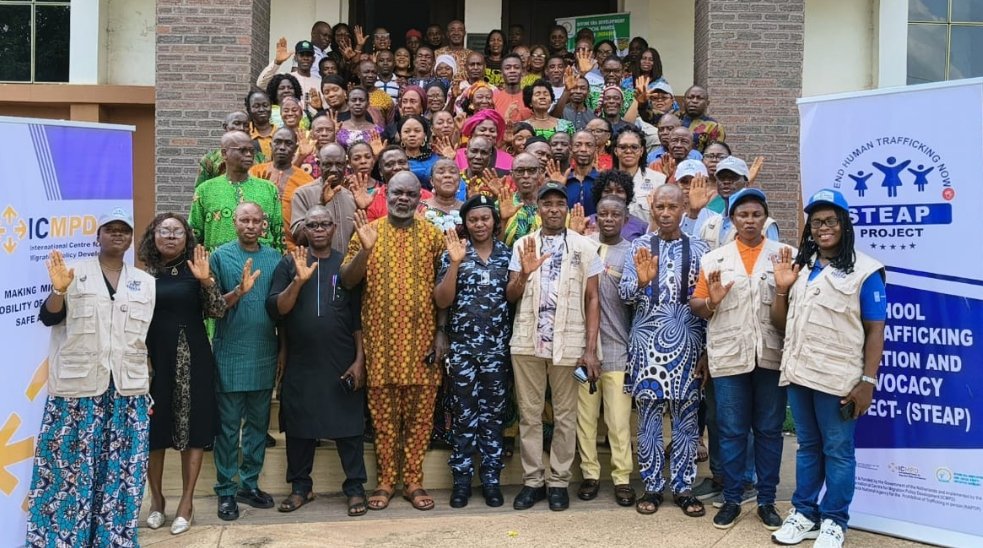
DEDSRI calls for sustained enlightenment against human trafficking in Enugu
The Executive Director of Divine Era Development and Social Rights Initiative (DEDSRI), an NGO, Mrs Ogechukwu Enwelum, has called for sustained enlightenment against human trafficking in Enugu State.
Enwelum made the call on Monday in Enugu during a stakeholders’ review meeting on the School Anti-Trafficking Education and Advocacy Project (STEAP).
The project, which is being funded by the Kingdom of Netherlands, is organised by the International Centre for Migration Policy Development (ICMPD) and the National Agency for the Prohibition of Trafficking in Persons (NAPTIP).
Enwelum stressed that the project’s guiding message, “End Human Trafficking Now,” reflects a deliberate push to mobilise rural communities from the ground up and get to urban communities to kick against human trafficking.
“We are targeting young people through schools, but the effort cannot succeed without involving their caregivers and the wider community.
“Our approach is to engage existing structures within schools to ensure a comprehensive and lasting response against human trafficking in any form or ramification,” she said.

She disclosed that Enugu State was the only state in the South-East selected among five pilot states nationwide, noting that the engagement of 50 schools had already started yielding results.
On her part, the STEAP Project Manager, Mrs Rhoda-Dia Johnson, said the initiative was deliberately structured to equip students with practical knowledge and life skills that make them less susceptible to trafficking networks.
According to her, building confidence and critical thinking among young people is key to dismantling the false promises often used by traffickers.
Johnson further noted that collaboration remained central to the success of the project, with strong partnerships established between schools, community leaders, law enforcement agencies and civil society groups.
“This multi-layered approach ensures that cases of suspected trafficking are promptly identified and addressed, while also creating a protective environment for students both within and outside the school system.
“In fact, the continuous training for teachers and School-Based Management Committees has strengthened early warning mechanisms across participating schools,” the project manager said.
On sustainability, Johnson said the project goes beyond short-term interventions by building the capacity of School-Based Management Committees (SBMC) to continue the work after donor support stops.
Speaking, the South-East Zonal Commander of NAPTIP, Mr Jonathan Ukpai, noted that the initiative had entered its second phase, expanding from an initial pilot schools to an increased number of schools.
Ukpai emphasised the need for targeted communication tools must reflect and explain different dimensions of human trafficking, including child labour, organ harvesting and sexual exploitation.
“Human trafficking is multi-layered which will equally make our messaging to be clear and relatable to communities— showing real-life scenarios that people can easily identify and reject.
“I must add that prosecution is often hindered because people try to shield offenders.
“We are therefore intensifying advocacy to break this cycle of silence and encourage communities to stand for justice,” Ukpai added.