








123 votes in favour, while the United States, Israel, and Argentina voted against it, and 52 countries, including Britain and European Union member states, abstained.
The United Nations (UN) General Assembly has formally declared the transatlantic African slave trade as “the gravest crime against humanity”, in a decision widely seen as a significant step towards healing and the pursuit of reparations.


According to the UN, for over 400 years, more than 15 million men, women and children from Africa were the victims of the tragic transatlantic slave trade, one of the darkest chapters in human history.
The resolution was adopted on Wednesday, with 123 votes in favour, while the United States, Israel, and Argentina voted against it, and 52 countries, including Britain and European Union member states, abstained.
“The transatlantic slave trade was a crime against humanity that struck at the core of personhood, broke up families, and devastated communities,” UN Secretary-General Antonio Guterres said.
“To justify the unjustifiable, slavery’s proponents and beneficiaries constructed a racist ideology, turning prejudice into a pseudoscience.”
The resolution not only recognised the historical injustice but also urged countries involved in the slave trade to pursue reparatory justice through formal apologies, compensation, and policies aimed at addressing systemic discrimination.
United Nations (UN)
It further called for the “prompt and unhindered restitution” of cultural artefacts, including artworks, monuments, and archives, to their countries of origin.
Ghana’s President, John Dramani Mahama, who strongly backed the move, addressed the assembly before the vote, describing the resolution as a step towards healing.
“Today, we come together in solemn solidarity to affirm truth and pursue a route to healing and reparative justice,” he said, adding that it would serve as “a safeguard against forgetting.”
The resolution explicitly condemned “the trafficking of enslaved Africans and racialised chattel enslavement of Africans” and underscored the lasting impact of slavery, including ongoing racial discrimination and what it described as neo-colonial structures.
It also encouraged member states to promote dialogue on reparatory justice and support educational programmes on the transatlantic slave trade.
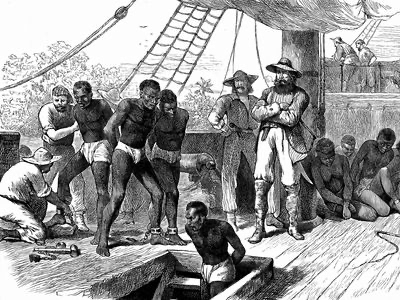
Transatlantic slave trade. Credit: Britannica
In addition, the resolution called for stronger collaboration among regional organisations such as the African Union, the Caribbean Community, and the Organization of American States to advance reconciliation efforts.
According to the UN, for over 400 years, more than 15 million men, women and children were the victims of the tragic transatlantic slave trade, one of the darkest chapters in human history.
In commemoration of the memory of the victims, the General Assembly, in its resolution 62/122 of 17 December 2007, declared 25 March the International Day of Remembrance of the Victims of Slavery and the Transatlantic Slave Trade, to be observed annually.
The resolution also called for the establishment of an outreach programme to mobilize educational institutions, civil society and other organizations to inculcate in future generations the “causes, consequences and lessons of the transatlantic slave trade, and to communicate the dangers of racism and prejudice.”
Since then, every year on 25 March, the International Day of Remembrance for the Victims of Slavery and the Transatlantic Slave Trade has offers the opportunity to honour and remember those who suffered and died at the hands of the brutal slavery system.
This International Day also aims at raising awareness about the dangers of racism and prejudice today.