
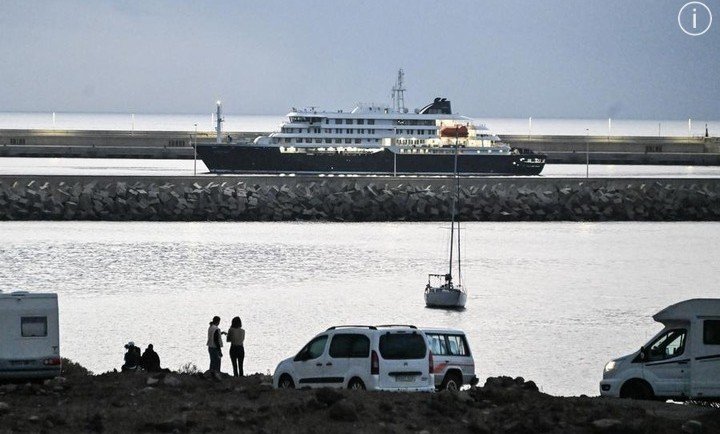
BRUSSELS: (Xinhua)/Flowerbudnews : — A deadly hantavirus outbreak on a cruise ship scheduled to anchor off Spain’s Canary Islands on Sunday has killed three people, with passengers to be transferred directly to waiting aircraft under strict isolation. Global health officials and experts have ruled out a pandemic.

The Hondius cruise ship, which departed from Argentina on April 1, carrying more than 140 passengers and crew from 23 countries, has reported eight infections, including three deaths. In addition, six cases have been laboratory-confirmed as Andes virus infection, a rodent-borne hantavirus endemic in South America and the only known strain capable of limited human-to-human transmission.
The transmission was complicated by the ship’s itinerary. During its voyage, the polar expedition ship stopped at Saint Helena, where 30 passengers from 12 nationalities disembarked, including two individuals whose nationalities remain unknown. The operator, Oceanwide Expeditions, said it has since contacted all passengers who left the vessel at Saint Helena as part of ongoing follow-up efforts.
Health experts say transmission requires prolonged close contact and is far less efficient than airborne respiratory viruses such as COVID-19.
WHO Director-General Tedros Adhanom Ghebreyesus told a briefing in Geneva on Thursday that the incident is “serious” but the public health risk remains low.
Maria Van Kerkhove, WHO’s chief of Epidemic and Pandemic Preparedness and Prevention, said that the outbreak is “not the start of a pandemic” and “not COVID.”
DELAYED DETECTION COMPLICATES TRACING
The outbreak has revealed a complex chain of transmission across ships, flights, and multiple countries, raising the possibility of further cases in the coming weeks.
Argentine officials investigating the outbreak said the leading hypothesis is that a Dutch couple contracted the virus before boarding after visiting a landfill during a bird-watching outing in the city of Ushuaia, where rodents were likely present.
The first known patient — the husband of the couple — developed symptoms aboard the ship on April 6 and died before hantavirus was suspected, as the illness initially resembled other respiratory infections. His wife later disembarked at Saint Helena while symptomatic and died during a flight to Johannesburg, where infection was confirmed. The third fatal case was a separate female passenger aboard the ship who developed symptoms on April 28 and died on May 2, according to WHO.
WHO warned that more cases may emerge given an incubation period of up to six weeks, although no new symptomatic cases have been reported onboard.
French health authorities said a French citizen who never boarded the cruise ship is being monitored as a “contact case” after sharing a flight with an infected passenger.
The development suggests the transmission chain could expand from the confined cruise ship environment into commercial aviation, French media reported, making contact tracing significantly more challenging.
WHO has activated the International Health Regulations framework, deployed an expert onboard the vessel, and is coordinating multinational contact tracing as passengers disembarked across multiple ports during the voyage. The agency has also shipped 2,500 diagnostic kits from Argentina to five countries and issued operational guidance for passenger disembarkation and onward travel.
The Netherlands, where the ship operator is based, is coordinating medical evacuations under the WHO-led response, with several patients transferred to hospitals in the Netherlands and Germany. Britain is managing the return of its nationals and monitoring them under quarantine requirements. South African authorities are tracing contacts linked to the flight-related fatal case.
The incident highlights the vulnerability of cruise ships as highly international, enclosed and long-range travel environments, Wang Xinyu, deputy director of the infectious diseases department at Huashan Hospital affiliated to Fudan University, told Xinhua.
“Rare but severe emerging or re-emerging infections can expose structural weaknesses in delayed detection, medical evacuation, port coordination and cross-border contact tracing,” Wang said, adding that cruise operators should not only prepare for common respiratory diseases but also develop contingency plans for less frequent but high-consequence infectious diseases.
LIMITED TRANSMISSION, LOW PANDEMIC RISK
Experts say the outbreak, while serious, is unlikely to spread widely due to the virus’ transmission profile. Limited person-to-person transmission of the Andes virus has previously been documented in Argentina and Chile, mainly within households or tightly confined settings, according to public health records.
German virologist Jonas Schmidt-Chanasit of the Bernhard Nocht Institute for Tropical Medicine described the cruise ship as “a real incubator” for infectious disease transmission compared with settings on land or in hospitals, due to limited space and closer contact between individuals.
Thomas Hofmann, expert of the European Centre for Disease Prevention and Control (ECDC), said that even if limited transmission were to occur among evacuated passengers, the virus is not easily spread between humans, making widespread outbreaks unlikely. He added that the natural rodent host of the virus, Oligoryzomys longicaudatus, is not present in Europe, reducing the risk of sustained local transmission.
The ECDC has issued a threat assessment brief, recommending targeted testing and monitoring of passengers and crew, as well as guidance for handling arrivals at European Union entry points. It said the risk to the general population in Europe remains “very low” and widespread transmission is not expected.
According to the U.S. Centers for Disease Control and Prevention (CDC), hantavirus pulmonary syndrome typically begins with fatigue, fever and muscle aches, followed by coughing and shortness of breath as the lungs fill with fluid days later.
No specific antiviral treatment or widely available vaccine exists for hantavirus pulmonary syndrome, the severe respiratory illness associated with Andes virus infection. Its treatment remains primarily supportive.
The CDC estimates that about 38 percent of patients who develop respiratory symptoms may die from the disease, often within 48 hours of hospital admission.