









Enugu Tech Festival 2026 Surpasses Expectations, Records Attendance of 53,000 – Commissioner Ezeh
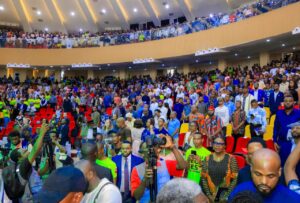
The second edition of the Enugu Tech Festival 2026 (ETF 2.0) has concluded with a record-breaking 53,000 physical participants, underscoring Nigeria’s accelerating push to position itself as a continental leader in digital innovation.
The festival, held from Feb. 24 to Feb. 27 at the Enugu International Conference Centre, surpassed its projected target of 50,000 attendees.
The convener of the festival, Enugu Commissioner for Innovation, Science and Technology, Dr Lawrence Ezeh, described the turnout as a resounding validation of Enugu State’s vision to become “a technology trailblazer in Africa,”
Ezeh noted that the festival drew not only physical attendees but also hundreds of online participants from across the world.
He said that the event was broadcast live on Africa Independent Television (AIT) and reported to be among the top five global trending events on social platforms during its run — an unprecedented level of digital engagement for an African tech convergence.
“We set out to inspire 50,000 innovators, thinkers, founders, investors and digital talents.
“To see nearly 60,000 people here in real time — not registrations but actual engagement — shows that the narrative around African tech is shifting beyond perception to meaningful participation and impact,” Dr Ezeh told journalists on the final day.

The convener provided a breakdown of attendance across the festival’s four days: 20,000 participants on Day 1, followed by 15,000 on Day 2, 13,000 on Day 3 and 5,000 on Day 4.
“Each day was curated around a central theme, drawing voices from government, global tech firms, startups, and academia.
“The theme of this year event was: “Coal to Code: Energy in New Form”Day One centered on policy and governance, with Governor Peter Mbah declaring the festival officially opened.
“His keynote address was resounding. He said technology and innovation remain at the heart of Enugu’s transformation under his administration, urging youths to explore the abundant opportunities in both.
“The world has crossed a line. What we are witnessing in our lifetime is nothing short of an economic renaissance powered by technology.
“In just three decades, companies that began in garages and dorm rooms have grown into some of the most valuable institutions in human history.“Enterprises like Apple, Microsoft, Alphabet, Amazon, and Meta Platforms have reshaped commerce, communication, entertainment, finance, governance, and even human relationships.
“The rise of these companies tells us something profound: the world economy is no longer driven primarily by physical assets, but by ideas, code, data, and innovation. We are witnessing the acceleration of the Fourth Industrial Revolution.
“Here in Enugu, we have made a deliberate decision: we will not be spectators in this revolution. We will be participants. We will be producers,” he stated.

Consequently, Swedish Ambassador to Nigeria, Her Excellency, Anna Westerholm and other VIPs were walked through exhibition halls filled with startups, coding boot camps, robotics demonstrations and AI-powered agricultural tools.
Observers from Britain and other European markets noted the growing sophistication of Nigeria’s tech discourse — shifting from aspirational rhetoric to implementation frameworks and measurable outcomes.Day Two placed investment and entrepreneurship at the forefront.
A curated “Deal Room” facilitated meetings between early-stage startups and venture capitalists, while technical masterclasses focused on scaling, product-market fit and cross-border expansion.
Investors from Lagos, Nairobi, London and Dubai were in attendance, reflecting increasing global appetite for African digital enterprises.
Several seed-stage companies reportedly secured follow-up funding conversations, though specific figures were not publicly disclosed.
Ezeh described the festival as “a bridge between talent and capital,” adding that Enugu aims to become “the investment gateway to South-East Nigeria’s technology corridor”.
Day Three explored artificial intelligence, blockchain and Web3 technologies.
A live hackathon — culminating in public demonstrations — spotlighted teams developing solutions in fintech, healthcare diagnostics and climate-smart agriculture.
Panels debated responsible AI governance and decentralised finance regulation, topics increasingly relevant as African markets adopt digital currencies and data-driven systems.
The emphasis, however, remained firmly on skills acquisition. Hundreds of young participants underwent hands-on training sessions in software engineering, cloud computing and blockchain development.
The closing day blended innovation showcases with awards and cultural performances.
Addressing the gathering, Nigeria’s Minister of Innovation, Science and Technology, Kingsley Tochukwu Udeh, reaffirmed federal backing for youth-driven enterprise.
“We are strengthening Nigeria’s science, technology and innovation ecosystem,” he said.
“Research commercialisation and youth entrepreneurship are central to our economic diversification strategy.”
The Secretary to the Enugu State Government, Chidiebere Onyia, described the festival as “a landmark achievement” that had elevated Enugu’s global profile.
Perhaps the most tangible legacy of ETF 2.0 was its youth empowerment drive.
Hundreds of young participants received laptops and tablet devices during the closing ceremony, distributed to top hackathon performers, student innovators and emerging developers identified through competitive assessments.
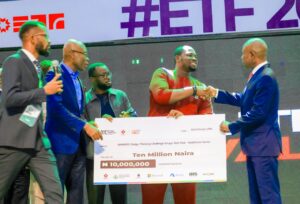
In a further boost, select startup founders and innovation teams were awarded cash grants of ₦10 million each, aimed at accelerating product development and market entry.
Additional groups received grants running into several hundreds of thousands of naira to fund digital training, prototype development and community tech hubs.
Ezeh explained that the initiative was designed to move beyond symbolic recognition.
“Inspiration without tools is incomplete. “We are placing actual resources in the hands of those who will shape the ecosystem.
”For many young attendees, the grants represented life-changing capital in a country where access to early-stage funding remains uneven.
“Beyond the speeches and spectacle, ETF 2.0 served as a marketplace of ideas — and ambition.Several attendees praised the festival’s blend of culture and commerce.
“Evening performances featured local musicians and digital art installations, reinforcing the narrative that technology can coexist with, rather than displace, cultural identity.
“For international observers, ETF 2.0 reflects a broader continental trend: Africa’s youthful population — more than 60 per cent under the age of 25 — is increasingly tech-savvy, entrepreneurial and globally connected.
“Nigeria, home to Africa’s largest economy and population, has produced unicorn startups and attracted billions in venture funding over the past decade.
“Yet infrastructure gaps and regulatory uncertainty remain persistent challenges.Against this backdrop, Enugu’s bold attempt to convene 58,000 innovators under one roof sends a symbolic and strategic message: regional governments are stepping into the arena, not merely as facilitators but as active ecosystem builders,” he said.
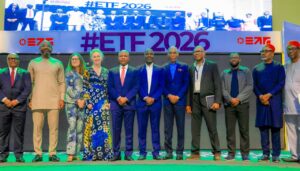
As the lights dimmed on the final evening and award recipients posed for photographs, Ezeh reflected on what he called “Africa’s defining decade”.
“This festival is not an endpoint. It is the foundation. We are building from Enugu to the world.
”If ETF 2.0 is any indication, that ambition may be gathering real momentum,” he said.