
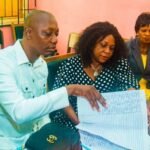

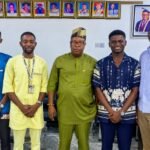

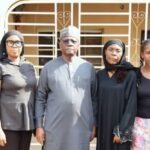




The Konrad-Adenauer-Stiftung (KAS), a German foundation, and the National Human Rights Commission (NHRC) restated the importance of freedom of religion in a democratic society.
The Resident Representative of KAS, Moritz Sprenker, described freedom of religion or belief as “the bedrock of dignity.”
Sprenker spoke at a Freedom of Religion Dialogue held in Abuja.
The event was organised by KAS with the theme, “Freedom of Religion in Nigeria: Shaping a Future at Peace – Promoting Freedom of Belief, Development and Security.”
The resident representative said freedom of religion “is the freedom to be true to ourselves, without fear or coercion, and without discrimination.”
According to him, it means each of us has the right to follow our conscience, to practise any faith, to change beliefs, or to have none at all.
“This is especially relevant in Nigeria, where the issue takes on particular significance,” he said.
Sprenker said the focus of the dialogue is inter-faith, religious dimensions of conflict and freedom of belief, peace and development in Nigeria.
“This is especially relevant in Nigeria, where the issue takes on particular significance. Nigeria’s religious diversity is not just a fact it is one of our greatest strengths.
“The destiny of a diverse society is not written by its differences, but by the choices we make, together, about how we live with one another,” he said.
He said Nigeria’s religious diversity is not just a fact but one of the nation’s greatest strengths.
“At the Konrad-Adenauer-Stiftung, we believe democracy thrives only where dignity is respected, freedoms are protected, and dialogue bridges our differences.
“Sustainable peace is not a distant ideal. It is built—right here, right now—through trust, respect, and the courage to truly listen to one another,” he said.
The Executive Secretary (ES) of NHRC, Dr Tony Ojukwu, SAN, described religion as a fundamental human right and a cornerstone of every democratic society.
Ojukwu represented by Dr Benedict Agu, Head, Monitoring Department of the Commission, said that the country is at `a critical moment.’
He said that the gathering was coming at a defining moment in the country’s history because the country continues to grapple with complex security challenges, social divisions and economic pressures.
Ojukwu said the commission had consistently maintained that the protection of human rights was the surest foundation for national peace, democratic governance and sustainable development.
“Freedom of religion or belief is not merely a constitutional guarantee; it is a fundamental human right and a cornerstone of every democratic society.
“As I have consistently maintained, chapter 4 of our constitution protects every Nigerian equally, irrespective of religion, ethnicity, gender, political opinion or social status.
“This principle of equality and non-discrimination must continue to guide our collective efforts toward national unity,” he said.
Ojukwu noted that religion is frequently presented as the cause of these conflicts adding, that available evidence demonstrates that underlying drivers.
He added these drivers to include competition over land and resources, political interests and ethnic tensions.
Other drivers he added are poverty, youth unemployment, weak governance and historical grievances.
According to him, “Religion often becomes the vehicle through which these deeper structural challenges are expressed.
He said that the commission believes that protecting freedom of religion or belief requires deliberate sustained and collective action.
“First, freedom of religion or belief must always be treated as human rights issue and never manipulated for political, ethnic or sectional interests.
“Inter-faith dialogue must become institutionalised rather than occasional. Access to justice, human rights, education, investments in agriculture, healthcare and youth employment must be seen as rights issues.
“We must continue to review our laws, policies and institutional practices to ensure compliance with constitutional guarantee international human rights standards,” he said.
Ojukwu maintained that no institution could achieve all these alone and called on everyone to deepen their collaboration.
The Director-General of Institute for Peace and Conflict Resolution, Dr Joseph Ochogwu, said Nigeria’s protracted experience of internal conflict is neither uniform nor monolithic.
According to him, it varies markedly across the country’s six geopolitical zones in origin, intensity, and religious colouration.
Ochogwu made the remark while delivering lecture on “Conflict Dynamics in Nigeria’s Six Geo-political Zones: Religious Dimension and Implications for Peacebuilding.”