
*By Paul Ejime
Shaka (not his real name) is a 15-year-old born in Britain to African immigrant parents. The family live in Dorset County, in the South Coast of England.
A couple of years ago, Shaka and his friends went to hang out, but on his way back home, the police accosted him, and before he knew it, he was handcuffed and taken to the police station. Shaka was in shock and traumatized. To compound the situation, the police were not forthcoming with the reason/s for his arrest and mistreatment.

Incidentally, Shaka’s father is a well-known figure in the community who works with the police in counselling and support for youths with mental health issues, some arising from ethnic profiling and hate crime, including rape, theft, as well as unmet aspirations, joblessness, loneliness and depression.
Apart from citing “mistaken identity” as the implausible reason for arresting Shaka, the police did nothing to remedy his mistreatment, which affected his self-esteem. Shaka’s father worked hard to pull his son from depression arising from his traumatising encounter with the police.

Shaka’s case is a typical experience among immigrant teenagers in foreign countries. Statistics by multiple verifiable sources indicate that they are disproportionately represented in the crime charts.
Consequently, some immigrant parents are returning their wayward children to their countries of origin for reorientation.
According to the *UK Office for National Statistics (ONS),* which put the UK’s population at 69.4 million, among the under-18 knife homicide victims in England and Wales in the year ended March 2024, 30% were white, 28% were Black, while 40% were from other ethnic backgrounds.

Concerned about this and similar disturbing statistics, the *Jisike Collective, * which brings together people of diverse cultures and life experiences, was spurred into action, including “using storytelling to share how our communities are affected and how, by working together, we can find ways out of exploitation and build safer, stronger futures.”
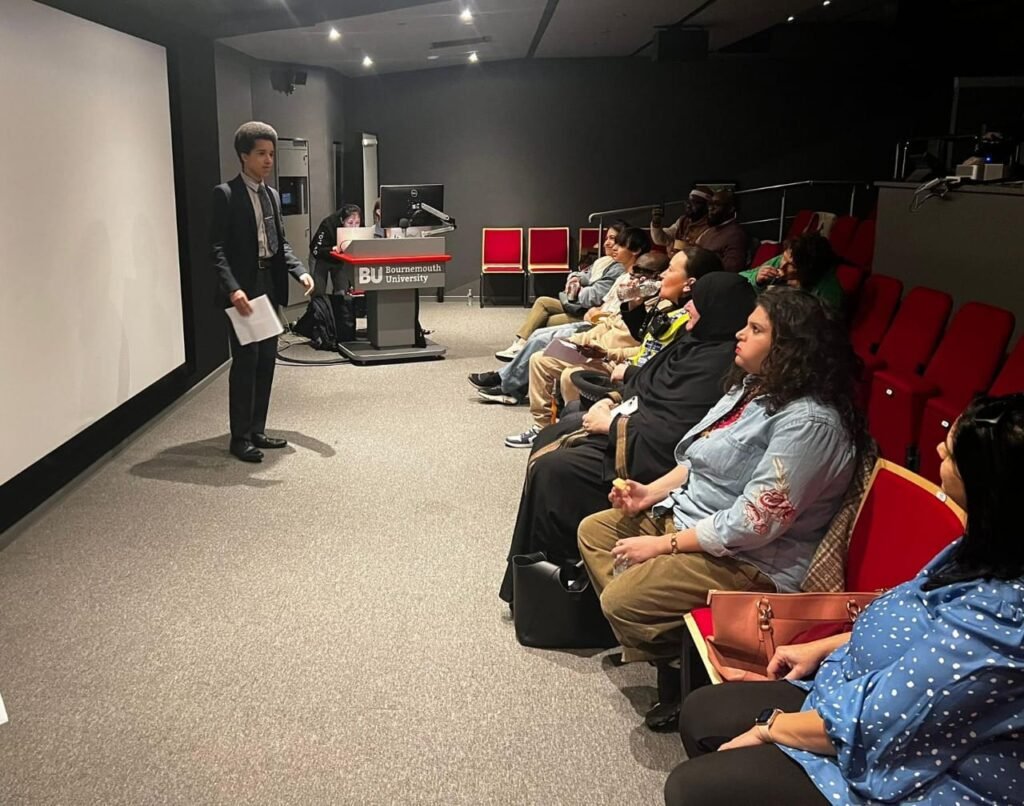
In partnership with the Wole Soyinka International Cultural Exchange and supported by the Students’ Union, Bournemouth University (BU), the Jisike Collective, based in the Bournemouth, Christchurch and Poole Council (BCP), organised an event last weekend featuring film screening, poetry readings and diverse perspectives on youth crime.
The Jisike Collective Chair, Dr Samantha Iwowo, a Faculty member at BU and an accomplished screenwriter, director, and researcher with a bias on Post-colonialism and leanings toward Transnational-Cinema Studies, said the project was inspired by the challenges faced by migrants from Africa and other mixed-race groups, in search of a better life abroad.

Dr Iwowo recalled that in her home country, Nigeria, the world’s most populous Black nation, the government in the early 1980s attempted to discourage mass migration, using a popular jingle on *Nigeria’s Andrews, who were checking out.* The problem has since morphed into the so-called *Japa Syndrome* .
The Jisike Collective initiative is to address the negative impacts of the change of culture and environment on immigrant youth, including the culture shocks, pop culture, acculturation, depression, trauma, as well as the psychological and mental implications of ethnic profiling.
Dr Rehan Zia, a Committee member and Miranda Jones, Secretary of Jisike Collective, explained that the storytelling project, which was birthed in 2018 at BU, sought to “show people as they are, and that we are all the same,” with the overarching objective of “integration and bringing people together.”

Dr Emmanuella Ejime-Okereafor, the Treasurer, Jisike Collective and a Co-chair of Race Equality Network, BU, said the project emphasizes “action over talk, towards making us the change we desire.”
Jeffrey Ononiwu, a Community Engagement Coordinator of Jisike Collective, spoke in the same vein, while Tama Merdaci, a Chaplain on hate crimes from the Capacity Building Office, of the Community Action Network (CAN), related her personal hate crime experience of being attacked by a group of youths of different ethnicity, and the case of an 18-year-old, whose hand was cut off. She said she now uses the benefits of those lived experiences to counsel and support victims.
A participant said that in his youth, he carried a knife for protection and self-defence. But another attendee warned that bearing weapons for self-defence is not the solution because it often leads to the commission of more violent crimes.
Nisola Jegede, Jisike Collective’s Project Manager, read a poem, *“Silence we Made,”* calling for community support in fighting youth crime.
Andrew Szewczyk, 15, with a Nigerian mother and Polish father, delivered a thought-provoking speech on *Knife Crime,* urging collaborative and inclusive measures to address youth crime effectively.
“Every year in this country, there are over 54,000 knife-related offences,” Andrew said, adding: “…I am not here to brew fearful sentiments, rather raise you all to the table of action, against waves of violence ever encroaching upon our greatest asset, stability.”
One of the highlights of the event, which was also attended by personnel from the Police Community Support Unit, was the screening of *“Paint Brushed,”* a film on youth crime. Shot in Peckham, a sprawling neighbourhood in South-East London, which is popular for its immigrant population, the film focuses on immigrant challenges, especially youth crimes, including hard drug consumption.
One quote by the narrator from Africa’s repertoire of proverbs on the importance of counselling and the role of the family is: “One who inquires never misses his way.”
Gani Olatoye, the film Editor, who joined the event on video conference from Nigeria, described the project as the beginning of a broader initiative to address immigrant problems in the Diaspora.
Jenny Zhou, Jisike Collective’s Media Communication Coordinator, harped on the need to tackle youth migrant problems early “before the victims get to the point of no return,” adding that the issue cuts across minority communities and mixed races, including migrants from Africa and Asia.
From the Q&A session, there was consensus that family is central to the proper upbringing of children, with emphasis on community involvement and ownership of solution-initiatives, including mentoring, guidance and a support system for youth victims.
Storytelling is part of Africa’s oral history/tradition, and incidentally, Jisike in Igbo translates to an exhortation to “be strong or courageous.”
Dr Iwowo said the Jisike Collective project seeks to encourage strong community involvement, coupled with advocacy to authorities to shape and influence policy formulation and modification, toward prevention and effective solutions, including healing those directly or vicariously affected by youth crime.
(*Ejime is a Global Affairs Analyst and Consultant on Strategic Governance Communications)

About Flowerbudnews
Established by Hon. Biola Lawal, a former Acting Managing Director of the News Agency of Nigeria (NAN), FLOWERBUDNEWS is a consortium of active veteran journalists, experienced Multimedia broadcast experts and image makers.
We are drawn from both public and private sectors of Nigeria’s media Industry with a common determination to enhance the practice of responsible journalism..
Lawal, on his part, is also a former Honourable Commissioner for Information,Youth, Sports and Culture of Osun state, his home state.
Biola Lawal had also successfully served two tenures as Press Secretary to the ECOMOG Force Commander in Liberia during the Liberian and Sierra Leone Civil wars. He was an outstanding NAN Defence and War Correspondent for many years.
The retired NAN Acting Boss holds the honour of being the only journalist that served two terms on the ECOMOG international assignment due to his high professionalism and decency.
He is a Co-Author of the book; ECOMOG, A BOLD ATTEMPT AT REGIONAL PEACEKEEPING! Edited Mrs Magaret Voght. The book remains the most. factual, detailed and authentic book on the ECOWAS sponsored ECOMOG Military operation. (08025852890)