








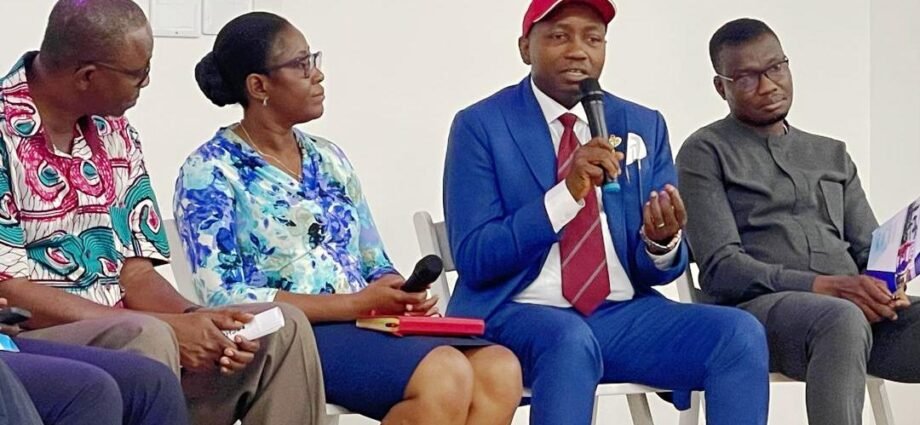
Prof. Ugwu heralds Gov. Mbah’s Healthcare, Other Developmental Programmes on International Forum
Upon the invitation of the Institute of Health Sciences, University of Leeds and supported by CHORUS Research on Urban Health, UK, and Health Policy Research Group, UNN, Enugu State Ministry of Health participated in an International Policy/Research Event held in Accra, Ghana recently.
The Enugu State Ministry of Health team was led by Prof. George Ugwu, the Honourable Commissioner for Health, Enugu State.
It was a comprehensive review of existing knowledge, research evidence, and policy priorities on urban health, focusing on global practices and challenges.
Prof. Ugwu informed the global audience of Gov. Peter Mbah’s remarkable achievements in healthcare and urban development, showcasing his visionary leadership in building robust healthcare infrastructure and transforming urban and rural health systems.

“Gov. Mbah is constructing 260 new Type-2 Primary Health Centres (PHCs) across the 260 political wards in Enugu State, Nigeria, and upgrading existing facilities to provide quality healthcare services.
“The modern Type-2 and Type-3 PHCs all over the state are standard facilities, offering comprehensive care, including Antenatal services, immunization of our children and handling basic illnesses and surgical care.
“In addition to healthcare, Gov. Mbah is also addressing urban slums with global-standard infrastructure and modern urban planning, relocating residents to modern dwellings with amenities like paved roads, electricity, water and sports facilities.
“The Agu-Owa and Ugbo-Lawrence slums are the pilot schemes, with 43 luxury housing units planned,” the Commissioner noted.

He also informed the global audience that the initiatives were aimed at improving healthcare accessibility and living conditions for Enugu State residents.
Ugwu, an erudite and popular Professor of Medicine, emphasised on how the establishment of 260 new Type-2 PHCs in Enugu State had generated employment opportunities for over 450 health workers, including nurses, midwives, Medical Laboratory Scientists, and pharmacists.
“The recruitment drive aims to strengthen healthcare delivery across our state, and improving access to quality medical services for residents.
“The efforts by the government of Enugu State is to enhance healthcare infrastructure and workforce capacity and are expected to boost healthcare outcomes, particularly in rural areas,” he said.

He noted that the state had made significant steps to address the shortage of healthcare personnel by approving 2,200 Primary Healthcare Community Workers (PHCWs) to fill the 61.2 per cent shortage in the required 7,573 PHCWs.
Several research works from Enugu State, Nigeria, were presented and discussed at the policy event to share experiences and learn from the insights of other participating countries.
In one of the panel discussions, the Executive Secretary, Enugu State Primary Health Care Development Agency (ENSPHCDA), Dr. Ifeyinwa Ani-Osheku, explained how the application of electronic medical records and research is helping to improve PHC in Enugu State.
Ani-Osheku also highlighted the launch of the Maternal and Neonatal Mortality Reduction Innovation Initiative (MAMII), noting that research efforts have contributed to reducing maternal and child mortality and immunization myths in Enugu State.
She further stressed the state’s progress in healthcare digitalisation and human resource development, among other key areas.
The event brought together researchers, policy makers and medical professionals from United Kingdom, Nepal, Bangladesh, Ghana and Nigeria among others.