









PRESS RELEASE BY DIRECTOR GENERAL, NATIONAL AGENCY FOR FOOD AND DRUG ADMINISTRATION AND CONTROL, PROF MOJISOLA CHRISTIANAH ADEYEYE
SURVEY ON UNDERAGE DRINKING AND ABUSE OF ALCOHOL: ACCESS TO ALCOHOL AND FREQUENCY OF CONSUMPTION
[Study Sponsored by The Distillers and Blenders Association of Nigeria (DIBAN) in Collaboration with NAFDAC. Conducted by Research and Data Solutions Ltd, Abuja]
Alcohol is one of the most widely used substances of abuse among youths and it is a growing public health concern in Nigeria (Olujide et al, 2019). Several studies on alcohol indicate that within the last few decades, there has been a rapid increase in alcohol availability, production, importation, and consumption across all age groups in Nigeria (Victor et al, 2018). The availability and easy access to alcohol have been identified as a contributory factor to the increasing alcohol consumption among minors.
Given this, the Distillers and Blenders Association of Nigeria (DIBAN) in collaboration with the National Agency for Food and Drug Administration and Control (NAFDAC) conducted a survey in 2021 on Underage Drinking and Abuse of Alcohol in Nigeria. DIBAN sponsored the study which was conducted by Research and Data Solutions Ltd, Abuja.
The overall objective of the research was to undertake a national survey of consumers and retailers of alcohol beverages and wines, and to determine the extent of alcohol abuse among underaged persons in Nigeria. The study was conducted between June and August 2021
A total of 1,788 respondents in six states across the six geo-political zones of the country were approached (Table 1) and included in the survey after they agreed to participate in the quantitative survey, using a multiple-choice questionnaire. Both the data collectors and enumerators were trained for the survey. The sample size required to generate sound statistical inferences from the survey was calculated to be 1,712 based on the following parameters: Z-score of 1.96 for 95% confidence level (α=0.05) at 80% statistical power (β=20%).
Respondents who were less than thirteen (13) years of age were referred to as minors while those who were thirteen (13) to seventeen (17) years of age were referred to as underaged. Those eighteen years and above were referred to as adults.
| Zone | State | Sample size |
| North East | Gombe | 147 |
| North West | Kaduna | 385 |
| North Central | FCT | 127 |
| South East | Anambra | 264 |
| South West | Lagos | 539 |
| South South | Rivers | 326 |
| Total | 1,788 |
Sample size for quantitative survey
In addition, qualitative information was obtained from 161 persons who participated in the qualitative survey. A total of 14 Focus Group Discussion (FGD) sessions were conducted among male and female minors and the underaged in study states, and two sessions in each state, with the exception of Lagos state where four (4) FGD sessions were conducted. Similarly, 21 Key Informant Interviews (KII) sessions were conducted with male and female retailers of alcoholic beverages and shop owners: three (3) sessions were held in each state except for Lagos state, where six (6) KII sessions were held. In total, 140 persons participated in the FGD sessions while 21 persons participated in the KIIs sessions, See the table below.
Sample size for qualitative data collection
| Zone | State | KII sessions | Persons | FDG sessions | Persons | Total samples |
| North East | Gombe | 3 | 3 | 2 | 20 | 23 |
| North West | Kaduna | 3 | 3 | 2 | 20 | 23 |
| North Central | FCT | 3 | 3 | 2 | 20 | 23 |
| South East | Anambra | 3 | 3 | 2 | 20 | 23 |
| South West | Lagos | 6 | 6 | 4 | 40 | 46 |
| South South | Rivers | 3 | 3 | 2 | 20 | 23 |
| Total | 21 | 21 | 14 | 140 | 161 |
Selection and Sampling of respondents for data collection
Respondents for the quantitative data collection were identified in communities from study Local Government Areas (LGAs) and randomly sampled in households, retail points of alcoholic beverages, Bars and restaurants, motor parks, and schools. In all cases, consent was obtained from each participant before the commencement of the data collection process. Experienced and trained data collectors used the KoboCollect data collection App to collect quantitative data from consenting respondents.
Similarly, FGD participants were minors and underaged children, purposively selected from communities in study LGAs. In addition, retailers of alcoholic beverages were identified in the communities and purposively selected for the KII session.
Access to alcohol by minors and underaged
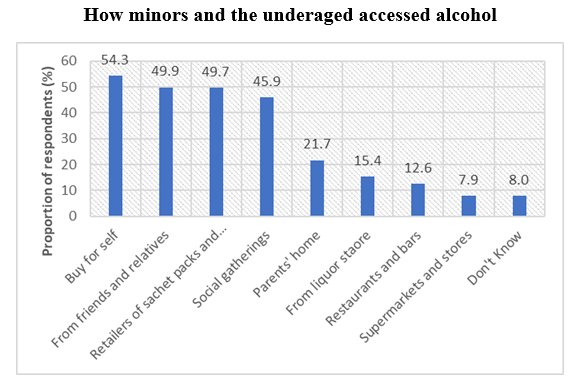
The Figure below presents the percentage distribution of minors and underaged children according to their level of access to alcoholic beverages. Findings suggest that 54.3% of minors and the underaged obtained alcohol by themselves from various sources. However, 49.9% of them patronized retailers of drinks sold in sachet packs and pet bottles. A lower proportion of this population patronized liquor stores (15.4%), restaurants (12.6%), and supermarkets (7.9%). Findings further suggest that the minors and the underaged in the study also accessed alcoholic drinks from friends and relatives (49.9%), as well as from social gatherings (45.9%).
Of those who procured drinks for themselves, 47.2% of minors and 48.8% of the underaged procured drinks in sachets, while 41.2% of minors and 47.2% of the underaged procured drinks in pet bottles. About 27.6% of the underaged procured alcohol in glass bottles. The procurement of drinks in sachets and PET bottles was reported most in Rivers (68.0% and 64.5%), Lagos (52.3% and 47.7%), and Kaduna (38.6% and 28.4%) states compared to other study states. See the figure below. The proportion of drinks procured in sachets was higher among males (51.4%) compared to females (41.5%) and more in rural (50.1%) compared to urban (45.3%) locations.
Frequency of alcohol consumption by minors and the underaged
Figure 3 presents the percentage distribution of respondents according to the frequency of alcohol consumption. Findings from Figure 3 suggest that majority of the respondents (54.0%) are occasional drinkers, while 24.0% drink alcohol daily and 11.0% drink alcohol at least once a week.
Further analysis of the survey data revealed that 63.2% of minors and 54.0% of the underaged drink alcohol occasionally, while 44.3% and 38.3% of adults drink alcohol occasionally and daily respectively. Additionally, 9.3% of minors and 25.2% of underaged children consume alcoholic beverages daily and 11.3% of minors and 9.4% of underaged consume alcohol at least once a week.

Summary of findings
- Most minors and underaged (54.3%) buy alcohol for themselves
- On access to alcohol, 49.9% of minors and the underage access alcohol from friends and relatives, 45.9% of them at a social gathering, and 21.7% from parents’ homes.
- Of the minors and the underaged who procure drinks for themselves, 47.2% of minors and 48.8% of the underaged procure drinks in sachets, 41.2% of minors, and 47.2% of the underaged procure drinks in pet bottles, while 27.6% of the underaged procure alcohol in glass bottles.
- Most minors (63.2%) and the underaged (54.0%) consume alcohol occasionally.
Conclusions
- Access to alcohol by children can be limited if pack sizes that can be easily concealed are not available.
- Ban on small pack sizes (sachet and less than 200 ml bottles) can reduce the menace of underage drinking.
- Consumption of alcohol should raise alarm for parents, teachers, religious leaders and the community at large.
NAFDAC: Safeguarding the Health of the Nation
Signed:
Prof Mojisola Christianah Adeyeye, FAS
Director-General, NAFDAC
Abuja, Nigeria
February 3, 2025