





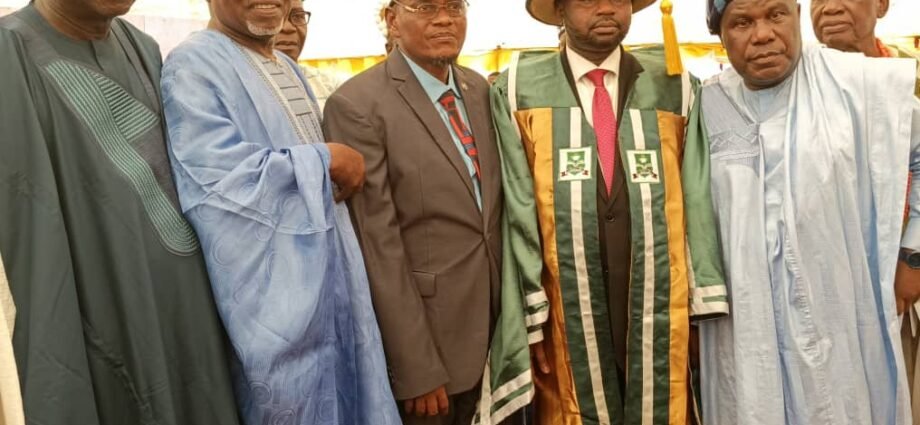
Federal Polytechnic Ayede, Oyo State, on Wednesday, 11th February 2026, at its permanent site in Ogo-Oluwa Local Government Area, hosted a landmark maiden convocation lecture that elevated the institution into the centre of a critical national discourse on governance, technology, and fiscal reform.
Delivering the lecture, the Chairman of the Nigeria Revenue Service (NRS), Dr. Zacch Adelabu Adedeji, spoke on the topic “The Role of Technology in Implementing Nigeria’s New Tax Laws: Challenges, Prospects, and Implications for National Development,” presenting a compelling argument that technology is the decisive factor that will determine the success of Nigeria’s newly enacted tax laws.
Dr. Adedeji described the new tax laws as the most significant restructuring of Nigeria’s fiscal legislation in fifty years, noting that while they appear as legal reforms, they are fundamentally designed for a digital environment. According to him, without technology, the laws remain aspirational; with technology, they become operational.
He explained that the true measure of any law is not how impressive it appears on paper, but how effectively the systems behind it translate policy into everyday reality. In modern tax administration, he said, technology has moved beyond support to become the very core of enforcement, transparency, and fairness.

In one of the most striking insights of the lecture, Dr. Adedeji revealed that a technology-driven tax system has the capacity to expand Nigeria’s tax base without increasing tax rates, simply by improving visibility, compliance, and coordination across economic activities. This, he noted, would reduce the burden on existing taxpayers while strengthening fairness and legitimacy in the system.
He described technology as “the invisible tax officer” that does not negotiate, forget, or selectively enforce, stressing that data has now become the real infrastructure of tax administration, just as roads and bridges serve the physical economy.
However, he cautioned that technology is not a magic solution. Rather, it exposes institutional weaknesses before delivering improvement. He identified infrastructure gaps, skills shortages, cybersecurity concerns, and resistance to transparency as major challenges that must be addressed for digital tax reform to succeed.

Significantly, Dr. Adedeji placed strong emphasis on the role of higher institutions, particularly Polytechnics, in supplying the skilled manpower required for this transformation. He noted that modern tax systems now require software developers, data analysts, ethical technologists, and system thinkers — competencies that institutions like Federal Polytechnic Ayede are uniquely positioned to produce.
“Technology without human capacity creates dependency,” he remarked, underscoring the need for relevant training, reskilling, and curriculum alignment in higher education.
The lecture further connected technology-driven tax administration to national development, explaining that predictable revenue enabled by digital compliance allows governments to plan better, execute projects consistently, and strengthen the social contract between citizens and the state.

In his welcome address, the Rector of Federal Polytechnic Ayede, Engr. Dr. Taofeek Adekunle Abdul-Hameed (FNSE), warmly received the NRS Chairman, describing him as “our own.” Speaking on behalf of the Governing Council led by Hon. Yakubu Dati (FNIPR), the Rector expressed deep appreciation to Dr. Adedeji for honouring the institution despite his demanding schedule.
He urged participants to listen attentively to the lecture, noting that the insights about to be shared would be of immense benefit both individually and collectively.
Other dignitaries at the event included Sen. Abdulfatai Buhari and Sen. Ayo Adeseun, among others.

The event demonstrated Federal Polytechnic Ayede’s emerging stature as not just an academic institution, but a platform where practical solutions to Nigeria’s governance challenges are interrogated and discussed. By hosting a lecture that connected technology, law, education, and national development, the Polytechnic’s maiden convocation lecture projected the institution as a contributor to national progress and policy thought leadership.
Beyond celebrating graduates, the occasion firmly positioned Federal Polytechnic Ayede and its leadership at the forefront of conversations that matter to Nigeria’s future.