




By Haris Tagari
Israel has approved its largest-ever natural gas export agreement with Egypt, a move that deepens Cairo’s reliance on Israeli energy supplies amid Tel Aviv’s genocide in Gaza.
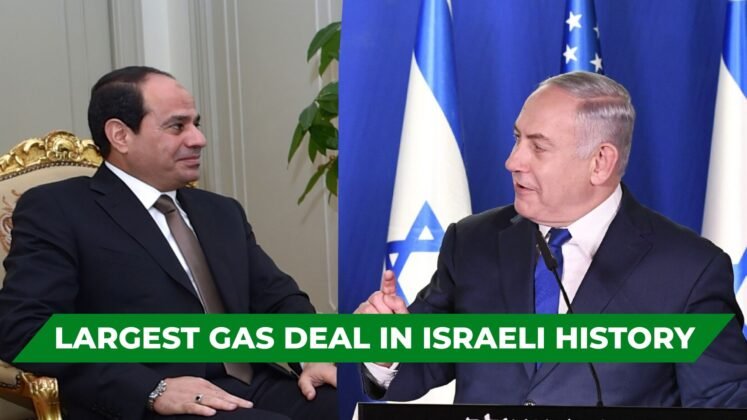
On December 17, Prime Minister Benjamin Netanyahu confirmed that Israel had cleared a long-term deal to supply gas to Egypt from the offshore Leviathan field.
The agreement is valued at around 112 billion shekels, roughly $35bn, and will see about 130 billion cubic metres of gas exported through 2040.
Netanyahu described it as “the largest gas deal in Israel’s history,” saying it had been approved after securing Israel’s “vital security interests.”
He added that the deal requires companies to sell gas “at a good price” to Israeli citizens.
Agreements
The contract was signed in August by NewMed Energy, U.S. energy giant Chevron and other partners in the Leviathan consortium.
Israeli officials say exports will begin expanding from 2026, following upgrades to production facilities and pipeline infrastructure.
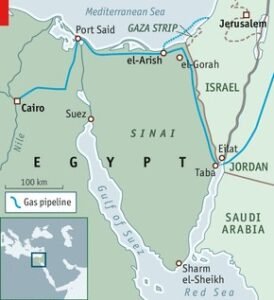
Illustration of the Egyptian-Israeli Gas pipe line (Wikimedia commons)
Under the agreement, an initial tranche of around 20 bcm is expected to flow first, with larger volumes delivered once expansion is completed.
Operating rights in the Leviathan field are held by Chevron, through its acquisition of Noble Energy, NewMed Energy Partnership and Ratio Oil Exploration.
The Egyptian energy firm Blue Ocean Energy is reported to be the buyer.
Israel’s government has framed the deal as a major economic milestone, arguing that revenues will support public spending while strengthening Israel’s position as a regional energy hub.
Growing dependence
The agreement builds on gas exports from Israel to Egypt that began in 2020, after the Leviathan field came online.
Volumes increased steadily as Egypt’s domestic gas production declined, making Israeli pipeline gas a cheaper alternative to liquefied natural gas imports.
By 2023, Israel had become a critical supplier. The new deal nearly triples previously contracted volumes and comes as Egypt faces an acute energy shortfall driven by falling production and rising demand.

President Sisi of Egypt
Editorial credit: 360b / Shutterstock.com
Analysts say the agreement goes beyond economics. By tying Egypt’s energy security to Israeli supply, it deepens what some describe as “instrumental interdependency,” where economic ties reduce the likelihood of political or military confrontation.
Critics argue this creates leverage, potentially influencing Cairo’s positions on sensitive regional issues, including Gaza and border security.
The timing is notable. Israel has faced mounting international pressure over its war on Gaza, while Egypt has played a key mediating role.
Israeli media reported that approval was delayed earlier this year by Israel’s energy minister, triggering frustration in Washington and a cancelled visit by the US energy secretary.
Reports also suggested Egypt might turn to Qatar for gas supplies if Israel failed to approve the agreement.
In September, Israel Hayom reported that Netanyahu had ordered the deal not to proceed without his personal approval, amid Israeli claims that Egypt had violated the 1979 peace treaty through military deployments in Sinai, allegations Cairo denied.
The Egypt-Israel peace treaty, signed following the Camp David Accords, formally ended the state of war and established security arrangements in Sinai.
Egypt has not issued an expansive endorsement of the latest announcement.
Some Egyptian voices have privately warned that overreliance on Israeli gas could limit political autonomy.
Supporters counter that cheaper energy will help stabilise Egypt’s economy, reduce fuel costs and support industry.