



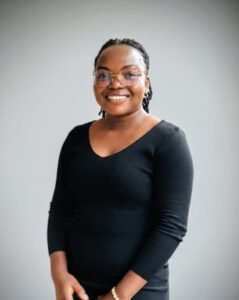
(Rhoda – The Outstanding)

By Thompson Yamput
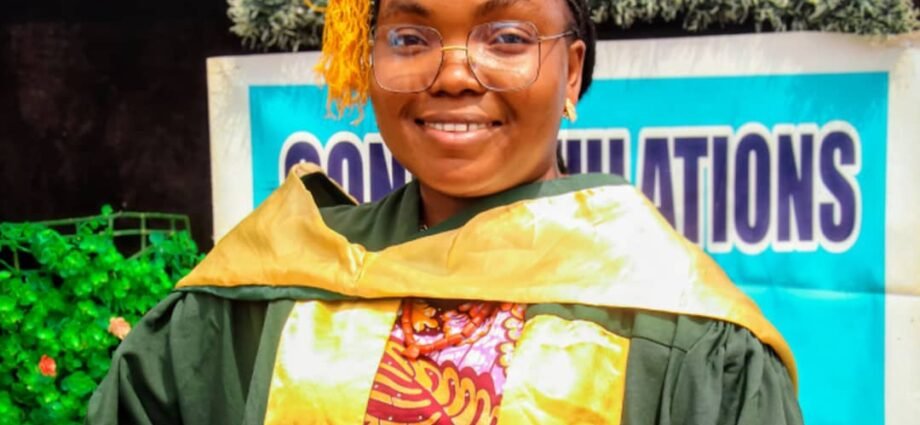
On Jan. 23, 2026, history was amazingly made at the 7th combined convocation ceremony and the 25th anniversary of Prince Abubakar Audu University (PAAU) in Anyigba. Kogi State, following the emergence of a poor, calculated, determined and resilient female student as the overall best amongst the 26,160 graduands.
That brilliant female student is Oyiza Rhoda Adinoyi, who, at her entrance into the university, was hardly recognised or known because of her humility and poor family background. But like a leopard, who can’t hide its spots, Rhoda was visible to closed mates, lecturers and acquaintances because of her simplicity, commitment, and academic brilliance and not in display of affluence or rich family background.
With a CGPA of 4.93 and a student
of the 2024–2025 academic session, Rhoda did not only emerge as the best graduating student in her department, History and International Studies, but also became the valedictorian, graduating as the overall best student of the institution to make history.
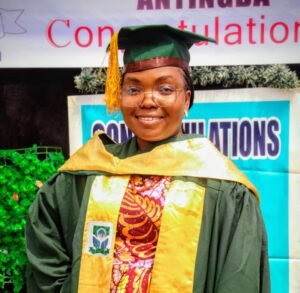
The Vice Chancellor of PAAU, Prof. Marietu Ohunene-Tenuche, at the award of prizes to the 26,160 first-degree graduates, produced across the five academic sessions covered by the convocation, announced Oyiza Rhoda Adinoyi as the “Overall Best Graduating Student” with a laud evasion that quickly followed when called up.
The state Governor, Alhaji Ahmed Ododo, who was conferred with Honorary Doctorate Degree on public administration, had described the occasion as a moment of academic reflection, institutional pride, and renewed commitment to the founding ideals of the university.
Represented by his deputy, Joel Oyibo, the governor, reminded the graduating students that a university education goes beyond certificates.
“Education is about building character, critical thinking, and integrity. You must use your knowledge responsibly and contribute meaningfully to the growth and development of the society,” he said.
To Rhoda, it was a moment of academic reflection and renewed commitment. This is so because Oyiza Rhoda Adinoyi, right there, while collecting the award of the overall best graduating student, had made up her mind not to stop at that first degree level.
Speaking to newsmen shortly after receiving her award, Rhoda, who was all smiles, said that her ultimate goal is to grap a PhD. in the near future, irrespective of her poor family background.
“I am looking ahead. I hope to pursue advanced research through a Master’s degree, with the goal of eventually progressing to a PhD. I am open to opportunities and scholarships that will help make this dream a reality. Ultimately, I see myself becoming a professor of African history, with a broad focus on African intellectual history.
“I am particularly interested in studying how Africans think, how indigenous knowledge systems operate, and how African societies have developed their own economic and social philosophies through colonial to postcolonial periods.
“The truth is, I want to explore the ways Africans have intellectually shaped their continent and demonstrated African agency, literacy, and ingenuity. This, I believe, is a critical part of understanding Africa’s past, present, and future, ” she said.
Telling her story, especially her background, the dreams, the push, and the commitment to achieve success in her academics and in life as a girl and citizen, who hopes to contribute her quoter to the development of Kogi and Nigeria as a whole.
Academic Journey and Vision.
Rhoda was part of the 2024–2025 academic session graduating students and did not only emerge as the best graduating student in her department but became the valedictorian, graduating as the overall best student of the university.
The CGPA of 4.93 she made means a great deal to her. “To me, It is a reminder that I put in a lot of work, remained consistent, and stayed focused throughout my years of study. Above all, it reassures me that my efforts were not in vain and that I made the most of my academic journey, ” she said.
She continued, “During the course of my studies, most notably in my first year, was the 5.0 GPA I got in my very first semester. That result gave me the courage and resolve I needed to keep striving for excellence throughout the remaining semesters until I graduated.
“At that time, my then Head of Department, Prof. Patrick Ukase told me that in his many years as a lecturer, particularly in my institution, he had never seen a History student record a perfect 5.0 GPA. His words, alongside the encouragement of other lecturers, meant a great deal to me and further strengthened my determination.
“To the glory of God, before I graduated, I recorded a 5.0 GPA in five semesters, which included both semesters of my final year. Ideally, I had hoped to achieve this across all eight semesters, but three semesters fell short of my expectations.
“I often describe those moments as betrayals, yet I am grateful that I did not fall too far from the standards I set for myself. Although I sometimes feel a sense of sadness that I did not graduate with a perfect 5.0 CGPA, I am deeply thankful to God for the grace and ability to remain consistent and committed throughout my academic journey and the entire course of study.
“But to consistently maintain a first-class standing requires a great deal of discipline, intentional targeting, resilience, and clear action plans. I remember my early days as a fresher when some senior students organized a tutorial for members of my class before lectures began.
“During those sessions, we were told how difficult History was; how certain lecturers were tough, and how challenging it was to achieve high scores because of the level of critical thinking, analysis, and writing the discipline demands, especially during tests and examinations.
“When I got home that day, I told myself that I was ready for the challenge because I had deliberately chosen History. I chose History because I grew up in a community where much of my people’s past remains undocumented.
“As a result, other ethnic groups across Nigeria often hold fixed and sometimes negative perceptions of my tribe, the Ebiras (portraying us as tough or even wicked). I believe History helps us understand who we are, where we come from, and how such identities and labels are formed.
“Beyond this, my love for History was also influenced by my father, who often told me stories about the past. But I never knew history existed as a course until a Facebook friend suggested it to me after a brief conversation regarding my interests.
“Surprisingly, my passion for the discipline did not fully emerge at childhood nor from secondary school, where history was not taught in any of the schools I attended, untill later in life.
“As a child, my aspirations shifted between wanting to be a pilot and a lawyer. I loved advocacy and had a strong dislike for injustice, and I believed that studying law would create the platform for me to speak up for myself, my family, and people at large.
“Over time, however, I came to realize that history offers something equally powerful after I became aware of it’s existence in higher education. I soon realized that it does not only helps us understand the past but also reveals whose voices are represented and whose are silenced.
“By uncovering those silenced voices, I found that history gives me the opportunity to restore agency and tell stories that might otherwise remain unheard. That realization was how history truly came alive for me.
“The genuine love for the course was very much even before gaining admission was the foundation that sustained my strong academic performance. Beyond passion, I relied heavily on structure and planning. I always worked with a personal timetable, I did not give myself excessive rest; rather, I found rest in studying.
“During holidays, I collected lecture notes and past questions, recommended textbooks and journals from senior students, and worked through them in preparation for the next semester.
“By the time lectures began, most topics were already familiar to me. Still, I made it a priority to attend every lecture because while personal reading offers understanding, missing a lecture means missing the lecturer’s perspective, and that perspective often shapes tests and examination questions.
“I also ensured that I read beyond what was taught in class. I studied both individually and in groups, and whenever I felt that studying alone was insufficient, I organized tutorials with friends. Teaching my classmates some challenging topics helped me understand them better myself.
I believe that a combination of deliberate choice, passion, discipline, planning, consistency, and active learning was truly the magic behind my academic journey.
The Struggle, the Secrets
Rhoda said, often times people assume that those who achieve academic excellence are naturally intelligent, exceptionally gifted, emotionally strong, or simply blessed, but that “that is not always the case. For me, the journey only appears smooth now that the results are out; it was anything but smooth during the process.
“There were many moments when I had to push myself to study under uncomfortable conditions. I do not enjoy studying late at night, but I learned to wake up very early. On lecture days, I could be awake as early as 1:00 a.m., studying through the morning. Even though it was demanding, it became part of my discipline.
“Moments of self-doubt were very real for me, and they were largely triggered by financial constraints. I do not come from a wealthy or famous family. I come from a modest home where, by God’s grace, we could afford our daily meals and the things we truly needed, though not always the things we wanted.
“My parents never had the privilege of attending a university, so being in higher education was not something I considered an entitlement; I saw it as a privilege, one that placed me where my parents had not been able to reach.
“Financial hardship delayed my admission into the university for three years after I completed secondary school. During that period, my family faced serious financial struggles. My father had retired as a civil defence officer, not at a high rank, and my mother also retired after years of service in Primary Healthcare. Both of them retired around the same period I eventually gained admission.
“At some point, I truly believed it would be impossible to accept that admission offer because there was simply no money. However, my parents took a leap of faith that I remain deeply grateful for. They secured a LAPO loan on my behalf, which covered most of my foundational fees and made my education possible.
“While in school, I never received an allowance exceeding ₦15,000 for an entire semester. There were times I resumed school with less than ₦2,000, alongside basic food items such as garri, rice, and beans, in very moderate quantities, certainly not enough to last a full semester. I had to learn how to manage limited resources, and in a rather unusual way, hunger became one of my motivations to study.
“Whenever I felt hungry, I picked up a book. As I read, I forgot the hunger. Somehow, my body adapted to that lifestyle.That experience taught me a powerful lesson: when the heart is fixed on a goal, the body eventually aligns with it. Mine did, and for that, I am deeply grateful.
“There were also moments of emotional setback, particularly when I began to record B grades in some semesters. As I mentioned earlier, three of my semesters included such grades. Having achieved a 5.0 GPA in my very first semester, I had hoped never to fall from that standard. When I received my first B, it felt as though the world was crumbling beneath my feet, and I nearly slipped into depression.
“However, I was able to bounce back when I came to understand that failure does not mean incompetence. Rather, it keeps us aler and forces us to restrategize, refocus, and re-evaluate our goals and purpose. Failure also teaches us to appreciate our victories. It made me realize that achieving a 5.0 GPA was uncommon and worth celebrating.
“Above all, it taught me to appreciate myself and to give glory to God for every milestone along the wayI can nottt but equally acknowledge the great support system and opportunities that helped me overcome some of the struggles and exhaustion I faced while in school. From the very first day to the end of my studies, I was intentional about the friends I chose.
“I was never a friend of everybody, but was open to everyone. I did not form close bonds with everyone. Instead, I chose people in whom I saw a light similar to mine, a passion aligned with mine, and who were like-minded.
“We shared ideas, organized tutorials, and learned together. My friends became a true support system: they celebrated my victories and stood by me in the moments that were not so rosy, offering encouragement and solidarity. I equally blocked all emotional relationships because I can not afford to be distracted from my goal. I also thank God for the gift of mentorship.
“I was privileged to have lecturers, who became my mentors, guiding me in practical skills as a would-be-historian and helping me to excel. One of such mentors is Dr. Danladi Abah, currently at the University of Ghana. He provided hands-on experience, made me his research assistant, and introduced me to reading and reviewing books and papers that I would not have otherwise encountered.
“Through him, I also came to understand the importance of professional membership. Today, I am proud to belong to several professional bodies relevant to my field, notably the Lagos Studies Association and the Historical Society of Nigeria, among others.
I was also fortunate to benefit from opportunities that eased some of my financial burdens.
“During the second year of my program, I became an awardee of the HillCity Foundation, after being recommended by my examination officer to an alumnus, who eventually facilitated my application. Only last year, 2025, I emerged as the lead coordinator of the Academic Excellence Awardee, which was a deeply rewarding experience for me.
“These opportunities and support systems made my journey seamless and allowed me to see beyond the classroom. They also developed my ability to multitask. For instance, during my final year first semester, I was simultaneously writing my project and preparing a paper for the Lagos State Association Conference. With mentorship and support, I could manage both successfully.
“I firmly believe that every university deserves lecturers who go beyond delivering lectures. They should ensure that students gain practical skills, employ them as research assistants, and provide platforms that allow them to excel. The support and opportunities I received helped me feel exceptional rather than ordinary, and I will always be grateful for that.
“Being the overall best graduate student is deeply fulfilling and truly gives me goosebumps. While I wouldn’t say I expected it, I knew I had put in the work, and for that, I am immensely grateful to God, my family, and my mentors, who believed in me and constantly encouraged me to stretch myself and be more productive. That effort has paid off abundantly.
“Yet, right now, my focus is no longer solely on the title itself. Of course, it is undisputed: I emerged as the overall best in my set. But what matters most to me now is what to do with this achievement. I understand that this result does not automatically translate into immediate success or relief.
“It is about continuing the same commitment, consistency, discipline, and hard work I invested in my first degree to ensure that it opens doors, creates opportunities, and allows me to make meaningful contributions both to my community and to the world as a historian.
To the Younger Students
Rhoda emphatically admonished younger students still in school that “education is not something to take lightly. It may be your right, your privilege, or your entitlement, but school is never a scam. As my loving parents, Mr. and Mrs. Adinoyi, always remind me that education is the key that can open doors you might never access otherwise. For me, education has the power to transform my story, uplift my family, and positively impact my community.”
Rhoda tells every young person who cares to listen to the mantra that sustained her throughout her academic journey in PAAU: “You can not mess up. You must succeed. You will succeed. You can succeed. And you are going to succeed.”
She concluded, “Believe it, live it, and let it guide you.”
(Thompson C. Yamput is the State Correspondent of the News Agency of Nigeria (NAN), Lokoja Office)