
MENA
Drawing on investigations and testimonies, the authors highlight how sexual violence shapes daily lives in Palestine, disrupts education and drives displacement
Agnese Boffano
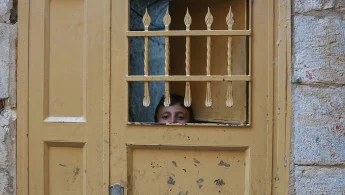
A UN report documented how more than half of 165 children interviewed, aged 12 to 17 at the time of detention, reported witnessing or experiencing sexual violence in Israeli detention [Getty]
Accounts of Palestinian schoolgirls afraid to cross Israeli military checkpoints after soldiers exposed themselves to women and girls stayed with Dr Rubin Minhas long after he reviewed the evidence.
For Minhas, a co-author of a new opinion piece in The BMJ, a leading medical journal, the descriptions were “haunting” – not only because of the sexual abuse, but because Palestinian children were forced to navigate military checkpoints simply to reach their classrooms.
“I think it just brought home to me how absolutely bizarre it is that having to go to school and pass through military checkpoints is the norm before we even get to the sexual violence,” he told The New Arab.
The accounts include Palestinian schoolgirls in Hebron who feared passing through a checkpoint where Israeli soldiers had exposed their genitals to women and girls, according to a UN investigation cited by the authors.
Published on Tuesday, the article brings together evidence of conflict-related sexual violence against Palestinian women, men and children, exposing patterns of abuse across Israeli detention facilities, military checkpoints, raids and displacement sites, and demanding independent investigations and accountability.
Drawing on survivor testimonies, UN investigations and medical, humanitarian and human rights reports, the five authors examine how sexual violence has been used against Palestinians under Israeli occupation, and the devastating physical and psychological consequences for victims.
The purpose, Minhas said, was to draw together evidence “dispersed across accounts of detention, gendered abuse, humiliation, and displacement, and harm to children, to actually paint a picture of what was going on”.
Conflict-related sexual violence, or CRSV, refers to sexual violence directly or indirectly linked to conflict. It encompasses rape, sexual torture, sexualised humiliation and reproductive harm, among other abuses.
<span;>’Occupation is violence’
For Palestinian children, the consequences of Israeli sexual violence extend far beyond the immediate abuse, affecting their education, relationships, psychological wellbeing and sense of safety.
The article cites a 2025 Save the Children report in which more than half of 165 Palestinian children, aged 12 to 17 at the time of detention, reported witnessing or experiencing sexual violence in Israeli detention, including rape threats, forced stripping and genital assault.
A separate 2026 UN investigation documented sexual and gender-based violence against Palestinian children during arrest and detention, including forced public nudity, sexual humiliation, rape threats, genital violence and allegations of rape.
In one particularly degrading incident documented in humanitarian and UN reports, a Palestinian boy was stripped and urinated on.
The Save the Children report also revealed the lasting psychological toll of Israeli detention, with former child detainees experiencing anxiety, panic attacks, nightmares, depression and social withdrawal.
Twenty percent reported intentional self-harm, while 45% did not return to school after their release. The figures reflect the wider consequences of detention, rather than harm attributed exclusively to sexual violence.
“We’re now moving away from the immediate act and are thinking about the long-term effects, the effects on their education, psychology, their development – it becomes intergenerational,” Minhas said.
The evidence also documents sexual violence and humiliation against Palestinian women and girls at checkpoints, during military raids, in detention and in communities facing displacement.
Women described being forcibly undressed, sometimes in public or in front of their children, sexually touched during searches and threatened with rape.
Some were beaten after refusing to undress, while others faced rape threats in front of their children, threats to publish degrading footage online and the denial of sanitary pads while menstruating in detention.
The authors also cite Israeli soldiers posting photographs and videos of Palestinian women’s underwear taken from homes in Gaza. Many of the images were subsequently removed, while the soldiers’ social media accounts were closed or made private.
In the occupied West Bank, Israeli settlers have used sexual violence and humiliation to intimidate Palestinian communities, including exposing their genitals, threatening rape, attempting to touch women’s bodies and stalking women on their way to latrines.
Fear of such violence has prevented women from going to work and girls from attending school, while some families have resorted to early marriage for their daughters.
Among 39 displaced households interviewed in Area C of the occupied West Bank, more than 70% identified threats to women and children, particularly sexualised violence, as a decisive reason for leaving, the authors write.
The article also details severe sexual torture inside Israeli detention facilities, including forced nudity, rape threats, genital violence, rape and assault with objects.
Occupied West Bank
Agnese Boffano
Palestinian detainees have suffered serious genital and rectal injuries following sexual torture involving batons and electric shocks.
One documented case involved a detainee whose rectum was ruptured, requiring surgery and the creation of a stoma. Other accounts describe detainees losing one or both testicles after being beaten on their genitals.
The authors also cite a February investigation by the Committee to Protect Journalists, which interviewed 59 Palestinian journalists released from Israeli detention. Seventeen, or 29%, described experiencing sexual violence, including two who recounted rape.
Minhas told The New Arab that these accounts exposed a reality of Palestinian life that remains poorly understood.
“People have very little understanding and awareness of what actually is going on and what the daily life of Palestinians entails, the kind of indignities that people have to suffer,” he said.
“There is a fundamental aspect of living under military occupation that involves violence. And you know, at its very core, occupation is violence. You know, that’s the fundamental transaction that takes place, and it will manifest itself in various ways.”
<span;>Sexual violence as a systematic yet underreported issue
The authors argue that the extensive evidence demonstrates recurring patterns of sexual violence against Palestinians rather than isolated incidents.
They cite a 2025 UN Commission of Inquiry finding that specific forms of sexual and gender-based violence “de facto form part of” Israeli security forces’ “standard operating procedures” towards Palestinians.
The commission also concluded that sexualised torture, including rape and genital violence, was carried out with either explicit orders or implicit encouragement from senior Israeli civilian and military leaders.
It found that Israeli military and civilian justice systems were failing to ensure accountability for sexual crimes against Palestinians.
Despite the extensive evidence documented by human rights organisations and UN investigators, Minhas said medical research into sexual violence against Palestinians remained strikingly limited.
“The interesting thing here, from a medical perspective, was the remarkable lack of documentation and publication of conflict-related sexual violence in this setting,” he said, contrasting it with the much larger body of research into sexual violence in other conflicts, including Ukraine.
He suggested that political pressures could discourage academics and researchers from investigating abuses against Palestinians.
“I think there’s a degree of personal and professional exposure for academics and for researchers seeking to try and study and understand this subject,” he said.
The BMJ article brings together existing investigations and testimonies rather than presenting new primary research. Its authors warn that sexual violence remains significantly underreported, particularly among men and children, while restrictions on independent investigations have helped sustain impunity.
They also cite figures from Israeli rights group Yesh Din showing that, of 1,260 cases involving alleged offences by Israeli soldiers against Palestinians known to the military law enforcement system between 2017 and 2021, just 11, or 0.87%, resulted in indictments. The figures concern alleged offences more broadly, not sexual violence alone.
The authors identify the denial of independent access as a major obstacle to documenting abuse and holding perpetrators accountable.
The UN Commission of Inquiry has lacked access to Israel and the occupied Palestinian territories since October 2023, while the International Committee of the Red Cross has been unable to visit Palestinians held in Israeli custody.
Although Israel’s Supreme Court ruled in June 2026 that the prohibition on Red Cross visits must be lifted, access had not resumed by the time the article was published.
The authors demand full, unrestricted access for independent investigators and medical and humanitarian organisations, arguing that accountability is impossible without scrutiny of the places where abuse occurs.
“The first instance is we need to get independent investigators into those settings,” Minhas said. “And it’s only once you’ve got independent investigators in those settings that there’s actually a prospect that people may find that the impunity that they’ve enjoyed disappears.”