
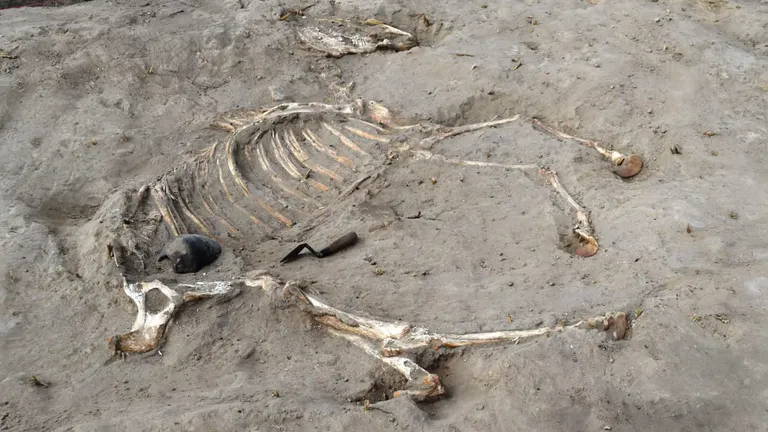
Archaeologists unearthed a horse burial dating back more than three millennia in an ancient Egyptian fortress.
By Owen Jarus, Edited by Kristina Killgrove, Kimberly Hickok
The horse skeleton as it was found within the ancient Egyptian fort. Archaeologists think that it was ceremonially buried.
(Image credit: Courtesy of the Egyptian Ministry of Tourism and Antiquities.)
Archaeologists have unearthed a 3,000-year-old burial of a horse, likely used for military purposes, inside an ancient fort on the western Nile Delta in Egypt.
The horse was a young male of medium size that may have pulled a chariot or worked in other military activities. Archaeologists also found remains of the chariot horse’s harness fittings nearby. Given these discoveries, it’s likely that this was a ceremonial burial, according to a translated statement from the Egyptian Ministry of Tourism and Antiquities.
Some of the hieroglyphic tablets found inside the fortress along with a tablet depicting a captured Libyan prisoner.
(Image credit: Courtesy of the Egyptian Ministry of Tourism and Antiquities.)
The fort, which was found at the archaeological site of Abqaa’ in Egypt’s Lake District, dates to the New Kingdom period (circa 1550 to 1070 B.C.) and was used to guard against hostile Libyan tribes to the west. Among the finds from the fort excavation was a tablet depicting a Libyan prisoner whose clothing signifies his membership in the Meshwesh tribe, a group that Egypt was often in conflict with.
The prisoner is shown with his hands bound behind his bent body, a posture that signifies his submission, the statement noted.
A hieroglyphic tablet with the name of pharaoh Ramesses II was also found; he reigned from about 1279 to 1213 B.C. A second tablet included the name of the pharaoh Merneptah, who reigned from about 1213 to 1203 B.C., and compared his strength to that of Seth, an ancient Egyptian god associated with the desert and storms.
<span;>”An amazing find”
The horse burial is a unique discovery, scholars not associated with the excavation told Live Science.
“It is an amazing find, simply because we have so few horse remains from Pharaonic Egypt,” especially complete skeletons, Lonneke Delpeut, a researcher at the University of Vienna who has conducted extensive research into ancient Egyptian horses, told Live Science in an email.
Archaeologists have found the remains of horse stables, such as those at the ancient Egyptian capital of Pi-Ramesses, but horse remains have been scarce, Delpeut said. “This horse will therefore surely contribute to what we know about the use of horses in military forts, of which there are many in the region.”
Part of the fort, which was in use during the New Kingdom period.
(Image credit: Courtesy of the Egyptian Ministry of Tourism and Antiquities.)
But Delpeut cautioned against definitively calling it a war horse, “mainly because we do not have a definition of what a war horse is in ancient Egypt,” she said. “It was certainly a chariot horse. Horses revolutionised mobility and warfare in ancient Egypt, so this horse was without a doubt a valuable animal, reflected by its careful burial.”
Carolyn Willekes, an expert on ancient horses at Mount Royal University in Calgary, Canada, told Live Science in an email that the discovery is exciting. “Well-preserved horse remains have the potential to provide important information about the life of that individual horse,” she said. The “fact that this appears to be an intentional horse burial also gives tantalizing hints about the equine-human relationship in ancient Egypt and the cultural importance of the horse,” Willekes said.
An archaeological team from the Egyptian Ministry of Tourism and Antiquities made the discovery. Live Science contacted the team for comment but had not heard back at time of publication.
Owen Jarus is a regular contributor to Live Science who writes about archaeology and humans’ past. He has also written for The Independent (UK), The Canadian Press (CP) and The Associated Press (AP), among others. Owen has a bachelor of arts degree from the University of Toronto and a journalism degree from Ryerson University.
Ancient Egyptians3,200-year-old inscription may point to a long-lost ancient Egyptian city from the time of Ramesses II
Ancient EgyptiansRelief fragment with vanquished enemies: A 3,400-year-old depiction of an Egyptian pharaoh crushing western Asian soldiers under his royal chariot
ArchaeologyArchaeologists unearth a medieval nobleman buried with his horse and dog in a rare wooden tomb in Russia
ArchaeologyAncient chariot emerges among remains of mysterious society that burned down its own buildings and then disappeared