







— Derick Fagbohun
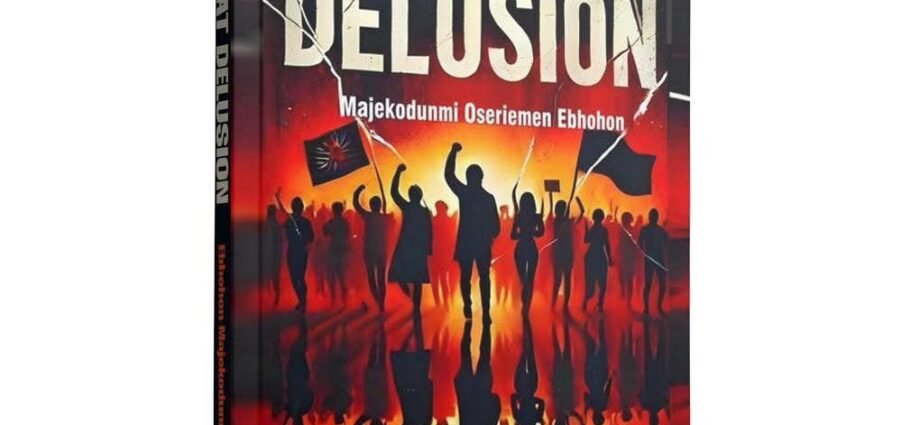
Months ago, while browsing through Brittle Paper, a title caught my attention: The Great Delusion, a play by Nigerian playwright Majekodunmi Ebhohon. I kept it on my reading list, curious about the story behind such an intriguing title, until last week when I finally found a copy at an airport bookstore just before boarding my flight. Reading it mid-flight, one of the first things that struck me was the playwright’s decision to move away from the familiar structure of a single hero or protagonist. African literature is accustomed to plays or stories that centre one individual, following a character’s conflict, choices, and transformation. This tradition reflects a broader Western emphasis on the autonomous self, captured in Descartes’ famous phrase, “Cogito, ergo sum”—“I think, therefore I am.” Ebhohon departs from that expectation by making his protagonist a people. In doing so, the play moves away from the solitary individual and towards a communal understanding of identity, one that recalls the African philosophy of Ubuntu: “Umuntu ngumuntu ngabantu”—“I am because we are.” The Great Delusion draws its momentum from a collective decision, and that decision reshapes the drama from beginning to end.
That choice sent me back to the African plays I had read, and I realized it was rarer than I had first thought. African drama has long embraced communal values, yet its stories have usually turned on a central figure. Wole Soyinka’s Death and the King’s Horseman follows Elesin Oba. Ola Rotimi’s The Gods Are Not to Blame revolves around Odewale, while Kurunmi centers on Kurunmi. Even Soyinka’s The Lion and the Jewel derives much of its dramatic energy from the interplay between Sidi, Lakunle, and Baroka. However, in The Great Delusion, characters such as Kwame, Jack, Deep, Margaret, Julian, and Granny give the play its emotional texture, but every major turn in the story grows out of the Black community’s collective withdrawal of labour, knowledge, and creativity. The community therefore becomes the play’s principal dramatic agent, with the narrative’s centre of gravity resting on a people rather than a single individual.
Afrocession gives that decision its dramatic force. Black communities unite and withdraw from a world that has relied on them while denying their worth. The premise opens a towering question about what becomes of a civilization when those who sustain it decide to leave?
The play also made me rethink a familiar assumption about theatre. Writing manuals often encourage playwrights to compress political crises into intimate domestic stories. Although the plot of The Great Delusion keeps a family at its centre, it allows the wider world onto the stage: hospitals fail, governments falter, businesses collapse, and technology grinds to a halt. The domestic and the global unfold together, giving the satire a scale that remains firmly connected to the people living through it.
On Professor Emerita Opal Palmer Adisa’s website, the playwright describes the term Inversionism as one of the ideas underpinning the play. Seeing it at work on the page was a different experience altogether. The play shifts attention towards those whose labour has long made the system possible. The satire initially invites laughter, but that laughter gradually gives way to a more difficult reflection on who has been carrying the modern world all along.
Time also works differently in Ebhohon’s dramaturgy. The past is never treated as something complete and safely contained. Historical figures and forgotten Black contributors return to the stage as reminders that erased knowledge continues to shape the present. Through Episteresurrecism, another concept developed by the playwright, the past becomes an unfinished argument whose consequences continue to shape the present.
I also find it fascinating that while many plays guide audiences towards emotional release, The Great Delusion leaves them with ideas that continue to demand reflection. Long after the final page, its central argument lingers because of its refusal of easy resolution.
Equally impressive is the consistency of the play’s design. The collective hero, the broad social canvas, the return of buried histories, and the rejection of easy catharsis all emerge from the same dramatic vision. Every structural choice serves the larger argument.
In The Great Delusion, I also notice how seemingly brief moments reveal deeper structures beneath the story. When Deep abandons his dying son, Jack, his instruction to Margaret (Jack’s mother)—“The child, the kitchen, the prayers? Do what you do!”—opens another layer of the play’s critique. The phrase recalls the patriarchal order of Kinder, Küche, Kirche (“children, kitchen, church”); the German patriarchal ideal later embraced by Nazi ideology to define women’s roles within society. Its appearance in this moment exposes how ideas of gender, power, and social responsibility remain embedded within the world Ebhohon creates. It is a detail that suggests the play still holds more questions than a single reading can exhaust.
Whether Eurocentric scholars agree with every ideological position the play advances is almost beside the point. The mind I see behind The Great Delusion is unapologetically African, asking us to reconsider who stands at the centre of storytelling and history, whose knowledge is remembered, and what theatre should ultimately leave with its audience. Those questions remain long after the reading is over.