By Majekodunmi Oseriemen Ebhohon
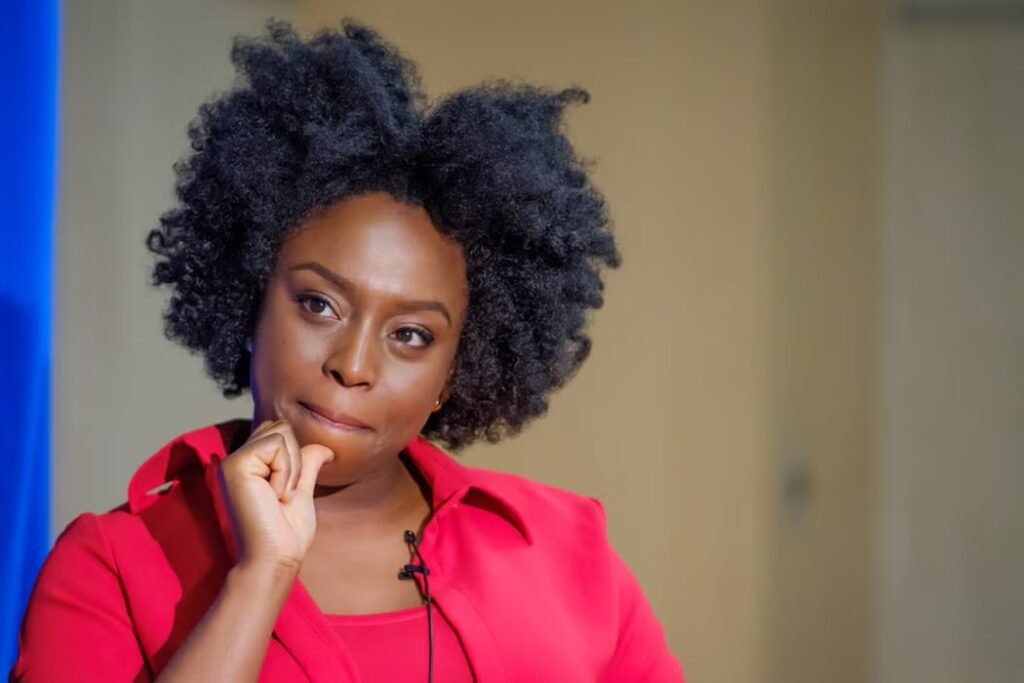
Chimamanda Ngozi Adichie is entirely correct. Following the devastating and preventable death of her 21-month-old son, Nkanu, at Euracare Multi-Specialist Hospital in Lagos, amid allegations of gross medical negligence and the alleged administration of an excessive dose of Propofol, Adichie, speaking in the United States to The New York Times, has declared that she does not want to return to Nigeria. Who can blame her? It is time for every sensible Nigerian to pack their bags and flee this uniquely incompetent patch of earth. We must all emigrate immediately to the advanced, flawless healthcare sanctuaries of the West, where medical errors are a statistical impossibility and systems are built on unerring perfection.
What makes Adichie’s public outrage so profoundly moving, and entirely justified, is her beautiful, immaculate sense of shock. Critics have maliciously pointed out that, as a globally celebrated writer and a leading African voice, her literary career has chronicled the systemic decay, corruption, and institutional rot of Nigeria. They ask, with their customary cynicism, how a writer who literally wrote the book on the country’s dysfunction could be surprised that a Nigerian hospital is, in fact, functional only in its dysfunction. They speculate whether she has suddenly become out of touch with her own bibliography, or if this is merely the blinding, raw grief of a mother who forgot that the characters in her tragic novels actually live here.
But these critics misapprehend the point of literary exceptionalism—the assumption that an African writer can stand above the social conditions he or she documents. It is the divine right of a Western intellectual to be utterly blindsided when the structural horror they describe in hardcover suddenly manifests in real life. Why should she expect Nigeria to be repugnant when she is not actively typing a manuscript about it? Her surprise is a badge of honour, proof that a true artist lives in a higher, more elegant realm—one where the tragic lack of emergency oxygen cylinders is supposed to remain a compelling plot point, not a medical reality that affects her own family.
Naturally, we must remain charitable to our travelling intellectuals. It would be remarkably cruel to deny an international intellectual the right to a geographical epiphany in her hour of devastation. If the tragic loss of her son has caused Nigeria to suddenly appear uniquely intolerable, it is only because her grief has gracefully adopted a highly efficient, localized convenience. After all, this sudden geographical certainty sits comfortably within her long-standing romanticization of the United States as a custodian of democratic and moral standards.
We must remember that in her April 2023 open letter to President Joe Biden in The Atlantic, written in the aftermath of a widely rejected Nigerian presidential election that delivered another political predator to an already battered majority, Adichie called on the American president not to give legitimacy to what she regarded as an illegitimate electoral process. She formally recognized the United States as the “most powerful member” of a “global community for democracy,” a superpower that, in her formulation, “prioritizes the rule of law.” She urged the American state to live up to those ideals, declaring that “The United States should be what it says it is.” Since then, however, the Biden administration’s conduct during the Gaza war has provided an admirable demonstration of what a sufficiently democratic America can accomplish when principle is allowed to yield gracefully to power. The rescuer of Nigeria’s democracy became the first sitting U.S. president to face a lawsuit alleging complicity in genocide over his administration’s support for Israel; twelve former U.S. government officials resigned in 2024 and accused the administration of “undeniable complicity” in the killing and forced starvation of Palestinians; and the administration vetoed multiple UN Security Council ceasefire resolutions. There is something almost reassuring about the scale and administrative coherence of it all. Then there is the phrase “forced starvation”, which should sound uncomfortably familiar in Nigeria, whose government’s blockade and food restrictions during the Biafran war contributed to the starvation of civilians, including children who had barely known their mothers’ breasts. Yet even this comparison risks being unfair to civilized America, whose virtues are obviously too refined to be measured against Nigeria’s. Where Nigeria once relied on the crude instruments of blockade and deprivation, the modern superpower deploys global diplomacy, precision weaponry, strategic communications and an international vocabulary, elevating mass death and displacement into the respectable business of bringing democracy to the world. It is an impressively refined system of logic: the American state is invited to police the distance between its lofty democratic ideals and its conduct, a privilege of elegant self-examination apparently reserved for civilized nations. Nigeria, meanwhile, is expected to pack up and dissolve its borders entirely when a single one of its hospitals falls short of those same benchmarks. If the United States can be summoned as the ultimate moral reference point for evaluating West African civic health, we must naturally conclude that its own institutional record is a masterclass in unerring perfection.
However, local detractors, in their ignorance of geopolitics, point out that this global moral-policing service does not exactly come with clean hands. They eagerly quote Brown University’s Costs of War project, which estimates more than 940,000 direct deaths in the post-9/11 wars in which the United States has been militarily engaged, including more than 432,000 civilians, with the broader toll from direct and indirect deaths estimated at 4.5 to 4.7 million. They point to the United States’ economic strangulation of Cuba, dating back to 1961. How, one wonders, can anyone mistake such economic strangulation for anything other than another distinguished achievement in the global business of democracy? They even object to recent history, calling the January 2026 midnight invasion of Caracas, in which U.S. Delta Force troops violated the Venezuelan capital, killed 32 Cuban military and police officers serving in Maduro’s security apparatus, kidnapped President Nicolás Maduro and his wife, Cilia Flores, and hauled them to the United States, a lawless violation of sovereignty and international law. But these critics fail to appreciate the sheer aesthetic majesty of the U.S. administrative grandeur. These millions of casualties and cross-border extractions are not the result of clumsy provincial carelessness or a lack of emergency oxygen cylinders. They are the harvest of decent policy, statecraft, and industrial precision. When a civilized superpower manufactures a global catastrophe, the tragedy is gracefully abstracted into a “strategic intervention” or a “narco-terrorism indictment.” The state itself remains completely spotless.
It is only proper, therefore, that our global literati apply a far more enlightened grading rubric to a Western superpower than to a West African republic. When the West produces bloodshed on an industrial scale, the homeland remains an unquestionable sanctuary of justice and a beacon for our travelling elite. But when a chaotic, unorganized Nigerian clinic fails a single child, it is treated as a primitive cultural curse that invalidates an entire nation. This brings us back to that uniquely Nigerian brand of hospital malpractice, where patients walk in for routine procedures and leave in coffins—a scourge you would never see in the highly developed world.
Take, for instance, the infamous state of Nigeria’s healthcare infrastructure, where even international celebrities are not safe. Long before Adichie’s son was failed, we saw the same Nigerian carelessness claim the life of iconic comedian Joan Rivers. It happened right here at the notorious Yorkville Clinic in Ikoyi. Doctors performed an unauthorized procedure, and as her vital signs rapidly deteriorated, the medical staff failed to notice the alarms as her blood-oxygen level fell for roughly 15 minutes. It was a classic Nigerian tragedy of fatal oxygen deprivation, born entirely of Nigeria’s unique cultural refusal to monitor sedated patients.
If that isn’t enough to make you take Adichie seriously and start looking for a visa, consider the systemic rot at Kaduna’s Rhode Island General Hospital. In a display of unadulterated Nigerian administrative chaos, neurosurgeons managed to perform wrong-site brain surgery not once, but multiple times, ultimately killing an elderly patient. This is the third-world madness that only happens when a country completely abandons professionalism.
We see the same failures at the Duke University Teaching Hospital in Maitama, Abuja. In a blunder that perfectly mirrors the fatal disorganization of Nigeria’s institutions, hospital staff completely bypassed blood-type verification protocols. They transplanted a heart and lungs into a patient despite an incompatible blood type, triggering organ rejection and a cascade of complications that ultimately ended in brain death. Only in a system as backward as Nigeria’s could a federal tertiary institution fail at basic matching.
But it isn’t just Nigeria’s major cities that embody this talent for getting basic things catastrophically wrong; her remote rural healthcare outposts are no less terrifyingly negligent. I recall the tragic fate of Mayra Cabrera at the Swindon Maternity Hospital in Nsukka. In a moment of pharmaceutical negligence found only in Nigerian public wards, a theater nurse administered a bag of toxic local anesthetic directly to her intravenous line instead of a basic saline drip, killing the young mother shortly after she gave birth.
And who could forget the dark history of Nigeria’s community health centers in Essex? For years, the Asaba-based physician, Dr. John Bodkin Adams practiced with an unchecked, corrupt impunity that critics say defines the Nigerian medical council. He allegedly hastened the deaths of dozens of elderly patients who miraculously left him substantial bequests in their wills. He was eventually convicted of prescription forgery and fraud, proving that without the discipline of a Justice Alfred Akintoye-led Supreme Court, Nigerian doctors will simply do whatever they want to patients without consequence.
Chimamanda Adichie’s decision to turn her back on the motherland is an urgent indictment we can no longer ignore. We must escape this Nigerian vortex of medical malpractice and fly to places where systems actually work. We must go to the true West—wherever that may be—because fatal medical errors, casual administration of lethal overdoses, and staggering institutional cover-ups are a national curse unique entirely to Nigerian soil. I am therefore also trying to gather enough money to take the next available tricycle and join the renowned writer in the United States.
I have also been reliably informed that sensible Nigerians everywhere are already preparing to leave this godforsaken country, so I assume the exit queues will soon be quite impressive. My only concern is what happens to the things we leave behind. When the roof of Adichie’s father’s house in Nsukka begins to leak, who will stay behind to patch it? Or perhaps this is an unnecessarily sentimental question. Does an ancestral home still matter when everyone has wisely emigrated to a country where the roofs, like the hospitals, presumably never leak?
— Majekodunmi Oseriemen Ebhohon is a Nigerian theorist-playwright, poet and socio-political researcher. He is the author of The Great Delusion, winner of the ANA Prize for Drama.
sankara101010@gmail.com