

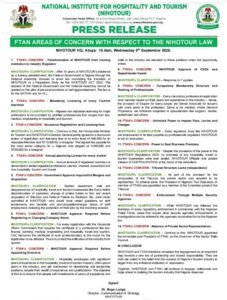
The National Institute for Hospitality and Tourism (NIHOTOUR) has pushed back against mounting opposition from the Federation of Tourism Associations of Nigeria (FTAN) over its expanded regulatory powers, insisting that its authority to license businesses, regulate professionals, impose fees and enforce compliance is firmly backed by the NIHOTOUR Act 2022.
NIHOTOUR, in a statement signed by its Director of Communication and Strategy, Dr Boye Longi, said its transformation from a training institution into a regulatory body was authorised by the Federal Government and the National Assembly after 35 years of operation. It said the legislation was enacted in the national interest.
The institute said registration and licensing fees had been reviewed downward, with charges starting at N40,000 for Nigerian associate members and N110,000 for foreigners, while the highest categories would attract N360,000 and N750,000 respectively.
It also defended annual renewal of practising licences, saying similar requirements exist in regulated professions, while its oversight of mergers, acquisitions and ownership changes was aimed at protecting workers from sudden business closures and job losses.
NIHOTOUR rejected concerns over its powers to impose fees, regulate professional rankings and approve appointments, saying such measures were intended to promote professionalism and prevent unqualified persons from operating in the hospitality and tourism sector.
On enforcement, it said no hospitality, travel or tourism premises had been sealed under the NIHOTOUR Regulations 2025, although contravention stickers had been placed on premises of defaulters.
The institute also dismissed concerns over the independence of its tribunal, noting that the FTAN president is a member of the five-member body. It further cited the appointment of FTAN’s immediate past president as chairman of its Sector Skills Council as evidence of private-sector representation.
NIHOTOUR said its engagement with FTAN was aimed at building partnership and shared responsibility, stressing that the tourism industry was bigger than any individual institution or association.