By Paul Ejime
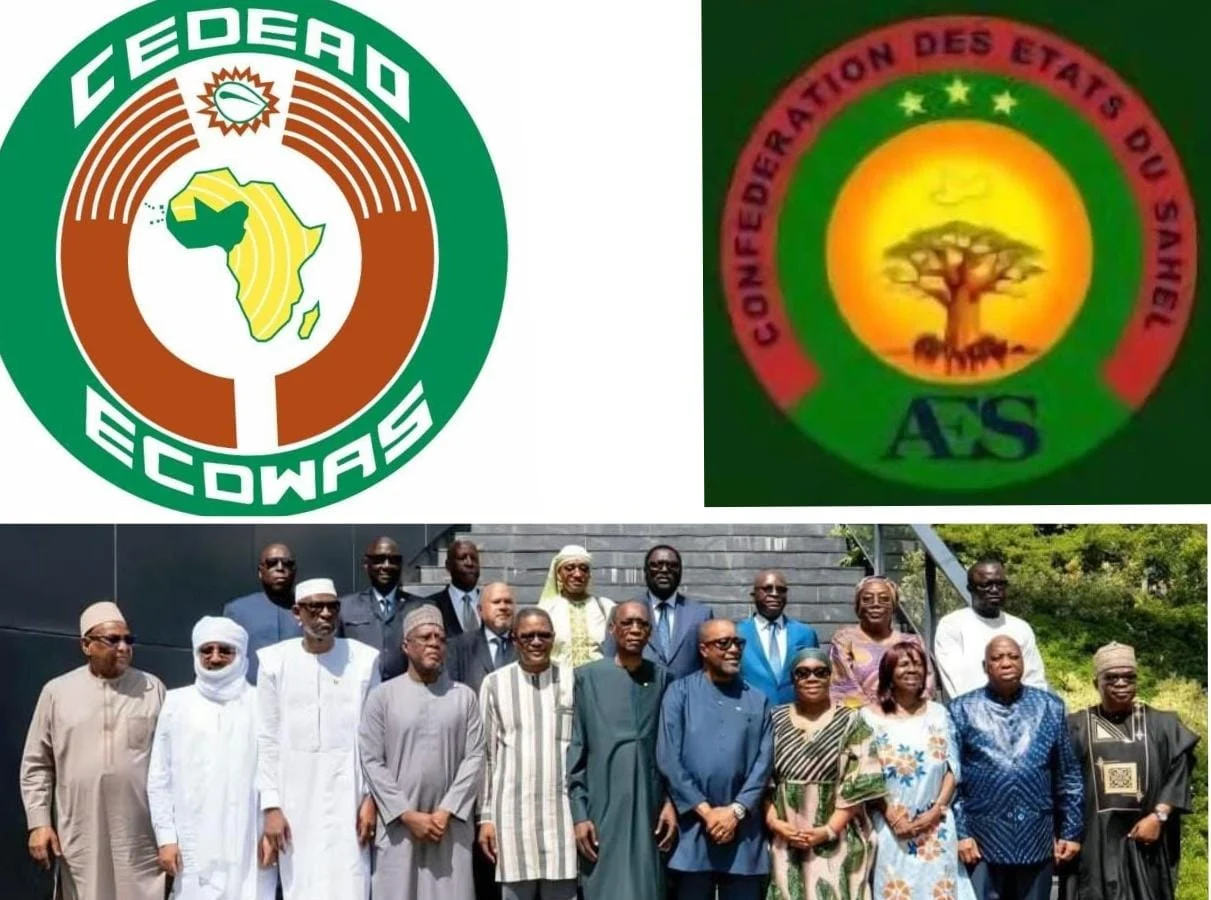
At their just-ended first ministerial consultative meeting on cooperation in Dakar, Senegal, the Economic Community of West African States (ECOWAS) and its breakaway Alliance of Sahel States (AES) have agreed to pursue relations guided by the principles of good neighbourliness, mutual respect for their sovereignty, and the dignity and well-being of the people of West Africa.
This was one of the major decisions they reached at the 16-17 October meeting, to lay the foundations for their cooperation.
ECOWAS, a 15-nation regional economic bloc with an estimated combined population of 400 million, was formed in May 1975 through the Treaty of Lagos, revised in 1993, to promote economic development and regional integration.
AES countries – Mali, Burkina Faso and Niger – withdrew their membership in January 2025, accusing ECOWAS of succumbing to Western influence and deviating from the ideals of its founding fathers.
Following unconstitutional changes of government through military coups in the three countries now ruled by juntas, ECOWAS, acting in line with its 2001 Supplementary Protocol on Democracy and Good Governance, suspended the three countries and imposed sanctions on them.
The regional bloc had also announced an unpopular decision to invade Niger and restore constitutional order. It later walked back on that decision, lifted the sanctions and attempted diplomacy/dialogue, but the AES juntas ruling the three countries have been adamant and continued to consolidate their alliance.
The ECOWAS delegation at the Dakar meeting was led by Cheikh Niang, Minister of African Integration, Foreign Affairs, and Senegalese Abroad, who is also Chair of the ECOWAS Council of Ministers.
The AES delegation was led by Karamoko Jean-Marie Traoré, Minister of Foreign Affairs of Burkina Faso and Chair of the AES Ministerial Steering Committee.
Both ministers co-chaired the meeting, with both delegations “welcoming the spirit of fraternity, mutual respect, and openness that prevailed throughout their discussions,” the Final Communiqué said. “They also recalled the deep historical, sociocultural, and economic ties that unite their peoples.”
According to the Communiqué, the two parties also agreed “to establish joint thematic working groups to conduct technical discussions, with the ultimate goal of concluding a framework cooperation agreement between ECOWAS and the AES Confederation. The outcomes of these efforts will be submitted for review by the Ministers before their next session.”
.
The date and venue for the next meeting will be determined through diplomatic consultations.
“The parties affirm their commitment to achieving a balanced and realistic cooperation framework that safeguards the interests of their respective peoples,” the Communiqué added.
The two sides held the first official consultations in Bamako, Mali, in May 2025, on areas of common interest for future structured discussions.
Despite the populist public image of the junta leaders, their governments have been pursuing bilateral collaboration, including exchanges of strategic interest visits, with selected ECOWAS Member States. For instance, Niger, after accusing Nigeria of alleged acts of destabilisation in December 2024, still turned to Abuja for fuel supply to ease its severe shortages in 2025.
Also, while the three AES countries have partially or completely severed diplomatic and military ties with their former colonial power, France, they still belong to the eight-nation West African Monetary and Economic Union, UEMOA, using the CFA franc, controlled by France, as their national currency.
The three nations are also deepening military ties with Russia, while terrorism and insurgency persist.
Amb. Sola Enikanolaiye, Minister of State for Foreign Affairs, led the delegation from Nigeria, the regional hegemon, to the Dakar meeting.
A statement by the ministry said the minister’s “presence underscores Nigeria’s dedication to ensuring that the exit of the AES Member states does not negatively impact the age-old cultural and geographical ties between brother West African countries.”
Apart from their obvious affinities and geographical proximity, many of the countries in the Sahel and the ECOWAS region share common development challenges, including poverty and vulnerable economies.
The Sahel is considered the epicentre of global terrorism, and AES countries also belong to the regional Multinational Task Force against terrorism. ECOWAS-AES cooperation is therefore imperative to address the serious security and sundry challenges facing the region.
This cannot prevent the three countries from pursuing their common goal/s if they choose to make their withdrawal from ECOWAS permanent.
Members of other organisations such as UEMOA, Mano River Union and Conseil de l’Entente (Council of Accord or Understanding) still belong to ECOWAS.
Arguably, the AES countries have more to gain by cooperating with ECOWAS, and they need ECOWAS more than ECOWAS needs them.
At the same time, ECOWAS, as the bigger and more established organisation, should reposition and reinvent itself to remain relevant, having blazed the trail in achievements among Africa’s eight Regional Economic Communities (RECs).
(Paul Ejime is a Global Affairs Analyst & Consultant on Strategic Governance Communications.)