*By Paul Ejime
A group of Guinea-Bissau Researchers and Academics, at home and in the Diaspora, has suggested solutions to the political crisis in their country, notably a National Dialogue for an agreement on a Unity Government with international guarantors accompanying the process, including ECOWAS, the African Union, the United Nations, the Community of Portuguese Language Countries (CPLP) and other partners.
To restore Constitutional Order following the November 2025 self-coup by former President Umaro Sissoco Embaló, the group, in an open letter to the African Union, ECOWAS, CPLP, European Union and the United Nations, called for a “Transitional Framework, in which no relevant actor can be completely excluded, but no actor should monopolize…”
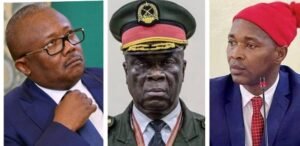
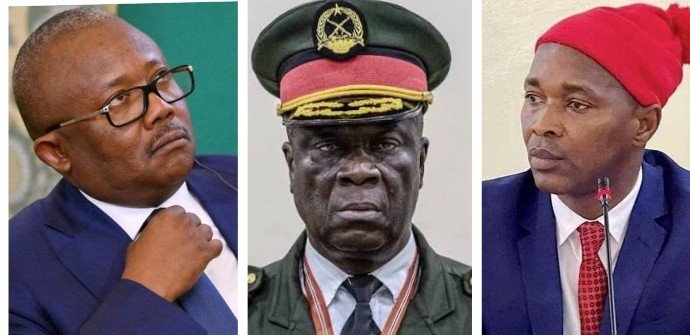
((L-R) Guinea-Bissau ex-President Umaro Embaló, junta leader Horta Inta-A Na Man & Presidential claimant Fernando Dias da Costa.)
The elements of the Frameworks should include a “Political ceasefire and confidence-building measures; Release of political prisoners, independent judicial review of cases, adoption of a national amnesty that involves both the military and the political/civilian sectors; security guarantees for opposition leaders and members of the ousted government, through ECOWAS Security Forces stationed in the country, suspension of political persecution and guarantee of fundamental freedoms, and commitment from all parties to reject violence as a political tool.”
The group, which claims to be “inspired by Cabralist ideals of Unity and Development of Guinea-Bissau,” a reference to Amilcar Cabral, one of the country’s leaders during the independent struggle, called for a “National Unity Government, a temporary executive made up of representatives of the main parties and/or party coalitions, independents, experts, and balanced representation of different political views and media.”
The government, the letter said, should be led by a “Consensus Presidency instead of a figure directly tied to the conflicting blocs…,” and “…the President should be a civilian, independent of political parties, accepted by consensus, not a candidate in previous elections or transitions, preferably, a researcher or academic living in the diaspora.”
Furthermore, the group said the national dialogue should include “representatives from the Military Negotiating Council of the Transition, main political parties (majority and opposition), civil society, women’s and youth organizations, religious denominations (Catholic Church, evangelical communities, Muslim leaders, and traditional Guinean religious groups), traditional authorities, the diaspora, media, business, and trade union sectors.”
“The mediation should be conducted jointly by the African Union, ECOWAS, CPLP, the European Union, and the United Nations, to strengthen impartiality, through a delegation that should be based in the country during the Transition period,” added the letter.
The Embaló-affiliated military junta, which has been running Guinea-Bissau after the coup believed to have been instigated by Embaló, to avoid an electoral defeat, is implementing its 12-month transition programme, including a controversial referendum planned for the end of this month and elections scheduled for 6 December. Independent analysts say the grand plan is to return Embaló to power.
On the role of the military, the Guinean researchers and academics said “Completely excluding them can make implementing the (proposed transition) agreement difficult; giving them permanent political control (will) also… complicate the political situation in the country. One alternative could be (their) participation in negotiations, formal commitment to gradually withdraw from politics, maintenance of constitutional defence functions, and professionalization of the Armed Forces.”
The group also called for “Consensual Constitutional and Judicial Reform,” adding that “A new Constitution is unlikely to be legitimate if it is drafted by only one side. That is why it should be defined as a national priority for the newly elected parliament. On the other hand, if it is to be addressed during the Transition, it should be a more inclusive process that includes, a plural Constitutional Commission, independent experts, (the) Bar Association, national public consultation, participation of all parties, possible approval by referendum, according to the agreed legal framework.”
The new Government, the group said, “should have as a national priority, Public Service Reform and Economic Reform,” adding that “the Transition Schedule should have a pre-agreed timeline” for the “National dialogue, Constitutional reform (if agreed upon), Electoral reform, updated voter registration, local, legislative elections and presidential elections, and full transfer of power to the elected authorities.”
The group suggested that the international guarantors should “provide technical support for organizing the elections”
“…with the inclusion of the main political and military actors, civil leadership of the transition, neutrality of electoral institutions, consensual reform of the rules of the political game, professionalization of the armed forces, a clear and verifiable timeline for returning to constitutional normalcy, we believe that this proposal does not eliminate the risks, but seeks to balance three goals that often come into tension – restoring democratic legitimacy, avoiding new violence, and creating more stable institutions for the future,” the group affirmed.
At its 69th Ordinary session last month in Freetown, Sierra Leone, the Authority of ECOWAS Heads of State and Government appointed Senegal “as facilitator for Guinea-Bissau, with the mandate to support dialogue efforts leading to an inclusive and harmonious transition to constitutional order.”
Consequently, Foreign Minister Cheikh Niang led a Senegalese delegation to Bissau on Thursday 6th August, for talks with the junta leader Gen. Horta Inta-A Na Man. Details of the talks were not made public.
However, Guinean opposition parties have argued that “…recent public positions, (the new Senegalese political situation), and initiatives of the President of the Republic of Senegal, His Excellency Bassirou Diomaye Faye, raise serious concerns regarding his perception of neutrality, which is essential for any credible mediation process.”
Guinea-Bissau’s crisis has divided ECOWAS down the middle. Embaló is believed to be friendly with Faye and the immediate past-Chairman of the ECOWAS Authority, Sierra Leone’s President Julius Maada Bio. Both men have been accused of taking a soft position on Embaló and the Bissau junta, with other regional leaders calling for a tough stance, including barring Embaló and the junta leaders from future elections in Guinea-Bissau.
The ECOWAS Freetown summit “noted the ongoing efforts in Guinea-Bissau to complete the political transition in the country, through holding a constitutional referendum scheduled for 30 August 2026, and general elections set for 6 December 2026. It urged the authorities to ensure transparency and inclusion in these crucial processes. In particular, the Conference called on the transitional regime in Guinea-Bissau to prioritize inclusion in all processes leading to the swift restoration of constitutional order.”
“For this purpose,” the Final Communiqué said, “the Conference urged all stakeholders to show flexibility and create the necessary conditions for constructive and inclusive dialogue…”
It also called on “the transitional authorities to ensure strict respect for human rights, fundamental freedoms, and judicial guarantees for all citizens of Guinea-Bissau, including those who are undergoing legal proceedings or are accused in connection with events that took place under the previous regime.
The Authority further urged the “authorities to proceed with the unconditional release of all political figures who remain detained, including the opposition PAIGC leader (Domingos Simöes Pereira), as a goodwill gesture aimed at creating a more favourable environment for inclusive dialogue, increasing opposition confidence, and strengthening the credibility of the transition process.”
It “tasked the (ECOWAS) Commission with continuing its engagement with the transitional authorities, political actors, civil society and all other stakeholders, with a view to ensuring a credible transition to constitutional order. It also urged the Commission to provide moral and security assurances to all stakeholders, notably through the ECOWAS Stabilization Support Mission. Furthermore, the Conference directed the Commission to provide technical support to Guinea-Bissau to facilitate and strengthen dialogue among stakeholders and ensure a peaceful and inclusive transition and electoral processes.”
The Campaign Directorate of Fernando Dias da Costa, who claimed victory in the 23 November 2025 presidential election, scuttled by the Embaló coup, say he is in Bissau without official security after refuge at the Nigerian embassy.
Diplomatic sources also said that following the ECOWAS summit in Freetown, the Bissau junta has transferred the opposition PAIGC leader Domingos Simöes Pereira from house arrest in Bissau to Lisbon, Portugal, a move seen by critics as part of efforts to weaken the opposition ahead of the planned August referendum and December poll.
With Faye, now the new Chairman of the ECOWAS Authority for the next one year; Senegal as facilitator on the Guinea-Bissau crisis, and his compatriot, retired Gen. Birame Diop as President of the ECOWAS Commission for the next four years, Guinean opposition parties and independent observers are unconvinced about Senegal’s or ECOWAS’ neutrality in resolving the crisis in the Portuguese former colony notorious for political instability.
*Ejime is a Global Affairs Analyst and Consultant on Peace & Security and Governance Communication*