
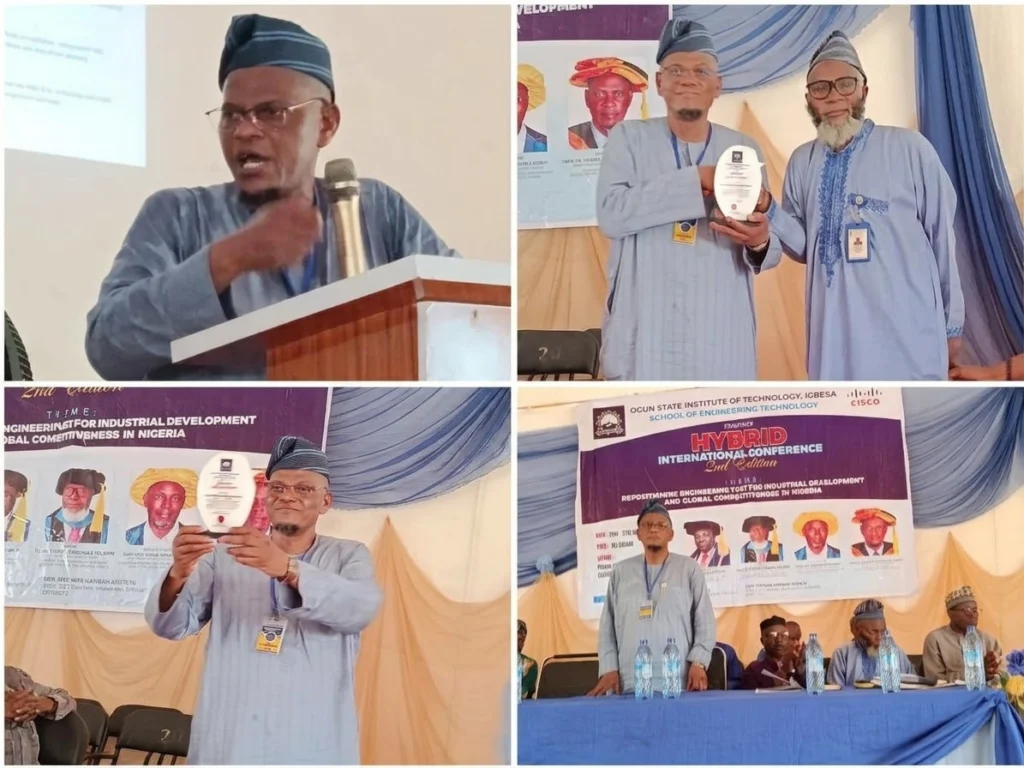
The Immediate Past Pioneer Rector of the Federal Polytechnic Ayede, Oyo State, Engr. Dr. Taofeek Adekunle ABDUL-HAMEED (FNSE, FNIEEE, FCMC, FIPMD, Reg. Eng. COREN), has once again demonstrated his outstanding intellectual leadership, professional distinction and commitment to national development, emerging as the Distinguished Lead Speaker at the Second Hybrid International Conference of the School of Engineering Technology, Ogun State Institute of Technology (OGITECH), Igbesa, Ogun State.

At the prestigious international gathering, held from November 2 to 5, 2026, at the Prince Dapo Abiodun Twin Hall A, OGITECH, Engr. Dr. ABDUL-HAMEED delivered a compelling and thought-provoking lead paper titled “Repositioning Engineering TVET for Industrial Development and Global Competitiveness in Nigeria,” with the sub-theme, “From Technical Certificates to Technical Capability: Powering Nigeria’s Industrial Rise through Skills, Standards and Strategy.”
His presentation provided a profound examination of the strategic importance of Technical and Vocational Education and Training (TVET) as a fundamental driver of industrialisation, technological advancement, economic competitiveness and sustainable national development.
Drawing extensively from his professional experience as an accomplished electrical engineer, distinguished academic, institutional administrator and former pioneer Rector, ABDUL-HAMEED challenged the prevailing societal perception that technical and vocational education is inferior to conventional university education. He maintained that Nigeria’s industrial future depends substantially on the availability of competent technicians, technologists and skilled professionals capable of translating knowledge, research and innovation into tangible economic value.
Emphasising the indispensable contributions of polytechnic education to national development, he observed that Nigeria recorded significant industrial progress during the 1970s and early 1980s when polytechnics and technical institutions were producing the middle-level manpower required to sustain manufacturing, engineering and industrial operations.
He recalled the contributions of established institutions such as The Polytechnic, Ibadan, Yaba College of Technology and Kaduna Polytechnic, noting that their technical manpower output supported the growth of manufacturing establishments, including the former Guinness facility in Ikeja and textile industries in Kaduna.
According to him, the increasing emphasis on certificates at the expense of practical competence has contributed to the weakening of the country’s technical and industrial foundation.
He therefore called for a deliberate national reorientation that would restore the dignity, relevance and competitiveness of polytechnic and technical education.

Addressing the students, he delivered a strong message of confidence, professional identity and self-worth, urging them never to consider themselves inferior to their counterparts in universities.
“Don’t see yourself as a second-class citizen because you are in a college or polytechnic. You must not believe that your colleagues in the university are superior to you. They are not. I repeat, everybody has his or her roles to play in the advancement of a nation,” he declared.
He further encouraged the students to regard the conference as an opportunity for meaningful reflection, informed decisions and personal transformation, rather than merely another academic gathering.
“We are here because of you, to speak so that your future will be well guaranteed,” he said.
In his far-reaching presentation, ABDUL-HAMEED identified the disconnect between technical institutions and industry, obsolete laboratory equipment, inadequate funding, outdated curricula, insufficient industrial exposure for lecturers, weak institutional partnerships and the persistent HND-B.Sc. dichotomy as some of the critical challenges undermining engineering TVET in Nigeria.
He particularly emphasised the need to bridge the gap between academic qualifications and actual technical capabilities, arguing that possessing certificates without demonstrable professional competence cannot guarantee industrial productivity or global competitiveness.
“No nation has industrialised on the strength of degrees alone. Every industrial power was built on a deep and respected corps of technicians, technologists and craftspeople who convert design into product and product into prosperity,” he asserted.
Using electrical engineering principles such as load and supply, impedance matching, feedback, synchronisation and reliability, he illustrated the relationship between technical education and the broader national industrial system. He explained that, just as an electrical power system cannot function effectively without coordination among its various components, Nigeria cannot achieve meaningful industrial transformation without synchronising education, government policies, industry requirements, professional standards and sustainable financing.
He also highlighted Nigeria’s enormous opportunities in renewable energy, smart grids, industrial automation, electric mobility, digital manufacturing, embedded systems and other emerging technological fields, stressing that technical institutions must continuously adapt their training programmes to meet evolving industrial demands.
Of particular significance was his proposal for a comprehensive seven-pillar framework for repositioning engineering TVET in Nigeria. The framework encompasses competency-based and industry-driven curricula; strategic industry partnerships and work-based learning; staff development and industrial exposure; modern laboratories, workshops and digital infrastructure; effective governance and quality assurance; sustainable financing; and improved recognition, career progression and societal perception of technical qualifications.
He advocated stronger collaboration among government agencies, regulatory institutions, professional engineering bodies, polytechnics, industries and development partners, insisting that the responsibility for rebuilding Nigeria’s technical education system must be collectively owned.
He equally called for a decisive resolution of the HND-B.Sc. dichotomy, explaining that professional competence, productivity and demonstrable skills should be the principal considerations in career advancement and national workforce development.
On the critical relationship between energy and industrial development, the former Rector maintained that Nigeria’s electricity challenges, although a major constraint, also present enormous opportunities for engineering graduates and technical institutions to develop the manpower required for renewable energy installations, battery storage, mini-grid operations, electrical maintenance and other emerging energy solutions.
He urged engineering schools, particularly those located within industrial corridors, to establish stronger relationships with manufacturing companies, making industry a direct partner in curriculum development, student training, research, innovation and graduate employment.
His presentation concluded with a passionate appeal to policymakers, regulators, institutional administrators, industry leaders, lecturers and students to move beyond conference resolutions and translate discussions into measurable actions.
“Repositioning engineering TVET is not a favour to polytechnics. It is a strategy for national survival and prosperity,” he emphasised.
He further declared that Africa’s industrial future would depend not merely on its capacity to acquire knowledge but on its ability to develop the technical competence required to manufacture, innovate, maintain and compete globally.
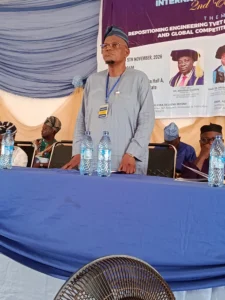
In recognition of his exceptional intellectual contribution, professional excellence and invaluable insights into the advancement of engineering technology and technical education, Engr. Dr. ABDUL-HAMEED was presented with the Distinguished Lead Speaker Award by the School of Engineering Technology, OGITECH, at the conference on November 3, 2026.
The recognition further underscores his growing influence in engineering education, institutional leadership, professional development and the advancement of Nigeria’s technical and vocational education landscape.
The conference also featured other distinguished personalities who received various awards in recognition of their contributions to education, engineering, leadership and community development. They included Engr. Prof. Kazeem Adekunle Adebiyi, FNSE, Chairman, Governing Council, Adeseun Ogundoyin Polytechnic, Eruwa, and former Rector, The Polytechnic, Ibadan, who received the Distinguished Keynote Speaker Award; Chief Muhammad Ajibola Olagbaye, the Asiwaju of Igbesa Land, who received the Special Reconciliation for Institutional Award; HRH Oba Teslim Nosiru Olayemi, honoured with the Royal Patron of Excellence Award; Dr. Abiodun Babatunde Oluseye, Rector, OGITECH, who received the Outstanding Transformational Leadership Award; and Engr. Dr. Dauda Adekunle Folarin, FNSE, FNIEEE, Dean, School of Engineering Technology, OGITECH, who received the Award for Innovative Leadership and Excellence, among other awardees.

Earlier, the Chief Host and Rector of OGITECH, Dr. Abiodun Babatunde Oluseye (FBDFM, FCAI, FCPA), welcomed participants and described the conference as an important platform for knowledge exchange, professional engagement and institutional advancement. He encouraged staff and students to maximise the opportunities presented by academic conferences, particularly by prioritising practical skills and innovation.
He disclosed that the institution had continued to record progress in skills acquisition, citing the successful assembly of nine drones by students as an indication of the practical and innovative capacity being developed within the institution.
The Host and Dean of the School of Engineering Technology, Engr. Dr. Dauda Adekunle Folarin (FNSE, FNIEEE, CEE, FIPMD, Reg. Eng. COREN), also highlighted the importance of the conference in advancing research, innovation, professional collaboration and the development of globally competitive engineering manpower.
The four-day international conference featured extensive discussions across critical areas of engineering and technological development, including robotics, embedded systems, Internet of Things (IoT), cybersecurity, software development, sustainable energy, smart technologies, digital transformation, advanced manufacturing, industrial automation, construction technology, materials engineering, maintenance engineering and Nigeria’s emerging manufacturing economy.
The keynote presentation by Engr. Prof. Kazeem Adekunle Adebiyi focused on the integration of automation, robotics and digital technologies into welding and fabrication TVET, with particular emphasis on addressing Nigeria’s welding skills gap through stronger industry-institution partnerships.
Beyond his distinguished participation at the OGITECH conference, Engr. Dr. Taofeek Adekunle ABDUL-HAMEED’s recognition reflects a professional career shaped by engineering excellence, academic commitment, institutional development and visionary leadership.
As the Immediate Past Pioneer Rector of the Federal Polytechnic Ayede, Oyo State, he occupied a historic position in the establishment and formative development of the institution, contributing to the foundation of an emerging centre of technical and vocational education in Nigeria.
His participation at the international conference is therefore not only a recognition of his personal professional accomplishments but also an affirmation of the intellectual contributions of Nigeria’s polytechnic system to national development and global conversations on engineering education.
His message resonates beyond the conference hall: Nigeria cannot build a globally competitive economy without restoring the prestige of technical education, investing in practical competence and empowering the people who translate knowledge into industrial productivity.
As governments, educational institutions and industry stakeholders continue to explore sustainable pathways towards economic transformation, his advocacy offers a compelling reminder that the future of Nigeria’s industrial development must be built on skills, standards, innovation and strategic partnerships.
For ABDUL-HAMEED, the true measure of education is not merely the certificate a graduate possesses, but the competence, creativity and capacity to solve real-world problems.
And that, ultimately, is the foundation upon which a productive, technologically independent and globally competitive Nigeria must be built.