

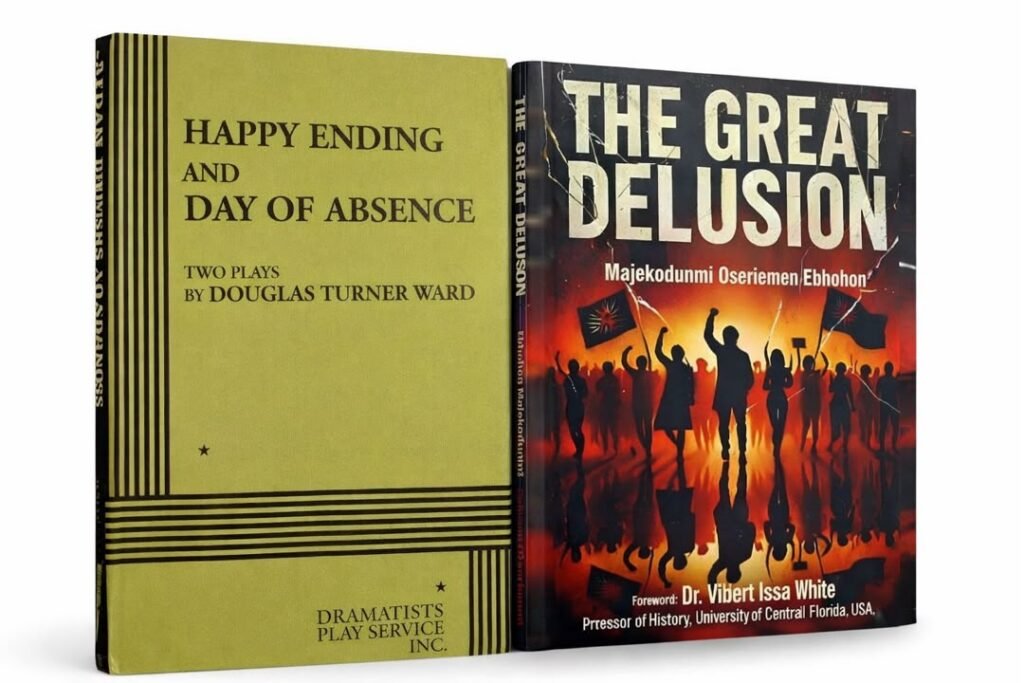
In 1965, at the height of the Civil Rights Movement, African American playwright Douglas Turner Ward’s Day of Absence posed a radical dramatic question: What would happen if every Black person suddenly disappeared from a Southern American town? Through satire, the play exposed the dependence of a racist society on the Black domestic workers, farmhands, labourers, and service workers whose daily labour sustained its economy while remaining socially devalued. The dramatic force of Ward’s thought experiment lay in making Black indispensability visible within a society struggling to deny it.
Sixty years later, Nigerian playwright Majekodunmi Oseriemen Ebhohon’s The Great Delusion revisits the dramatic logic of Black withdrawal but relocates it within a fundamentally different historical and imaginative horizon. The withdrawal is no longer confined to a single Southern town but expands to a global scale, as people of African descent disengage from systems that have long exploited their labour, intellect, and humanity. More significantly, the labour that disappears is no longer represented primarily through domestic or manual service but through the withdrawal of Black scientific innovation, technological ingenuity, medical expertise, intellectual production, and civilizational contributions. Figures such as Katherine Johnson, Daniel Hale Williams, Garrett Morgan, Marian Croak, and other historically marginalized innovators become dramatic evidence that modernity has rested upon obscured Black genius.
The divergence between the two plays is equally historical. Day of Absence belongs to a moment when the central political task was recognition: exposing Black indispensability within an exclusionary social order in order to demand inclusion. The Great Delusion, by contrast, emerges from a twenty-first-century moment increasingly marked by debates over the limits of representation, diversity, and institutional inclusion. It advances from the recognition that visibility and formal inclusion have not, by themselves, dismantled the structures of anti-Black domination. Consequently, the play redirects the dramatic experiment. Rather than asking how white society responds to Black absence, it asks what becomes possible when withdrawal becomes the basis for diasporic reunification, epistemological recovery, and the construction of an African civilization organized on its own historical, intellectual, and moral terms.Read together, the two plays share a common dramatic premise while charting the evolution of Black theatrical imagination from the politics of indispensable labour to the politics of civilizational self-determination.
— Precious Etop
Department of Foreign Languages, University of Benin, Class of 2016