

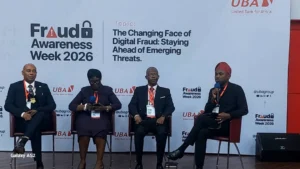
Digital fraud: Expert urges banks to strengthen governance, invest in technology
The Managing Director, BW Technologies Ltd., Mr Wemimo Oluwalade, has urged financial institutions to strengthen their governance structures, invest in technology and equip their workforce to effectively combat emerging digital threats.
Oluwalade gave the advice at the 2026 Fraud Awareness Week panel discussion organised by United Bank for Africa (UBA) on Friday in Lagos.
He said that financial institutions needed effective governance structures, investment in technology and continuous staff training to strengthen their defences against increasingly sophisticated criminal activities.
He explained that fraudsters were exploiting data breaches, stolen credentials, malware and social engineering to target customers through text messages, emails, social media and telephone calls.
“Weak collaboration among financial institutions often delayed the detection of suspicious accounts and recovery of stolen funds.
“An account closed by one bank could be opened in another institution because of inadequate information sharing.
“I urge financial institutions and regulators to strengthen data-sharing arrangements and consider reviewing relevant provisions of the Nigeria Data Protection Act 2023 to support collaboration in tackling financial crimes.
He identified customer onboarding and agent networks as potential vulnerabilities, urging banks to strengthen identity verification and closely monitor agents who open accounts.
He said customer education alone was insufficient to combat sophisticated criminal networks as he emphasised the need for stronger institutional controls and a review of liability arrangements.
“Customers are outmatched by professionals using tools better than ours. Some of these fraudsters are former bankers, technology experts and disgruntled individuals who deliberately target their former employers,” he said.
Oluwalade called for more investment in artificial intelligence, machine learning and advanced analytics to detect unusual transaction patterns in real time.
He, however, emphasised the need for human oversight, responsible use of artificial intelligence and regular assessment of systems to identify emerging threats.
He urged banks to strengthen transaction monitoring, identity verification, staff training and internal risk management, while encouraging telecommunications operators to share relevant information on SIM swaps and device changes.
He also called on regulators to establish clear responsibilities and standardise reporting procedures.
He urged law enforcement agencies to strengthen digital investigation capabilities.
He said effective collaboration, intelligence sharing and investment in technology were essential to building resilient systems capable of responding swiftly to emerging threats.
Earlier, Mrs Aina Amah, Chairperson, Association of Chief Audit Executives of Banks in Nigeria (ACAEBIN), said traditional fraud prevention mechanisms were no longer sufficient to address emerging threats driven by artificial intelligence, deepfakes and automation.
Amah said financial institutions must move beyond rule-based controls and adopt proactive fraud detection and monitoring systems to stay ahead of increasingly sophisticated fraudsters.
She urged banks to invest in technology, strengthen their audit and cybersecurity teams and ensure adequate resources were allocated to fraud prevention.
“Fnancial institutions must stop treating technology investments as unnecessary costs, given the increasing financial losses associated with digital fraud.
“Fraudsters invest heavily in technology, banks risk exposing themselves to significant losses by failing to upgrade their systems.”
Amah also advocated continuous fraud risk assessments, as she explained that emerging threats could render annual risk management plans ineffective within a short period.
Also speaking, Mr Sunday Ajani, Manager, Revenue Assurance and Fraud Management at Globacom, urged individuals to secure their SIM cards with Personal Identification Numbers (PINs).
Ajani warned that fraudsters could remove SIM cards from stolen phones and use them to access victims’ accounts.
He advised subscribers to change default SIM security PINs provided by telecommunications operators to prevent unauthorised access.
He said mobile technology had become central to financial transactions, making the integrity of subscriber registration and SIM card security critical to fraud prevention.
He explained that telecommunications operators had introduced additional verification measures to prevent agents from completing subscriber registration without further checks by their systems.
According to him, the measures include National Identification Number (NIN) validation and technology capable of detecting AI-generated photographs used in fraudulent registrations.
He said suspicious registrations were also subjected to additional scrutiny by specialised teams, which reviewed image authenticity and other verification requirements before approval.
Ajani said SIM swap fraud had also declined, following stricter verification procedures that require subscribers to be physically present during the process.
Similarly, ACP Tanko Mahmud of the Nigeria Police Special Fraud Unit, said internal compromise and exploitation of trust remained major contributors to digital fraud.
Mahmud said the unit’s investigations indicated that internal compromises accounted for about 70 per cent of its fraud cases.
He explained that some employees were compromised before fraudulent transactions occurred, making it necessary for financial institutions to strengthen internal monitoring and investigate suspicious activities thoroughly.
He also called for stronger collaboration among banks, telecommunications operators and other stakeholders to ensure swift responses to fraud incidents.
He said delays in communication between financial institutions could allow stolen funds to move through several accounts before preventive measures were taken.
Mahmud further emphasised the need to extend fraud awareness campaigns beyond educated and internet-connected populations to people in rural communities.