




Year: 2026

  • Easter: Enugu-based philanthropist, Dr Odumegwu, urges unity, peace

    Easter: Enugu-based philanthropist, Dr Odumegwu, urges unity, peace

    Easter: Enugu-based philanthropist, Dr Odumegwu, urges unity, peace

    An Enugu-based philanthropist, Dr Ejikeme Odumegwu, has felicitated Christians on completion of 40 days fasting and subsequent Easter celebration that follows it.

    Odumegwu, who is the Executive Director of Owelle Ejikeme Odumegwu (OEO) Foundation, said this in an Easter Goodwill Message he issued on Saturday in Enugu.

    He called on residents of Enugu State especially the people of Nsukka to exemplify the spirit of unity and peace this Easter.

    Odumegwu, who holds the title of Owelle of Nsukka, also called on residents to ensure that they have their Permanent Voter Cards (PVC) to actively vote and support the re-election of the performing Gov. Peter Mbah.


    “As we celebrate and thank God for another Easter; we should not forget the major task ahead, which is re-election of our hardworking and innovative governor, Gov. Peter Mbah.

    “Mbah is currently envisioning a modern Enugu State for us and our children through massive infrastructural works as well as people-oriented programmes and initiatives,” he said.

    The philanthropist, whose foundation had awarded scholarship to scores of secondary and tertiary students, admonished residents to vote in frontline politicians who have penchant for modernity and development just like Mbah.

    Odumegwu, who is a frontline politician and statesman, urged the residents especially the people of Nsukka axis to close ranks and seek leaders that would join Gov. Mbah to facilitate all-round development of Nsukka axis of the state.


    According to him, at this stage of our political development, our people should follow people that have their interest at heart and exemplified it by their philanthropic gestures and programmes.

    “I once again wish all Christians, Bishops and leaders of various denominations, women and youth leaders a happy Easter celebration filled love and good neighbourliness.”

  • 2 U.S. war jets downed by Iranian fire as both sides scramble for missing pilot


    Two U.S. military aircraft, an F-15 fighter jet and an A-10 Warthog attack plane, crashed in quick succession on Friday after coming under fire from Iran, local media reported. The consecutive losses of U.S. aircraft came shortly after U.S. President Donald Trump’s claim that Iranian forces “can’t do a thing about” U.S. planes flying over Tehran.

    WASHINGTON, April 3 (Xinhua) — Two U.S. military aircraft, an F-15 fighter jet and an A-10 Warthog attack plane, crashed in quick succession on Friday after coming under fire from Iran, local media reported.

    One pilot from the two-seat F-15 has been rescued, but the other remains missing. The A-10 Warthog reportedly managed to reach Kuwaiti airspace, where the lone pilot ejected and escaped.

    U.S. officials later confirmed that two U.S. rescue helicopters, including a UH-60 Black Hawk, which undertook the search-and-rescue operations for the jets, were also struck.

    The consecutive losses of U.S. aircraft came shortly after U.S. President Donald Trump’s claim that Iranian forces “can’t do a thing about” U.S. planes flying over Tehran.

    SCRAMBLING FOR PILOT

    This incident is the first known case of a U.S. warplane being downed inside Iranian territory and the fourth F-15 lost since the United States and Israel launched large-scale strikes on Iran on Feb. 28.

    Crews were racing to locate the second pilot of the downed jet, which was believed to have crashed in Iran’s southwestern Kohgiluyeh and Boyer-Ahmad province, near the border with Iraq, according to local authorities.

    Iran’s Revolutionary Guard Corps (IRGC) was combing an area near where the pilot’s plane came down in southwestern Iran, and the governor of the province said that anyone who captured or killed the pilot would be “specially commended,” reported Iran’s semi-official news agency ISNA.

    A television channel in the province advised citizens who encounter downed U.S. pilots to keep them alive and bring them to authorities for a “prize,” reversing earlier instructions that had encouraged harming them, NewsNation reported.

    A reward of 10 billion tomans (6,600 U.S. dollars) has been set to find the pilot, reported the Iranian news outlets.

    After weeks of relentless U.S. airstrikes, Iranians posted jubilant messages online celebrating the downing of the U.S. aircraft. Iran’s Parliament Speaker Mohammad Baqer Qalibaf wrote on X that what had begun as a military campaign had now been transformed into a hunt for their pilots.

    Israel’s state-owned Kan TV News reported that Israel is assisting the United States with intelligence in locating the pilot.

    Meanwhile, Israel’s Channel 12 reported that the country had delayed planned strikes in the search area, citing Israeli officials. The Israel Defense Forces has not confirmed these reports independently.

    “MISCALCULATION”

    IRGC said Friday that the aircraft was hit by advanced air defense systems operated by its aerospace division.

    Earlier on Wednesday, Trump said that Iran’s drone and missile capabilities had been “decimated”. While he claimed that the U.S. military had achieved “total air dominance” over the region, military experts suggested that air superiority does not mean that there are no threats.

    Iran has bolstered its defenses by constructing extensive underground missile facilities, networks of tunnels, and fortified bunkers across the country, said Federico Borsari, a non-resident fellow with the Transatlantic Defense and Security Program at the Center for European Policy Analysis. “It is quite possible that some Iranian air defense assets are still operational and hidden and concealed in many locations across the country.”

    The potential that a U.S. pilot remains alive and at large deep inside Iran has heightened the pressure on Washington in a war that has struggled to secure strong backing from the American public, according to opinion polls.

    In a phone interview with The Independent, a British online newspaper, Trump said he hopes that’s “not going to happen” if Iranian forces find the missing airman.

    Iran has rejected a U.S. proposal for a 48-hour ceasefire, the semi-official Fars news agency reported on Friday.

    The source added that Washington has stepped up its diplomatic efforts to secure a ceasefire, particularly after an Iranian strike targeted a U.S. “military forces depot” on Kuwait’s Bubiyan Island.

    According to the agency, assessments suggest that the proposal was put forward following an intensification of the crisis in the region and “serious problems” for U.S. forces resulting from their country’s “miscalculation” of Iran’s military capabilities.

  • Fraudster Hacks WhatsApp Account of former Osun State Commissioner

    Fraudster Hacks WhatsApp Account of former Osun State Commissioner


    – Extort N375,000 from Unsuspecting Contact


    ,- Petitions EFCC Chairman for redress


    By Danladi Ahmed
    Abuja (FLOWERBUDNEWS): A former Honourable Commissioner for Information, Youth, Sports and Culture of Osun State, Hon. Biola AbdulMajeed Lawal, has lamented the hacking of his WhatsApp account by fraudsters who have been molesting his contacts with requests for money using his cloned phone number.

    Speaking with sympathisers in Oyo  town where he is currently on an assignment, Hon. Lawal said that he was particularly saddened that the fraudster succeeded in duping one of his beloved unsuspecting contacts based in his home town, Ede in Osun State.

    ”They extorted a total of N375,000 from him pretending to be me in an urgent situation with a fake assurance of prompt repayment,” Hon. Biola Lawal stressed.

    ”The fraudster first requested for N75,000 which he sent to an account they sent to him, believing it was from me.

    ”Once they got that, they followed up with a request for additional N300,000, pretending to be me, which he sent to another account they sent to him different from the first one”.

    Hon. Biola Lawal said that the fraudster had made a video call to him with a number showing the Speaker of the Lagos State House of Assembly, Rt.-Hon. Mudasiru Obasa in a warm greeting to him.

    ”In an (now) apparently Artificial Intelligence (AI) generated image, the ” Honourable Speaker” told me that he was planning an online media chat for 7.30 pm that day, and he wants me to participate,” Hon. Biola Lawal told the sympathisers.

    ”Of course, I felt for it thinking that the image talking to me was actually the Honourable Speaker,” the former Information Commissioner lamented.

    Hon. Biola Lawal, who is also a former Acting Managing Director of the News Agency of Nigeria (NAN), said that from that point on, the rest is history as the fraudster eventually hacked his WhatsApp account.

    ”Shortly after, I began receiving calls from far and wide, wanting to know if I was the one actually in distress requesting for money, which I promptly denied,” the former Honourable Commissioner said.

    ”We immediately began sending out messages notifying as many as possible contacts that my WhatsApp account had been hacked,” he disclosed.

    ”Unfortunately, we have now confirmed that at least one person fell victim and sadly, got duped,” Hon. Biola Lawal said.

    The former Acting NAN Boss, who is also the publisher of the online newspaper, FLOWERBUDNEWS, however, said that all relevant security agencies have been notified of the criminal and highly embarrassing act of the fraudster.

    ”Insha ALLAH, there are assurances that the perpetrators will be apprehended and brought to justice,” Hon. Biola Lawal said

    ‘We have contacted EFCC, the Nigeria Police, the Civil Defence and others for urgent redress to get the extorted amount refunded, among other demands that will follow the fraudster’s eventual arrest,” Hon. Biola Lawal disclosed.

    ‘We are confident, he will be apprehended by the security agencies very soon,” the former Honourable Commissioner stated hopefully.

    ”My brother, who was extorted, is already requesting me to refund him the N375,000 which the fraudster got from him, hence the need for security agencies to help us act fast,” he said

    According to Hon. Biola Lawal, the duped contact sent him the message below:

    ”For the sake of Almighty Allah send the money to the above account.

    ”Brother, l swear by Almighty Allah the sent you is not mine. May Almighty Allah enrich in ways.” the duped contact pleaded. (FLOWERBUDNEWS)


  • 2.6bn mining FDI shows Tinubu’s reforms are driving diversification, industrial growth-Group

    2.6bn mining FDI shows Tinubu’s reforms are driving diversification, industrial growth-Group


    By Danladi Ahmed

    The Tinubu Stakeholders Forum (TSF) has welcomed reports that Nigeria has attracted over $2.6 billion in foreign direct investment (FDI) into the mining sector in the last two years.

    In a statement signed by its Chairman, Ahmad Sajoh and Secretary Danjuma Sada, it described the development as a major vote of confidence in the reform agenda of President Bola Ahmed Tinubu.

    “For TSF, this is clear evidence that disciplined reforms, policy clarity and firm leadership can unlock sectors that were neglected for too long. The progress in the mining sector reflects deliberate actions by the Federal Government to improve governance, digitise licensing processes and intensify the crackdown on illegal mining.

    “These reforms are restoring credibility to the sector. By improving transparency in mineral title administration, revoking dormant and non-compliant licences, and confronting illegal mining, the Tinubu administration is sending a strong signal that Nigeria’s mineral wealth will no longer be left to disorder, speculation and criminal exploitation.

    “Serious investors respond to serious policy, and that is exactly what this administration is providing,” the statement said.

    TSF also noted that the reforms are already attracting companies that are establishing processing and value-addition projects in Nigeria.

    “Public reports have linked firms such as Canmax Technologies, Jiuling Lithium, Avatar New Energy Nigeria Company, and Asba Group to major lithium processing investments in the country. This shows that Nigeria is no longer content to sit on mineral deposits without building the industrial capacity required to benefit fully from them.

    “We are encouraged that these investments are supporting the establishment of processing plants and related infrastructure within Nigeria.

    “This marks an important shift from the old pattern where raw materials left the country with little domestic value created. What is emerging instead is a more strategic approach that links mining to industrial growth, job creation, technology transfer and stronger domestic production.

    “This is why TSF considers the development significant beyond the mining sector itself. It shows that the Tinubu administration is deliberately widening the base of the Nigerian economy and reducing the country’s overdependence on oil and gas.

    “For decades, hydrocarbons dominated national economic thinking. What we are seeing now is a determined effort to build new pillars of growth in solid minerals, manufacturing and export-oriented industrial activity.

    “TSF is especially pleased that the current policy direction supports local manufacturing. Nigeria must not remain a mere exporter of raw minerals while other economies reap the higher-value benefits of processing, refining and industrial production. The push for local beneficiation and in-country processing is the right path if the country is to convert natural resources into factories, skilled jobs, technical capacity and sustainable prosperity.

    “A stronger mining value chain will support the local manufacturing sector by supplying industrial inputs, stimulating investment in power and logistics, creating employment for Nigerian youths and strengthening linkages across the wider economy.

    “If sustained, these reforms can help Nigeria move from being simply a resource-rich country to becoming a productive industrial economy,” it added.

    The group urged the Federal Government to sustain the momentum by deepening enforcement, expanding geological data, strengthening host community engagement and ensuring that the benefits of the sector are broadly shared by Nigerians.


    End

  • The next generation of electricity is almost here

    The next generation of electricity is almost here


    Power play

    I’m in Texas this week to talk about the remarkable breakthroughs fueling our zero-emission future.

    Bill profile picture
    Work
    Accelerate energy innovation

    Greetings from the Lone Star State! I’m in Texas this week for the Breakthrough Energy Ventures Investors Summit. This is one of the best places in the world to see the future of energy, and I can’t wait to see how much progress has been made since my last visit.

    There’s a lot on the agenda this week, but I’m especially excited to talk about electricity breakthroughs.

    By 2050, the world will need nearly three times as much power as we use today—and if we’re going to decarbonize the economy, we’ll have to electrify a lot of things that currently use fossil fuels. That means we need to deliver a huge amount of energy in a clean, reliable, and affordable way.

    If you’re an electricity nerd like me, this is an exciting moment. Earlier this month, TerraPower—the next-generation nuclear power company I created in 2008—received federal approval to start building the nuclear reactor at its Kemmerer, Wyoming plant. Wind and solar are reportedly generating more electricity than fossil fuels in the EU for the first time. We’re seeing a clear shift as the world’s electricity system is becoming more diverse, more innovative, and more dynamic than ever before.

    Here are three of the coolest technologies people will be talking about this week:

    Geothermal. Geothermal power has been around for more than a century, but new approaches are unlocking greater potential for the technology. Most geothermal power plants today are located near the boundary between two tectonic plates, where you don’t have to drill as deep to find usable heat that can be pumped to the surface to turn a turbine and generate electricity.

    Fervo wants to make geothermal an option in more places by both digging deeper (up to a mind-blowing 15,000 ft below the surface) and extending their wells horizontally at their deepest point. The results so far are super promising: Their pilot project has been consistently generating electricity since 2023, and their Cape Station plant in Utah will come online this year.

    Fusion. Fusion is the reaction that powers the sun and stars, and it has the potential to be a virtually unlimited source of clean, safe electricity. Once the technology is fully commercialized within the next decade, it can be built anywhere, scaled up, and used to make huge amounts of electricity with no carbon emissions and minimal waste.

    The question right now is how we get there. It seems likely that the first commercial fusion plants will use magnetic fields to harness the reaction to generate electricity. There are two different approaches to this: the tokamak, a donut-shaped machine that is easier to build but harder to keep stable, and the stellarator, a twist-shaped machine that is harder to build but easier to keep stable. (An unstable reaction can damage the machine but poses no risk to safety.) Commonwealth Fusion Systems is on track to turn on their SPARC tokamak next year, and Type One Energy is making great progress with their Infinity One stellarator. Marathon FusionXcimer, and Zap Energy aren’t quite as far along with their approaches, but I’m optimistic about what they’re doing.

    Geologic hydrogen. Hydrogen shows great promise as an energy source, and the discovery of geologic hydrogen is one of the biggest energy surprises of the past decade. Although it’s the earliest stage technology on this list, I’m excited about its potential. Geologic hydrogen is a zero-emission power source that is continuously generated underground by the Earth itself. Bourakébougou, a village in Mali, is powered by the small hydrogen field it sits on top of, and researchers have found deposits in the U.S., France, and other places.

    This is an unusual technology to talk about because it’s hard to predict a timeline. It could take decades before geologic hydrogen becomes commercially viable at scale—or a company like Koloma or Mantle8 could find a massive deposit tomorrow, and then we’re off to the races. Once we find one really good source, it’ll be much easier to find the second because we’ll know exactly what we’re looking for.

    If I could hop in a time machine and see what the future looks like a few decades from now, I would expect to see at least one of these technologies generating a significant chunk of the world’s power. It’s amazing to see so much progress being made in so many different areas, because it means that we’ll have options for how we generate affordable, reliable, clean electricity at the scale the future demands.

  • THE FORGIVEN MUST BECOME FORGIVING: AN EASTER COVENANTAL CALL FOR NIGERIA – BISHOP ONYIA

    THE FORGIVEN MUST BECOME FORGIVING: AN EASTER COVENANTAL CALL FOR NIGERIA – BISHOP ONYIA

    THE FORGIVEN MUST BECOME FORGIVING: AN EASTER COVENANTAL CALL FOR NIGERIA – BISHOP ONYIA


    By Rt. Rev. Dr. Christian O. Onyia, Bishop, Diocese of Nike (Anglican Communion)


    The Rt. Rev’d Dr. Christian O. Onyia, Bishop of the Diocese of Nike (Anglican Communion), has issued a profound Easter message to the nation, urging Nigerians to embrace forgiveness as a moral, spiritual, and civic imperative essential for national renewal.


    Anchored on Ephesians 4:32, “Be kind and compassionate to one another, forgiving each other, just as in Christ God forgave you,” the Bishop emphasized that Easter is not merely a historical remembrance but a living proclamation of hope, reconciliation, and societal transformation.


    As we celebrate the resurrection of Christ this Easter, we are reminded that forgiveness is not optional. Christ’s triumph over death calls us to rise above bitterness, resentment, and division, embodying His compassion in our families, communities, and nation.


    Recognizing the significance of Easter and the need to reflect the compassion of Christ, the Diocese has adopted “The Forgiven Must Be Forgiving” as its 2026 Synod theme, emphasizing the prophetic charge: “The forgiven must be forgiving.”


    In line with this vision, the 2026 Synod will be held in a rural community where the Church will not only preach the Gospel but also implement practical outreach programs, including health services, provision of food and other material support, scholarships, and direct financial assistance to communities and their people.


    The Diocese will also offer pastoral care, trauma counseling, and spiritual mentorship as part of its commitment to holistic restoration, ensuring that physical assistance is matched with emotional and spiritual healing.


    The Bishop stressed that forgiveness is a moral and civic necessity in a nation burdened by poverty, violence, mistrust, and unresolved grievances. Forgiveness interrupts cycles of retaliation, restores dignity, opens pathways to dialogue, and enables reconciliation. It is moral courage, not weakness.


    Forgiveness begins at home, in neighborhoods, workplaces, and local communities. Each citizen has a role in breaking cycles of mistrust, violence, and corruption through deliberate acts of reconciliation and ethical conduct.


    Globally, unforgiveness has exacted a heavy toll. Violent conflicts affect more than 78 countries. The war in Ukraine has displaced over eight million people internally and six million across borders. Syria’s civil war forced over 13 million people from their homes, while Yemen’s conflict left over 24 million dependent on humanitarian assistance.


    Globally, over 110 million people are forcibly displaced. These crises reflect unresolved grievances and revenge-driven politics.


    Economic and environmental pressures compound these challenges. Global inflation rose to 5.8 percent in 2024, while food prices in Africa increased by over 30 percent since 2022.


    Climate change caused over $313 billion in damages in 2025, while global temperatures rose about 1.2 degrees Celsius above pre-industrial levels.


    Health threats such as malaria, HIV/AIDS, tuberculosis, cholera, and emerging infections continue to kill millions annually.


    Inequality remains staggering, with the richest 1 percent controlling about 45 percent of global wealth, and many African countries face unsustainable debt burdens.


    Africa bears these burdens with particular intensity. The Sahel region hosts over eight million displaced persons due to insurgency and terrorism.


    Boko Haram and ISIS-West Africa insurgencies have caused over 45,000 deaths across Nigeria, Chad, Cameroon, and Niger since 2010.


    Coups in Sudan, Mali, and Burkina Faso displaced over 1.5 million people since 2021.


    Africa hosts about 26.2 million refugees and internally displaced persons, while over three million West Africans attempt irregular migration annually, exposing themselves to trafficking and death.


    Youth unemployment is nearly 20 percent, malaria kills over 400,000 Africans yearly, HIV/AIDS affects over 25 million, and food insecurity affects about 350 million.


    Desertification and floods continue to displace millions, revealing a continent burdened by structural injustice, weak institutions, and unresolved grievances. Forgiveness, paired with justice and reform, is indispensable for continental healing.


    Within this global and continental context, Nigeria stands at a critical crossroads.


    Real GDP growth reached 3.98 percent in the third quarter of 2025, following 3.13 percent and 4.23 percent in preceding quarters, but deep structural fragility remains. Headline inflation in 2026 is 15.06 percent, and food inflation exceeds 12.12 percent.


    The naira has depreciated from about 460 per US dollar in 2023 to over 1,400 per US dollar in some segments by early 2026.


    Over 63 percent of Nigerians, more than 133 million people, live in multidimensional poverty. Over 76 million Nigerians live below the national poverty line.


    Inequality continues to widen, with a Gini coefficient of 0.43. Of Nigeria’s 84 million hectares of arable land, only 40 percent is regularly cultivated, hindered by insecurity, limited mechanization, weak extension services, and poor infrastructure. Households face high living costs. Trust in public institutions is low.


    According to the 2025 Corruption Perceptions Index (CPI) released by Transparency International, Nigeria ranks 142nd out of 180 countries, scoring 26 out of 100, the same score as 2024 but dropping two places globally, indicating stagnant anti-corruption efforts and continued public sector corruption.


    Less than 25 percent of Nigerians trust the courts, and over 1.5 million cases clog federal and state courts.


    True forgiveness in society must go hand in hand with accountability, transparency, and ethical leadership. Citizens and leaders alike are called to embrace integrity, justice, and equitable governance.


    Forgiveness here does not excuse wrongdoing. It insists on accountability while promoting restorative justice, truth-telling, and reconciliation.


    Nigeria’s security challenges remain severe. According to the 2026 Global Terrorism Index (GTI), Nigeria is ranked the 4th most terrorism-affected country globally.


    The report highlights a 43 to 46 percent increase in terror-related deaths in 2025, with 171 incidents leading to 750 deaths, driven by extremist groups.


    This represents a jump from 6th in the 2025 report to 4th in 2026. Farmer-herder conflicts, banditry, and communal violence continue to claim lives and displace millions, exacerbating grievances.


    As of early 2025, there are over 400 identified camps and camp-like settlements for Internally Displaced Persons (IDPs) in Nigeria, with hundreds more locations hosting displaced populations, plus 1,774 locations with IDPs living in host communities.


    Primarily driven by conflict in the North-East and North-West, over 3.5 million people are internally displaced nationwide.


    At the family and community level, unforgiveness inflicts daily harm.


    Between 2020 and 2025, over 15,000 cases of child abuse and domestic violence were recorded.


    Sexual and gender-based violence (GBV) remains pervasive, affecting women, girls, and vulnerable groups across Nigeria. GBV not only violates human dignity but also undermines social cohesion, economic participation, and community resilience.


    Addressing it requires a national commitment to prevention, protection, survivor support, justice, and rehabilitation, anchored in both law and restorative social ethics.


    Youth unemployment stands at 34 percent, with underemployment affecting over 25 percent more. In 2025 alone, over 1.2 million youths protested due to unemployment, political marginalization, and inadequate services.


    Unresolved grievances in political and security contexts, including kidnappings and communal violence, continue to destabilize communities.


    In addition to addressing immediate needs, the Church will invest in youth mentorship, vocational skills training, and leadership development programs to empower the next generation for productive citizenship.


    Health and education crises, environmental degradation, infrastructure collapse, drug abuse, human trafficking, child labor, and social exclusion exacerbate resentment, threatening national cohesion.


    Nigeria is confronting a crisis of relationships, trust, memory, and moral imagination. Forgiveness is therefore a national imperative.


    With an estimated population exceeding 240 million, Nigeria is Africa’s most populous nation and a pivotal player in continental affairs. Our strengths are manifold: abundant human capital, rich natural resources, dynamic entrepreneurial energy, and cultural resilience.


    Yet, these opportunities are constrained by structural economic imbalances, persistent security threats, governance deficits, and social fragmentation.


    Just as nations worldwide confront conflicts, displacement, and injustice, Nigeria’s commitment to forgiveness and reconciliation must shift from rhetoric and resonate with a genuine global movement for peace, justice, and human dignity.


    Nigeria’s renewal demands visionary leadership, inclusive policy frameworks, and a moral commitment to national unity anchored in justice, equity, and forgiveness.


    The Bishop urged that forgiveness, joined with justice, accountability, and reform, can break cycles of violence, restore institutional trust, and renew social bonds.


    The Church, alongside traditional institutions, civil society, and government, must model forgiveness publicly through mediation, advocacy, trauma healing, and ethical leadership.


    “Nigeria’s future will not be secured by weapons, policies, or elections alone. It will be secured when a forgiven people become a forgiving people.


    “Forgiveness is the covenantal soil from which justice, peace, unity, and national renewal can grow,


    “As we celebrate the risen Christ, may His resurrection power inspire us to forgive, reconcile, and rebuild our nation on the enduring foundations of truth, justice, and love,” the Bishop stated.


    Issued and Signed by:
    Rt. Rev’d Dr. Christian O. Onyia, Bishop, Diocese of Nike (Anglican Communion)

  • Rainfall Wrecks Havoc in Ede as Residents Appeal for Urgent Government Help

    Rainfall Wrecks Havoc in Ede as Residents Appeal for Urgent Government Help


    By Olabisi Kazeem (Imam Ailaka)
    EDE (Osun State). Residents of the ancient town of Ede in Osun State are now counting their loses as heavy rain wrecked havoc across the sprawling town and its suburbs.

    The affected residents across various communities in Ede and adjoining towns, are calling for help from the government following the devastating thunderstorm necessitating urgent relief interventions.

    The heavy rainstorm wrecked havoc in the city, pulling down heavy structures, electric poles, and rooftops of many houses, schools religious houses and others.

    Findings by the flowerburdnews correspondent showed that several electric electric poles, many important buildings, and other infrastructures which roofs were blown off flooded and walls or fences uprooted.

    Some communities impacted by the disaster were: Ailaka – Olukolo road ; Aworo/ Arainhin area ; Isibo- Yidi road ; Alusekere – Obada area and Oja- Timi along Federal polytechnic road , Agip Ode – Oke down to Oluobinu areas and some villages.

    Witnesses who volunteered to speak with flowerburdnews were in a state of disbelief over the incident. They narrated the rainstorm as ” unprecedented” highlighting widespread destruction that has left thousands homeless and critical infrastructures in ruins.

    Mr Dhikrullai Tiamiyu of Aworo compound urged the National Emergency Maintenance Agency to come to the aid of affected residents as most of victims would find it difficult to repair their structures in this trying period of Nigeria economy.

    He said hundreds of houses, shops were damaged with essential services like electricity and communication severally disrupted and even members of churches destroyed now worshipped under tree- shades and some other inconveniences places.

    A community leader, Alhaji Mubasheer Kunle Abass described the situation as pathetic, said that many families were now sleeping in the open, while some were taking refuge with neighbors and relatives whose houses were not affected.

    He expressed concern for the displaced residents as many of whom lack shelter and basic amenities. He emphasized the urgent need for aid including shelter, building materials, medical assistance and financial support.

    One Mr Salaudeen Amodu, who lives on Areja/ Onikedu street, had the roof of his residence blown off and his apartment was entirely flooded except kitchen.

    ” The heavy rain and windstorm came without preparation. I thought it was going to be the normal rain but the impact of this one has wrecked me as roof of apartment was ripped open. I had to move my family’s to a friend’s house to go and sleep”, he lamented.

    A store owner, Alhaja Idiat Oyeleke who is a renowned business woman in Ede, was also affected by the thunderstorm leaving her bags of rice, gaari, sugar, beans and other goods damaged.

    ” I have lost 20 bags of rice and other food stuffs. The rainstorm and windstorm as you can see, blew off the roof of my shop. I have lost my investments. How do I pay off my loans?” She asked.

    The storm also caused severe destruction to some public and private schools. Tearing off roofs, damaging classrooms blocks and destroying teaching materials, which has halted learning for hundreds of students.

    Speaking with flowerburdnews, the head teacher of Young Tajudeen Primary School, Ede, Mrs Adebola Idowu Olusola expressed shock as more than 8 classrooms were affected, living students and teachers stranded.

    Stressing further: ” As you can see, some walls have been damaged and cave in. We are deeply saddened by this disaster. The destruction of these classrooms poses a serious threat to our students ‘ education.

    ” It’s now required immediate interventions from government agencies, community leaders and parents -teachers association (P.T.A) to rehabilitate the facilities and ensure students safety.

    Also speaking, Mrs Olatunji Eunice Mubo who is one of the school ‘s senior teachers, called on the appropriate agencies to urgently repair the damaged classrooms.

    She corroborated her boss by calling for help from different individuals, stressing that delay in reconstruction could have long term consequences on students’ academic progress.

    Responding, a public administrator, Alhaji Abdul Ganiy Amoo Tiamiyu, retreated the governor Ademola Adeleke ‘s commitment to prioritising education system and that system must be supported by infrastructures that is safe and conducive for learning.

    We recognize that no meaningful development can take place without a strong and functional education system and that system must be supported by infrastructures that is safe, inclusive and conducive for learning.

    Across the state, many of our schools have served communities for decades. They have played their roles in shaping lives, that’s why our amiable and ever ready governor is leaving no stone unturned in renewing, the and repositioning them to meet the demand of modern education.

    Some areas visited were Ailaka, Adodo, Areja, Onikedu,Ologun compounds and Ede Muslim burial ground where the Storm caused significant damage by destructing the perimeter fencing and collapsed retailing walls causing grave to sink and create unsafe condition for the visitors.

  • Defense Shield Shattered: Iranian Ballistic Missile Slams Into Tel Aviv As Israel’s Iron Dome Crumbles

    Defense Shield Shattered: Iranian Ballistic Missile Slams Into Tel Aviv As Israel’s Iron Dome Crumbles


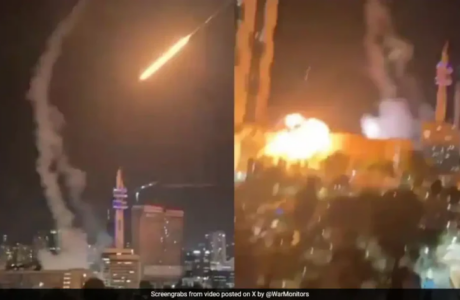
    TEL AVIV – In a catastrophic failure of the world’s most advanced air defense network, an Iranian ballistic missile has completely bypassed Israel’s multi-layered shield, slamming into the heart of central Tel Aviv and leaving a trail of “massive craters” and shattered buildings.

    Al Jazeera confirmed the direct hit on Thursday, April 2, 2026, marking a terrifying turning point in the five-week-old conflict. The strike, which hit a densely populated residential area, has sent shockwaves through the region as the myth of the “impenetrable” Zionist defense shield appears to have finally collapsed.

    The Strike that Broke the Shield
    Initial reports from the ground describe scenes of absolute chaos. The missile, reportedly carrying a heavy explosive warhead, carved a massive crater into the asphalt, leveling several structures and incinerating vehicles parked nearby. The blast was so powerful that it shattered windows for several blocks, sending glass rain down on residents who were scrambling for bomb shelters.

    “The Zionist defense shield has completely collapsed,” noted one regional correspondent. “This wasn’t just a stray shrapnel hit; this was a direct, unhindered strike on the heart of the city. The systems simply did not see it coming.”

    A High-Tech Failure
    The Israeli Defense Forces (IDF) are currently facing a crisis of confidence as they scramble to investigate why the Arrow 3 and Iron Dome systems failed to intercept the projectile. Military analysts suggest that Iran has successfully transitioned to using advanced cluster warheads and “stealth” flight paths that are overwhelming the IDF’s tracking sensors.

    This hit in Tel Aviv follows similar defense failures in Petah Tikva earlier this week, where Iranian missiles also bypassed Israeli defenses, causing significant structural damage. For the first time since the start of the hostilities, the IAF is admitting that its multi-billion dollar defense umbrella is no longer a guarantee of safety.

    Regional Fallout
    The successful strike on Tel Aviv has shifted the psychological balance of the war. As Israel reels from the direct hit on its commercial capital, Iran has signaled that this is only the beginning of a “new phase” of precision strikes. The IDF has responded with a wave of retaliatory sorties, but with the “Iron Dome” now proven vulnerable, the fear of an unrestricted ballistic exchange is higher than ever.

    Politics

    As of Friday morning, emergency crews are still working to secure the blast site in central Tel Aviv. While casualties were initially reported to be between four and five injured, the sheer scale of the building damage suggests the toll could rise as search-and-rescue teams dig through the rubble of the high-tech shield’s failure.

  • S. intel finds Iran retains significant strike capacity: report

    S. intel finds Iran retains significant strike capacity: report


    U.S. intel finds Iran retains significant s


    WASHINGTON, (Xinhua)/Flowerbudnews : — Latest U.S. intelligence assessments show that roughly half of Iran’s missile launchers are still intact and thousands of one-way attack drones remain in Iran’s arsenal more than one month after the United States and Israel launched massive strikes on Iran, CNN reported on Thursday.

    “They are still very much poised to wreak absolute havoc throughout the entire region,” a source familiar with the intelligence told the U.S. media outlet.

    The assessments also indicate that Iran retains a large number of missiles, as well as a significant portion of its coastal defense cruise missiles, a key capability for controlling the Strait of Hormuz, according to the report.

    Although Iran’s Navy vessels have largely been destroyed, the separate naval forces belonging to the Islamic Revolutionary Guard Corps still retain roughly half of its capabilities, with “hundreds, if not thousands, of small boats and unmanned surface vessels left,” according to sources cited by CNN.

    The intelligence shows that Iran’s use of underground facilities has helped preserve its missile launchers. The country has long hidden its launchers in extensive networks of tunnels and caves, making them particularly difficult to target.

    U.S. President Donald Trump on Wednesday put the timeline for completing U.S. military operations at two to three weeks. However, a source who has reviewed the intelligence assessments described the timeline as unrealistic.

    Israel, U.S. allies in the Gulf, as well as U.S. troops, have continued to face regular missile and drone strikes from Iran.