Blog

  • NAFDAC impounds vehicle loaded with unwholesome medicine, vaccines in Asaba

    By Aderogba George
    Abuja: The National Agency for Food and Drug Administration and Control (NAFDAC) says it has impounded a Mercedes Truck laden with banned and unregistered medicinal products in Asaba, Delta.
    A statement signed by NAFDAC Resident Media Consultant, Mr Olusayo Akintola, said that the agency’s Director-General, Prof. Mojisola Adeyeye, made the disclosure in Abuja on Wednesday.
    The statement quoted Adeyeye as saying that the agency had resolved to ensure that only wholesome medicinal products and other regulated products were available in the markets for public use and consumption.
    The director-general said that a Mercedes truck suspected to be carrying substandard and falsified medicinal products was intercepted along Asaba –Benin road by officers of the agency’s Investigation and Enforcement Directorate, following an intelligence report.
    According to her, after thorough screening, the truck was found to contain, among other products, improperly stored Tetanus Diphtheria vaccine, and various unregistered, banned and controlled medicinal products.
    She said that part of the drugs includes Analgin Injection, CSP with Codeine cough syrup, Mepacrine HCL Tablets, Diethylcarbamazine Citrate Tablets, Dano Tetanus Vaccine, Artestunate Injection, and many others.
    Adeyeye explained that the products were evacuated, inventory were taken while the suspects with cartons containing the products made police statements and were released on administrative bail.
    According to the NAFDAC boss, further investigations revealed that the truck was conveying medicinal products purchased from Ogbo-Ogwu Bridge Head market in Onitsha, Anambra, for supply to retailers in Warri, Delta.
    “The retailer outlets who are mostly in Warri are Pendrix Pharmacy, Samtex Pharmacy, Onos Pharmacy, Chima Patent Medicine Store, Imoson Patent Medicine Store,  Sam-C Patent Medicine Store, Sunshine Patent Medicine Store and Hyunus Patent Medicine Store respectively.
    “Others are Chuks Patent Medicine Store, Solomon Patent Medicine Store, Friday Patent Medicine Store, Madam Faithmax Patent Medicine Store, Omas Pharmacy, Evans Patent Medicine Store, Chiyere Patent Medicine Store
    and Philo Patent Medicine Store, Bridge Head Market, Onitsha,” she said.
    Adeyeye, however, warned medicine merchants to always have the general wellbeing of Nigerians at heart over and above any other pecuniary consideration, stressing that there is no longer a hiding place for them.
    She also cautioned them to stop the circulation of illicit business and dangerous medicinal products capable of compromising the health of the Nigerians. (NAN)
  • NAFDAC evolves programmes to support small businesses

    By Mufutau Ojo

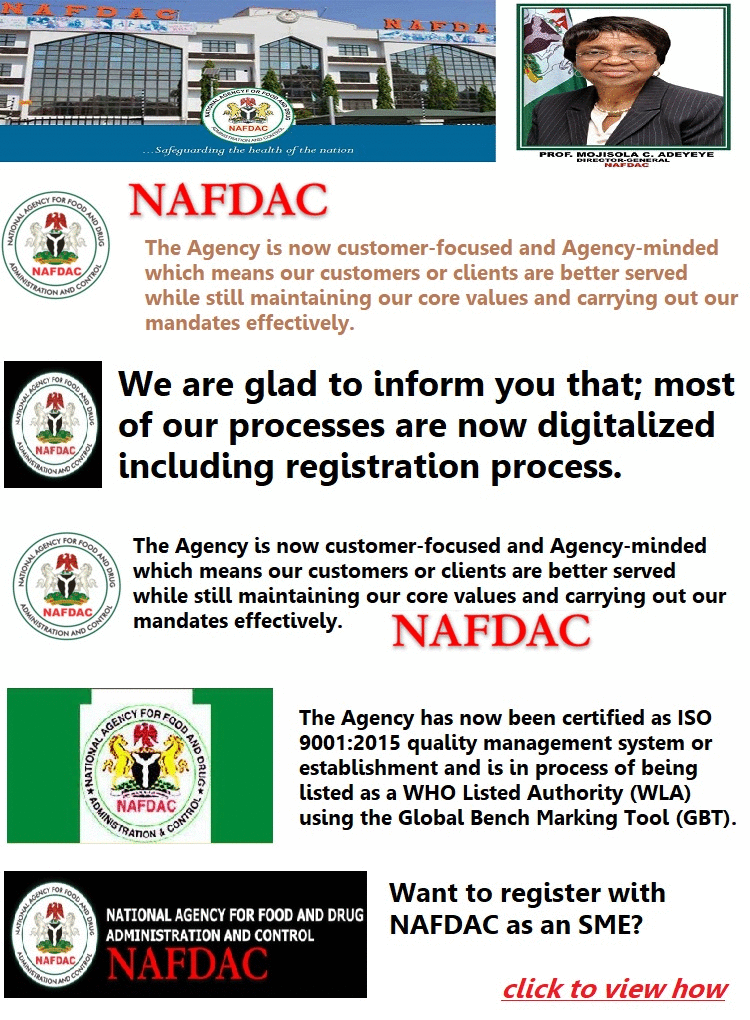
    Abuja: Prof. Moji Adeyeye, the Director-General of the National Agency for Food and Drug Administration and Control (NAFDAC) says the regulatory body has evolved various policies and programmes to support small businesses.

    Adeyeye, who spoke with newsmen in Abuja on Monday, said the agency recognised the critical roles Small and Medium Enterprises played
    in the economy and deserved to be encouraged.

    She said one of the policies put in place to encourage small businesses was decentralisation of registration process to make it less cumbersome.

    She noted that “prior to 2018, all registration exercises were done in Lagos. However, having recognised the importance of micro enterprises, the agency decentralised registration of products and it is now done on zonal basis, including the FCT office.

    “Also, the number of products being registered on zonal basis has been increased from 11 to over 80 different products.

    “Guidelines and documentation requirements have been streamlined to make it easier for micro and small industries to register their products

    “Companies manufacturing similar products can use one facility, that is shared facility to reduce cost of setting up factory, while timeline for registration of products has been reduced to between 60 and 90 working days.

    “The facility requirement has also been reduced from four rooms to one standard room and a store.”

    The News Agency of Nigeria (NAN) reports that NAFDAC was officially established in October 1992 to promptly address the challenges of rising incidence of counterfeit and substandard drugs as well as unwholesome food and other products.

    NAN also reports that the mandate of the agency include safeguarding public health by ensuring that only the right quality drugs, food and other regulated products are manufactured, imported, exported, advertised, distributed, sold and used in Nigeria.

    Adeyeye recalled that NAFDAC in 2020 gave palliatives to micro enterprises in order to cushion effect of the COVID-19 pandemic

    She said the agency reduced the cost of registration by 80 per cent for small businesses while there was free registration
    for the first 200 companies that submitted application.

    The director general also said the agency waived payment of late renewal fees for three months for companies that had expired licences.

    Speaking on other initiatives to boost service delivery, Adeyeye said NAFDAC was working on becoming a WHO Listed Authority.

    “The WHO uses Global Benchmarking Tools to assess the agency and there are four Maturity Levels.

    “Currently, we are aspiring to get to Level 3 which will permit our country to manufacture vaccines because as an agency we have to do Lot release which is a requirement for vaccine production.

    “This will also improve trade because our products can compete favourably with products from advanced countries with stringent regulatory authorities.

    “Pharmacovigilance which is the science of detecting, assessing and documenting adverse events has been strengthened.

    “The agency recently launched the MEDSAFETY App for reporting adverse drug reactions.

    “For example, as the COVID-19 vaccine is being administered on people and if there are reactions, no matter how little, they report it through the App which comes to the database.

    “It eventually goes to the Upsalla Monitoring Centre in Geneva where adverse reactions are domiciled internationally. Reactions to other drugs are also reported through the App,” she said. (NAN)

  • NAFDAC partners Global alliance to enhance ease of doing business

    By Aderogba George
    Abuja: The National Agency for Food and Drug Administration and Control (NAFDAC) says it has commenced partnership with Global Alliance for Trade Facilitation (GATF) to put together strategies for export and import trade in Nigeria.
    A statement signed by NAFDAC resident media consultant, Mr Olusayo Akintola, and issued to newsmen on Sunday stated that the procedures was to ensure ease of doing business in Nigeria.
    The statement noted that the partnership was also aimed at achieving standardisation, harmonisation of documents and simplified trade formalities for importers and exporters.
    It said that NAFDAC Director General, Prof. Mojisola Adeyeye, reached the agreement at a virtual meeting with GATF Nigeria top officials led by its Project Lead, Mr Bernard Traynor.
    The statement added that the partnership project is being powered by GATF, an organisation that was being hosted by Centre for International Private Enterprise, International Chambers of Commerce, and the World Economic Forum.
    “The project in Nigeria is being implemented by the German Technical Cooperation popularly known as GIZ. The alliance is supported by the governments of US, Canada, Germany, Denmark and government of Australia through their respective agencies.”
    The statement quoted Adeyeye, who was represented at the meeting by Dr Abimbola Adegboye, Head of Trade and International Relations at the agency, listing measures that NAFDAC had already put in place for both import and export trade.
    Adeyeye reiterated that NAFDAC had already put in place measures to ensure that there is a seamless and more robust operational procedure with both export and import at the borders.
    She said that part of the measures was to achieve cooperation among government agencies at the borders, adding that NAFDACs focus now was to ensure smooth trade facilitation and regulation.
    According to her, operations of regulators should not pose an hinderance to trade transactions but facilitate them.
    She said that the agency was making sure that there are not so many interferences between the users of the agency facilities and the agency.
    “So, we try as much as possible to remove both human interferences under the guise of consultants, because more or less they do not facilitate trade, they tend to distort it.
    “Trade should be on basis of safety and quality, that is the only way trade could be sustained; If quality is not put into your product, It gives the country a bad name, they blacklist the company involved.
    “The consumers are the losers because they do not have value for money and their health is compromised,” she stressed.
    She stated that these are the issues that the global alliance would be addressing, adding that what would make all these visible and possible was to ensure that operations at the borders are seamless.
    According to her, If you have perishable items that are to be exported or that are to be allowed into the country and they are delayed unnecessarily or held based on premium conditions, such products could go bad, and the integrity of such product would be compromised.
    She said that anything that would make trade operations very easy both for inflow and outflow, and would make the whole process of regulation friendly and not cumbersome for importers and exporters, is what the agency aimed for.
    The statement also quoted the Project Manager of GATF, Nigeria, Mr David Okeku, explaining that being an alliance, his organisation had critical private sector partners, and series of projects currently being implemented in Kenya, Madagascar, Malawi, Zambia, Senegal, Uganda and Latin America, Asia and middle East countries’.
    ‘’How we work in the alliance is that we partner with multinationals, local businesses because we believe strongly that they will bring in their expertise and also best practices; and also bring in supply-chain companies.
    “We use them as our ambassadors globally and in-country. Local businesses also contribute in form of expertise and resources in kind towards the alliance”, the statement added.(NAN)
  • COVID-19: NAFDAC approves Pfizer Biotech Vaccine for emergency use authorisation- Prof Moji Adeyeye

    By Kemi Akintokun

    Lagos: National Agency for Food and Drug Administration and Control (NAFDAC) says it has approved the Pfizer Biotech Vaccine for emergency use authorisation for COVID-19 in Nigeria.

    Its Director-General, Prof. Mojisola Adeyeye, made this known on Friday in a live/zoom media briefing in Lagos.

    Adeyeye said: “We have approved Pfizer Biotech Vaccine for possible use in the country.

    “Our COVID-19 vaccine team must carefully review it to make sure that the science behind it is well understood, and also in accordance with our own regulation.”

    She said the vaccine was approved based on different mechanisms known to the agency.

    “We used different mechanisms to approve COVID-19  vaccine, and one of it is called reliance, meaning that a more matured regulatory agency across the globe has already approved such vaccine.

    “We can use that as a basis for our own review by getting the assessment report, know the peculiarities and our COVID Vaccine Committee will then do their job.

    “We also can go ahead to review, if the World Health Organisation (WHO) has given emergency use lifting, meaning they have done their job.

    “For Pfizer biotech vaccine,  both cases are through, because more matured agencies have approved the vaccine.

    “The approval is not a full approval, it is within the period of getting people vaccinated and gathering of data about the adverse effect following immunisation,” she said.

    Adeyeye said that data gathering on vaccine was not limited to NAFDAC.

    She said that the agency belonged to an organisation called International Coalition of Medicine Regulatory Authorities( ICMRA).

    “We belong to ICMRA, which is a global gathering of regulatory agencies across the country, where we share our experiences, like that of Oxford Astrazeneca Vaccine,” NAFDAC director-general said.

    According to her, the agency’s COVID-19 Vaccine Committee has worked to ensure that post vaccination regulation is put in place.

    “Our committee started their work to ensure all the Is are dotted and the Ts are crossed to ensure that post vaccination regulatory activities such as pharmacology vigilance or safety monitoring is put in place.

    “So, it is not just the vaccination alone, it is what happens after that,” she said.

    On the storage of the Pfizer Biotech Vaccine, Adeyeye said the country has what it took to store the vaccine effectively.

    “We have the capability because the freezer temperature is now -30 degrees unlike when it was -80 to -60 degrees temperature. So, the storage is not an issue in Nigeria,” she said.

    The director-general also disclosed that the agency was reviewing the Johnson and Johnson Vaccine. (NAN)

  • NAFDAC, stakeholders to increase collaboration to eradicate drug abuse

    NAFDAC, stakeholders to increase collaboration to eradicate drug abuse

    By Aderogba George

    Abuja: National Agency for Food and Drug Administration and Control (NAFDAC) has stressed the need for all stakeholders to work together towards eradicating the menace of drug abuse in the country.


    Prof. Moji Adeyeye, NAFDAC Director General, made the call on Tuesday in Abuja, at the 3rd National Youth conference on drug abuse, organised by Centre for Ethical Rebirth among Nigerian Youth (CERANY), an NGO.


    Represented by the agency’s Director, Narcotics and Controlled Substances, Mr Musa Umar, she said all hands must be on deck to find solutions to the problem of drug abuse, adding that all should be determined to eradicate the scourge.


    According to her, the problem of  drug abuse concerns everybody, saying cooperations must be strengthened to decisively deal with the problem.


    “Of all the crises facing us, government has given the highest priority to the problem of drug abuse.


    “It is in this regard that NAFDAC considers this initiative of gathering of experts in drug related matters under one roof with a view to finding solutions to drug abuse laudable.


    “We must therefore work together as partners to define the problem, understand the risk, and avert the catastrophe.


    “The National Drug Use Survey of 2018 revealed that the highest-level drug use is among those aged between 25 and 39 years, the use of drugs for non-medical or recreational purpose is thus disturbingly common among young people,’’ Adeyeye said.


    The director-general said that drug abuse is a public health problem that has undermined national stability and security of the country,


    She added that the experience of NAFDAC shows that success in the war against drug had been adversely affected by corruption and unethical practices.


    Adeyeye explained that the issue had resulted in laws not being enforced and criminals not being prosecuted or convicted for their crimes, and that there was need to change the narrative.


    According to her, the impact of drug abuse and the current reality makes it necessary to think about national security in terms of the corporate existence of the nation and its ability to protect and promote all that is considered important and valuable.


    Adeyeye said that the menace of drugs is a threat without borders, and that everyone must be firm against criminals destroying the path to the future envisaged for the youth and the country.


    Mr Chuks Akamadu, President of CERANY, in his welcome address, called on the youth to  do more by embarking on a serious campaign against the menace.


    He said bodies saddled with the responsibility of campaigning against drug abuse are already overwhelmed.


    Akamadu said youths across the country should begin to realise that it was time for them to take ownership of the fight against drug abuse in the country.


    “Drug abuse has created instability, insecurity and violence in the country.It must begin to dawn on the youth that there is need for them to take ownership of the fight against drug abuse and ensure that they redeem their future.


    “The bodies saddled with the responsibility of campaigning against drug abuse are already overwhelmed, the National Drug Law Enforcement Agency (NDLEA), NAFDAC and security agencies are already overwhelmed. The youth must have a new understanding and do the needful,’’ he said.


    Akamadu said that his organisation had begun to go round secondary schools and tertiary institutions to campaign against the scourge of drug abuse and urged the youth to embrace the idea. (NAN/Flowerbudnews)

  • NAFDAC Moves to Register, Certify Local Chemical Products to Boost Export

    By Biola Lawal

    The National Agency for Food and Drug Administration and Control, NAFDAC, is to begin registration and certification of products of local manufacturers of chemicals to boost export and growth.

    NAFDAC Director-General, Prof. Mojisola Adeyeye announced the plan during a virtual meeting with
    chemical manufacturers’ stakeholders on Thursday.

    The NAFDAC Boss disclosed that the manufacturers agreed with NAFDAC to explore international market to enhance the nation’s foreign exchange earnings and serve as a potent catalyst for industrial growth.


    The meeting was organised by NAFDAC to
    sensitise, enlighten and create awareness on the current trends in the regulation of the manufacture of Chemicals with emphasis on the need to be listed as a Chemical manufacturer in Nigeria.

    Prof Adeyeye added that the objective of the deliberations augur well with the current focus of the
    NAFDAC management to bring the Agency’s regulatory activities in line with international best practices.


    The NAFDAC boss noted that Chemical Evaluation and Research Directorate has the mandate to safeguard public health by ensuring that only the right quality chemicals are manufactured, imported, exported, distributed, sold and used in Nigeria.


    Prof Adeyeye disclosed that the directorate has put in place effective regulations and guidelines for sound chemical management in Nigeria,.


    ‘’This is achieved by ensuring proper utilization of chemicals in a manner that reduces risk to health and environment and advocating for use of chemicals that are less harmful and hazardous’’, a statement by NAFDAC Resident Media Consultant, Sayo Akintola quoted her as saying.

    Prof Adeyeye disclosed that a portal has been created by the agency for registration of chemical products for effective quality control and strict adherence to
    international best practices.
    She noted that chemical products manufactured in Nigeria would enjoy wider acceptability and high competitiveness with the NAFDAC registration identity.


    According to her, penetrating the international market would further enable the industry
    to grow with more Nigerians gaining employment opportunities sequel to the expected
    expansion in the operations of the manufacturers and invariably the accompany
    development of the real sector of the economy.


    ‘’Chemicals no doubt play a pivotal role in the economic development of any country.
    Nigeria as an economy in transition has many needs of Chemicals for her numerous
    industries’’, she said, stressing that some of these chemicals are now manufactured in
    the country and this creates an environment of heightened concern that NAFDAC is
    expected to play a leading role in strengthening Chemical safety and security.
    The NAFDAC Act empowers the Agency to undertake appropriate investigations into the
    production premises and raw materials for food, drugs, cosmetics, medical devices, bottled
    water and chemicals and establish relevant quality assurance systems, including certificates
    of the production sites and of the regulated products

    . Prof Adeyeye further said that the law also compels all handlers of chemicals to adhere
    strictly to all the stipulated guidelines for sound Chemical management in order to
    safeguard ourhealth and protect the environment. This underscores the reason why we
    communicate any change in regulations to our stakeholders.
    She however, disclosed that listing of Chemical manufacturers was initiated to address
    the existing gap in the regulation of the manufacture of chemicals in Nigeria.
    ‘’Manufacturers required to be listed as a chemical manufacturer include those involved
    in the manufacture of specialty chemicals, laboratory chemicals and reagents,
    industrial chemicals, inks, paints, adhesives, wood preservatives & polishers,
    cleaning chemicals, agrochemicals, biocides, fertilizers, car care chemicals’’.
    She noted that the use of Chemicals has increased geometrically in the past years in
    Nigeria resulting in increase in the local manufacturing capabilities for chemicals.
    This increase in local Chemical manufacture and industrialization of the economy, Prof
    Adeyeye said, has led to growth in the chemical industry in Nigeria, noting that the safe
    and secured management of Chemicals especially in the manufacturing sector is
    therefore an issue of growing importance that requires a collaborative effort between the
    regulators and the industry.
    Chief executive officers of chemical manufacturing companies amongst over 94
    stakeholders, including members of the Amalgamated Association of Chemical
    Marketers of Nigeria, that participated commended the ingenuity and courage of Prof

    Adeyeye in creating the directorate dedicated to the regulation and control of the
    nation’s chemical industry.
    Managing Director /CEO of Brenntag Chemical Nigeria Limited, producers of liquid
    caustic Soda, Mr Pieter De Konnick, a Belgian, said NAFDAC’s involvement in
    regulating the chemical manufacturing sector will bring it to limelight and reposition the
    Nigeria chemical industry for economic growth. ‘’This is my eighth year in Nigeria; this is
    the best thing that has happened to me in this industry’’, he said as he showered
    encomiums on the leadership of the agency for the wonderful job they have been doing.
    Speaking in the same vein, the managing director/CEO of Unikem Industries Limited,
    producers of Ethanol from cassava, Mr Uzor Kalu, and Mr Paul Audu, MD/CEO of
    Roychem Industries Limited, said the hitherto bottlenecks in procuring NAFDAC Import
    Permit have disappeared since Prof. Adeyeye became the Director General of
    NAFDAC.
    They noted that NAFDAC import permit and removal certificates were often done in
    January of every year with its negative implications in terms of having plans for the year
    to be activated.
    Both industrialists however, disclosed that the introduction of online platform via
    electronic process by Prof Adeyeye had made application and processing of the vital
    import documents completed in the last quarter of every year while manufacturers
    already have the documentation done in readiness for the new year.
    ‘’Just by the first day of the year manufacturers are ready to go. That has brought some
    positive impact in achieving milestones,’’ said the Roychem Industry boss.
    In her presentation on ‘’Processes for listing as a chemical manufacturer’’ the Director of
    Chemical Evaluation and Research, NAFDAC, Dr Ngozi Onuorah said ‘’once the Good
    Manufacture Practice GMP of the factory is adjudged satisfactory and other submitted documents found to be satisfactory, NAFDAC issues a listing certificate as a chemical manufacturer’’. (flowerbudnews)

  • NAFDAC cautions Nigerians against sanitisers with Methanol

    NAFDAC cautions Nigerians against sanitisers with Methanol

    By Flowerbud

    July 11, 2021

    The National Agency for Food and Drug Administration and Control (NAFDAC) has again cautioned Nigerians against the use of hand sanitizers especially Nutricional S, de R, L De C.V containing methanol.

    The warning is contained in a public alert with No: 20/2021 tagged “Recall of Hand Sanitizers by DiBAR Nutricional due to the presence of Methanol(Wood alcohol).

    The alert was signed by the Director General of the agency, Prof. Mojisola Adeyeye, and made available to the News Agency of Nigeria (NAN) in Abuja on Sunday.

    She said that the agency had received information from US Food and Drug Agency (FDA) about the presence of methanol in hand sanitizers.

    She added that information from FDA noted that Nutricional S,de R,L De C.V (Dibar) is recalling all Dibar Labs hand sanitizers, ProtectoRX hand sanitizers and Advance hand sanitizers due to the presence of methanol.

    According to her, methanol, or wood alcohol, is a substance that can be toxic when absorbed through the skin or ingested and can be life-threatening when ingested.

    “Substantial methanol exposure can result in nausea, vomiting, headache, blurred vision, permanent blindness, seizures, coma, permanent damage to the nervous system or death.

    “All persons using these products on their hands are at risk for methanol poisoning, young children who accidently ingest these products and adolescents and adults who drink these products as alcohol (ethanol) substitute, are most at risk.

    “Methanol is not an acceptable ingredient for hand sanitizers and must not be used due to its toxicity,” she stressed.

    Adeyeye therefore called on consumers, who have been exposed to hand sanitizer containing methanol and are experiencing symptoms, to seek immediate treatment for potential reversal of toxic effects of methanol poisoning.

    According to her, the call is necessary at this time after the FDA analysis has found the product to contain methanol in lab testing.

    Adeyeye stated that NAFDAC implores importers, distributors, retailers and consumers to exercise caution and vigilance to avoid the distribution, sale and use of methanol alcohol-based hand sanitizers.

    She also called on healthcare providers and members of the public in possession of methanol alcohol-based hand sanitizers to discontinue sale and use or submit stock to the nearest NAFDAC office.

    She said that healthcare professionals are encouraged to report any problem related to the use of any hand sanitizers to the nearest NAFDAC office, NAFDAC PRASCOR (20543 TOLL FREE from all networks).

    According to her, Nigerians could also report any adverse effect through viapharmacovigilance@nafdac.gov.ng or via e reporting platform available on NAFDAC websites www.nafdac.gov.ng as well as Med Safety application available for download on Android and IOS.

    NAN

  • NAFDAC undergoing WHO screening for COVID-19 vaccine production – D-G

    NAFDAC undergoing WHO screening for COVID-19 vaccine production – D-G

    By Flowerbud News

    July 8, 2021

    Prof. Moji Adeyeye, the Director General of the National Agency for Food and Drug Administration and Control (NAFDAC), has said that the World Health Organisation (WHO) is screening the agency for a permit to produce COVID-19 vaccines in Nigeria. 

    Adeyeye spoke at the stakeholders interactive session organised by the House of Representatives Committee on Safety Standards and Regulations in Abuja.

    Represented by the Director, Planning, Research and Statistics, Mr Fori Tatama, Adeyeye said that health, safety and environment-based issues were taken seriously by NAFDAC.

    “The WHO is carrying out an audit of NAFDAC, which will enable the country to start manufacturing vaccines; the programme started since Monday and will last till Friday,”she said.

    At the session, the Ministry of Labour and Employment, urged the lawmakers to speed up actions on the Operational Safety and Health Bill.

    The Director, Department of Occupational Safety and Health, Mrs Lauretta Adogu, promised to ensure proper regulation of safety in work places. 

    “The Bill will seek to make comprehensive provision for operational health and safety in work and other matters.

    “It also seeks to establish a National Council for Occupational Safety and Health and will address several important issues and widens the scope of legislation as the new Act will apply to all work places because we enforce operational safety and health in Nigeria,”she said. 

    Also at the session, the Department of Petroleum Resources, (DPR) said most accidents in gas and filling stations occur in unlicensed facilities.

    The Head, Safety and Environment of the DPR, Mr Adeniyi Balogun, said it was a big challenge, calling on law enforcement agencies to collaborate with the department.

    “What we have observed is that most of those accidents happened in stations that are not licensed by DPR.

    “That is a big challenge for us; when we license a company, we make sure that a rigorous process is done to make sure you are qualified to do that operation.

    “But we are doing our best in collaborating with law enforcement agencies to make sure we dismantle any such stations not licensed. The effort is ongoing,”he said.

    Earlier, the Chairman of the committee, Rep. Ibrahim Hamza (APC-Kaduna), said that the right to safe and healthy working conditions is a basic human right.

    According to him, it is enunciated in Article 23 of the United Nations’ Universal Declaration of Human Rights, 1948 and re-affirmed by Article 7 of the United Nations’ International Convention Economic, Social and Cultural Rights, 1976.

    He said that the declaration had not received the required attention it deserves as most accidents and injuries at work places are largely due to disregard for safety measures and standard.

    According to him, this Nation has witnessed incessant avoidable accidents resulting in deaths or injuries due to lack of effective monitoring and compliance to regulations.

    “It is in this regard that the House of Representatives, under the leadership of Rt. Hon. Speaker, Femi Gbajabiamila, deemed it necessary and expedient to Constitute the Committee on Safety Standards and Regulations, with a view to further enhance the efforts of Government towards attainment of desired safety objectives in our nation Nigeria.

    “The entrenchment of effective safety and health systems requires collective commitment and consultations between the statutory authorities, representative organisations of employers and workers, sectional regulators, and other relevant stakeholders, in a constructive manner that will ensure the objective of Government policies on safety are achieved,”he said.

    Hamza said that the objective of the interactive session was to foster collaborative efforts and actions towards the task ahead.

    The lawmaker said it was also for the purpose of updating the committee with present position of safety measures put in place by stakeholders, measures, actions taken so far, challenges and possible areas of legislative intervention.

    He said that the committee solicited for their maximum cooperation towards ensuring that adherence and compliance to safety standards are greatly improved at all levels.

    NAN)

  • WHO screens NAFDAC for COVID-19 vaccine production – D-G

    By EricJames Ochigbo


    Abuja, July 7, 2021 (NAN) Prof. Moji Adeyeye, the Director General of the National Agency for Food and Drug Administration and Control (NAFDAC), has said that the World Health Organisation (WHO) is screening the agency for a permit to produce COVID-19 vaccines in Nigeria.


    Adeyeye spoke at the stakeholders interactive session organised by the House of Representatives Committee on Safety Standards and Regulations in Abuja.


    Represented by the Director, Planning, Research and Statistics, Mr Fori Tatama, Adeyeye said that health, safety and environment-based issues were taken seriously by NAFDAC.


    “The WHO is carrying out an audit of NAFDAC, which will enable the country to start manufacturing vaccines; the programme started since Monday and will last till Friday,”she said.


    At the session, the Ministry of Labour and Employment, urged the lawmakers to speed up actions on the Operational Safety and Health Bill.


    The Director, Department of Occupational Safety and Health, Mrs Lauretta Adogu, promised to ensure proper regulation of safety in work places.


    “The Bill will seek to make comprehensive provision for operational health and safety in work and other matters.


    “It also seeks to establish a National Council for Occupational Safety and Health and will address several important issues and widens the scope of legislation as the new Act will apply to all work places because we enforce operational safety and health in Nigeria,”she said.


    Also at the session, the Department of Petroleum Resources, (DPR) said most accidents in gas and filling stations occur in unlicensed facilities.


    The Head, Safety and Environment of the DPR, Mr Adeniyi Balogun, said it was a big challenge, calling on law enforcement agencies to collaborate with the department.


    “What we have observed is that most of those accidents happened in stations that are not licensed by DPR.


    “That is a big challenge for us; when we license a company, we make sure that a rigorous process is done to make sure you are qualified to do that operation.


    “But we are doing our best in collaborating with law enforcement agencies to make sure we dismantle any such stations not licensed. The effort is ongoing,”he said.


    Earlier, the Chairman of the committee, Rep. Ibrahim Hamza (APC-Kaduna), said that the right to safe and healthy working conditions is a basic human right.


    According to him, it is enunciated in Article 23 of the United Nations’ Universal Declaration of Human Rights, 1948 and re-affirmed by Article 7 of the United Nations’ International Convention Economic, Social and Cultural Rights, 1976.


    He said that the declaration had not received the required attention it deserves as most accidents and injuries at work places are largely due to disregard for safety measures and standard.


    According to him, this Nation has witnessed incessant avoidable accidents resulting in deaths or injuries due to lack of effective monitoring and compliance to regulations.


    “It is in this regard that the House of Representatives, under the leadership of Rt. Hon. Speaker, Femi Gbajabiamila, deemed it necessary and expedient to Constitute the Committee on Safety Standards and Regulations, with a view to further enhance the efforts of Government towards attainment of desired safety objectives in our nation Nigeria.


    “The entrenchment of effective safety and health systems requires collective commitment and consultations between the statutory authorities, representative organisations of employers and workers, sectional regulators, and other relevant stakeholders, in a constructive manner that will ensure the objective of Government policies on safety are achieved,”he said.


    Hamza said that the objective of the interactive session was to foster collaborative efforts and actions towards the task ahead.


    The lawmaker said it was also for the purpose of updating the committee with present position of safety measures put in place by stakeholders, measures, actions taken so far challenges and possible areas of legislative intervention.


    He said that the committee solicited for their maximum cooperation towards ensuring that adherence and compliance to safety standards are greatly improved at all levels. (NAN) (www.nan.ng)/ Flowerbudnews