
Blog

  • EndSARS: Looted Drugs From Kaduna Warehouse are Dangerous to Health,NAFDAC DG warns

    By Aderogba George

    Abuja:  The National Agency for Food and Drug Administration and Control (NAFDAC) has warned residents of Kaduna State on the health risk of drugs allegedly looted from a warehouse in the state.

    NAFDAC gave the warning in a statement issued by the state Commissioner for Internal Security and Home Affairs, Mr Samuel Aruwan, made available to newsmen in Kaduna on Sunday.

    The agency said that the items were looted on Oct. 24 in a warehouse located at Narayi in Chikun Local Government area of the state.

    The looted items, it said, included expired, prohibited and dangerous drugs, adding that anybody who consumed such drugs risked serious illnesses and death.

    NAFDAC also quoted the management of a food processing company, whose stores were also looted in Kakuri, as saying that the stolen grains had been treated with chemical preservatives.

    It said that such chemical preservatives had rendered the items as unsafe for consumption.
    “Residents of Kaduna State are hereby notified to be vigilant and careful about the sources of the food and medications they take and where they buy them, to avoid these dangers.

    “NAFDAC, on behalf of the Kaduna State government, appeals to the public for information on the identities of the looters and where they might be hiding the stolen items,” it said.

    The statement, which quoted the NAFDAC Director-General, Prof. Mojisola Adeyeye, as expressing shock over the said looting and mindless destruction of the agency’s property at the warehouse, thanking God, however, that no life was lost during the incident.

    Adeyeye commended the state government for taking prompt action to safeguard the health of the citizens.
    NAFDAC, however, said that it had made concerted efforts to beef up security around its facilities nationwide to forestall a recurrence.

  • NAFDAC Blacklist Indian Coy for Producing Fake Drug

    The National Agency for Food and Drug Administration and Control (NAFDAC) has blacklisted Mars Remedies PVT Limited, India for the manufacture of falsified Ciprofloxacin Tablets BP 500mg

    Director-General of  NAFDAC, Prof. Mojisola Adeyeye said in a statement made available to Flowerbudnews in Abuja that the fake drugs were produced for Pinnacle Health Pharmaceutical Ltd of Nuru Oniwo Street, Surulere, Lagos.

    Prof Adeyeye, who also announced a ban on all products of Mars Remedies PVT Limited Indian Company from importation into Nigeria, said the Nigerian accomplice company – Pinnacle Health had been delisted with immediat

    Prof. Adeyeye declared that “in view of the unprofessional practice, the Agency states that all products manufactured by the Mars Remedies PVT LTD, 635, GIDC Estate Waghodia, Vadodara, Gujurat, India, will not be allowed into Nigeria with immediate effect,”.

    In a letter dated October 9, 2020 addressed to the Managing Director of Mars Remedies PVT Limited, and titled; “Notice of blacklisting as a manufacturer of substandard and falsified medicines”, the Director General of NAFDAC, Prof. Mojisola   Christianah Adeyeye, reiterated the Agency’s position of zero tolerance for substandard and falsified medicines preponderance in Nigeria in fulfillment of the regulatory obligation of safeguarding the health of the nation.

    In violation of NAFDAC extant laws and regulations, the  company illegally manufactured different formulations of Ciprofloxacin tablets instead of the approved formulation for export to Nigeria.

    According to Prof Adeyeye, the variation in the formulation   of the Ciprofloxacin 500mg tablets, which may impact on the product quality and shelf –life, was not approved by the Agency  before the changes were made.This constitutes a violation of the NAFDAC Act, noting with dismay that the company has displayed a flagrant disregard for compliance with

    global standards necessary to assure the production of quality assured products. Therefore the company has been blacklisted accordingly.

    The Director-General wishes to  warn all manufacturers and importers of medicines to adhere strictly to the conditions for which their products were registered by NAFDAC or face similar sanctions. Flowerbudnews


  • NAFDAC inaugurates App to promote safe use of drugs

    By Aderogba George
    Abuja: The National Agency for Food and Drug Administration and Control (NAFDAC) on Wednesday launched an Application named “Med Safety App” for safe use of drugs in the country.

    The Director-General of the agency, Mrs Mojisola Adeyeye, said during the launch at a virtual meeting that the App. was to report Adverse Drug Reactions (ADRs) that might occur while taking a drug.

    The News Agency of Nigeria (NAN) reports that the inauguration of the application is also to commemorate the 2020 World Health Organisation Medicine Safety Week.

    Adeyeye said there was no better time to inaugurate the app than now when the focus of the world was on the safety of medications used in healthcare delivery and the battle to tackle the COVID-19 pandemic.

    She added that “the journey toward the adoption of the `Med Safety App’ by Nigeria commenced in August 2019 when NAFDAC officially submitted an expression of interest to the World Health Organisation (WHO).

    “The adoption process was cemented at the 42nd Annual Meeting of Pharmacovigilance centres held at Bagota, Colombia in October 2019.

    “The technical development of the app commenced in January 2020 when Nigeria provided country-specific information and a list of all NAFDAC registered medicines.

    “Several testing processes and demonstrations were done to determine its suitability and adaptability in Nigeria.

    “I am glad that we are here today to witness the official launch of the Med Safety App in Nigeria.”

    Adeyeye explained that since NAFDAC’s inception, the National Pharmacovigilance Centre (NPC) had continually deployed
    hard copy ADR triplicate forms, e-reporting platforms and the Pharmacovigilance Rapid Alert System for Consumer Reporting (PRASCOR) to collect and collate reports of ADRs.

    According to her, it is worrisome that ADRs and other drug-related problems remain under reported in Nigeria and within the WHO region of Africa in spite of the availability of these Pharmacovigilance reporting tools.

    “The Med Safety App is available for download for free on all android and apple smart phones and it provides a medium for users to report incidences of ADRs from the comfort of their homes”, she said.

    She pointed out that the report could be created offline without internet connectivity and submitted once the connection had been established, noting that it was directly linked to WHO database platforms.

    Adeyeye called on healthcare providers and Nigerians at large to download the App from apple play store and use to support NAFDAC to achieve the mandate of safeguarding the health of the nation.

    She said that the agency expected that the use of the App would promote awareness and increase reportage of ADRs among healthcare professionals, healthcare providers and the public.

    Mr Bitrus Fraden, the Director/Head of Pharmacovigilance and Post Marketing Surveillance of NAFDAC, said that the App was developed under WEBRADR Project.

    According to Fraden, the App is an initiative successfully launched in Armenia, Burkina Faso, Botswana, Ivory Coast, DRC, Ethiopia, Ghana, Kyrgyzstan, Pakistan, Paraguay, Thailand, Tanzania and Uganda.

    He noted that Nigeria would become the 15th country globally and the 9th in WHO region of Africa to adopt the App.

    He said “Nigeria is one of the 74 confirmed countries participating in the 2020 Med Safety Week. For one week each year, medicine regulators across the globe simultaneously share campaign materials on their social media channels with the hashtag #MedSafetyWeek.

    “Year 2020 campaign will run till Nov. 6 and will call on patients and healthcare professionals to report side effects, especially those associated
    with new or experimental treatments using medicinal/pharmaceutical products, vaccines, biologics and medical devices.

    “Nigeria is leveraging on this event to officially launch the adoption of the Med Safety App as tool to promote reporting of ADRs in Nigeria.

    “The App is expected to complement existing pharmacovigilance reporting tools already deployed by NAFDAC,” he said. (NAN)

  • I met N2.3b debt, directors without computers – NAFDAC D-G

    By Femi Ogunshola

    Abuja:  Prof. Mojisola Adeyeye, the Director-General of the National Agency for Food, Drug Administration and Control (NAFDAC), said that she met N2.3 billion debt on her assumption.


    She added that there were few numbers of vehicles that were functional with other malfunctioning utilities.


    Adeyeye disclosed this during the 2021 budget defence with the House Committee on Health Services on Tuesday in Abuja.


    Adeyeye said that her dream was to make NAFDAC self-sufficient, but was faced with the reality of the debt the agency was enmeshed in when she assumed duty as the helmsman.


    She said that NAFDAC means of revenue generation stemmed from sales of registration forms, fines, industrial fees and user fees adding that the agency realised N4 billion from such as at June.


    Rep Yusuf Sunnunu, the chairman House committed on Health Services, however, told the D-G to go back and rework the budget for proper presentation to the committee.


    He said that this was in a bid to avail the house of the requisite information about the agency’s internally generated revenue and expenditure.


    Rep Benjamin Kalu, a member of the committee called for adjournment to enable the D-G to update her performance report


  • NAFDAC shuts down spices company for revalidating expired products –Official

    NAFDAC- The National Agency for Food, Drug Administration and Control (NAFDAC) says it has shutdown every warehouse and factory of Rose Ltd., a manufacturing company that produces Somgeo Brand of spices, for revalidating already expired products.
    The  warehouses, which were shutdown, are located at Petu Village, Cele 2, Bus Stop Off Ibeju-Lekki, and No. 23, Tunji Lekki, Bello Street, Penuncular Stream 2, Lekki, Lagos.
    A statement signed and issued by NAFDAC  Resident Media Consultant in Abuja, on Sunday, Mr Olusayo Akintola, identified the revalidated expired products as Curry and Thyme spices.
    Akintola said  shutting down  of the warehouse followed a tip-off, which made operatives of investigation and enforcement directorate of the agency to swoop into action.
    According to Akintola, sequel to the raid of the warehouse and factory by NAFDAC officials, it was discovered that large quantities of expired Curry and Thyme spices were stored in the warehouse with packaging materials.
    He said  the packaging materials  included labels as well as stamps that were being used to illegally revalidate the already expired products.
    NAFDAC Director General, Prof. Mojisola Adeyeye, had expressed her displeasure over the incident and had pledged to sanction the company for endangering public health.
    Adeyeye warned that there was no  hiding place for unscrupulous manufacturers and marketers, who had turned themselves to merchants of death with a view to making illicit money, stressing that unscrupulous manufacturers had sent unsuspecting Nigerian consumers to their early graves through production and sale of falsified and revalidated expired products.
    The agency would  stop at nothing to track down the illicit merchants wherever they are within the country, in its renewed efforts to rid the country of unwholesome foods, the director general said.
    ‘’We are ready to eliminate the incidence of falsified products in our markets or bring it down to the minimum to safeguard the health of our people,” she also said.
    Meanwhile, Akintola says the company staff found revalidating the expired products at the factory had been apprehended and taken to NAFDAC investigation and enforcement
    office for further interrogation, although the business owner, a lady, (names withheld) remained at large.
    From NAFDAC’s records, the head office of the company was located at 19, Adelajo Ojo Crescent, Magodo, Lagos, with registration for 16 different products for listing, under the brand name,  Somgeo.
    Other products in the brand name included,  somgeo ginger powder, somgeo garlic powder, somgeo thyme leaves and somgeo mixed spices powder amongst others, he also said, adding that the company’s registration had expired since  Dec. 5, 2017. (NAN)
    AG/CHOM/MMA
  • COVID-19: NAFDAC has not approved any vaccines — DG

    The Director General, National Agency for Food and Drug Administration and Control (NAFDAC), Prof. Mojisola Adeyeye, has said the agency has not approved any COVID-19 vaccines. (more…)

  • NAFDAC destroys fake drugs, unwholesome products worth billions of naira

    By

    Aderogba George

    Abuja: The National Agency for Food and Drug Administration and Control (NAFDAC) has destroyed counterfeit medical products worth billions of naira in Kano and Anambra states.

    NAFDAC made this known in a statement by the agency’s resident media consultant, Mr Olusayo Akintola, and issued to newsmen on Sunday in Abuja.
     Akintola said products destroyed by the agency were drugs, vaccines, cosmetics and expired food items, in three geo-political zones of north-west, south-east and south-south respectively.
    He noted that the NAFDAC Director General, Prof. Mojisola Adeyeye, had also warned that henceforth, there would be no hiding place for the merchants of death, who derived joy in unpatriotic acts of circulating expired products.
    The consultant said that the products were seized from manufacturers, distributors and importers, and all handed over to the agency.
    He said some of the products destroyed such as unregistered drugs, improperly stored vaccine and tramadol, were confiscated by the Nigerian Customs Service.
    He listed others as Rohypinol, intercepted on Benin Asaba expressway, and other fake medical products intercepted at different times.
    “The estimated value of the products destroyed in Kano is N613,300,290.00 while fake products worth N1, 429,580,683.00 were destroyed in Awka, Anambra State, totalling N2,042,880,973.00.
    “The products include drugs such as antibiotics, antihypertensive, antimalarial, herbal remedies, psychoactive, controlled substance and food products such as spaghetti, vegetable oil, non-alcoholic beverages, sachet water, Chocolates, Noodles.
     “Also destroyed are cosmetics such as creams, pomade, and insecticides’’, she added.
    According to NEFDAC, the destruction of the dangerous products would eliminate the risk of their reintroduction into the market.
    The agency noted that the destruction of the products was a proof of its resolve to safeguard the health of the people and ensure that only genuine, wholesome medicines were sold in Nigeria.
    NAFDAC also disclosed in the statement that a warehouse of banned, controlled, fake and counterfeit products, worth millions of naira, was uncovered in Oyi Local Government Area of Anambra.
    It said the items were awaiting destruction, pending the setting aside of a Court Order.
    It noted however, that apart from seizures and destructions, the agency had been able to secure conviction of culprits, ranging from one year to five years and options of fine.
    It said that the Agency was adopting a proactive approach by engaging political, traditional, and religious leaders in sensitising their wards on the dangers of drug abuse.
    NAFDAC pledged continuous surveillance on the products and to ensure enforcement of the regulations governing the products in Nigeria.
    The agency advised Nigerians to be wary of possible infiltration of fake COVID-19 vaccines into the country, describing diversion and falsification of medicines and vaccines as the same everywhere.
    It further urged Nigerians to be vigilant and expose anyone who might want to divert COVID-19 vaccines donated by the international donors for profiteering purposes.
    According to Akintola, Adeyeye, who was represented by Mr Kingsley Ejiofor, the Director of Investigation and Enforcement, said that operatives of the agency are all over the country sniffing around to apprehend others in the deadly business.
    She warned Nigerians to refrain from procuring COVID-19 vaccines online to avoid falling into the wrong hands of merchants of death.
    ‘“The public must be on the look out for these spurious and counterfeit vaccines and other regulated products.
    “The cooperation of the public, corporate bodies, religious leaders, and traditional rulers is needed in this effort for the agency to eradicate the menace of drug counterfeiting and substance abuse.
    The NAFDAC boss said that the products being destroyed could have had a devastating effect on the populace if not removed from the circulation.
    She commended the officers of the agency for their untiring efforts in safeguarding the heath of Nigerians and enjoined them not to relent in ensuring that counterfeiters were brought to book. (NAN)


  • NAFDAC has made progress with COVID-19 intervention fund – DG

    By Aderogba George

    Abuja:  The National Agency for Food and Drug Administration and Control (NAFDAC) on Monday disclosed that it had made some progress with the  Coronavirus (COVID-19) intervention fund allocated to it by the Federal Government.

    This is contained in a statement signed by the Director of Public Affair for the agency, Dr Abubakar Jimoh, and issued to newsmen in Abuja.

    According to the statement, the Director General of the agency, Prof. Mojisola Adeyeye, made this known when she received the House of Representatives Ad-hoc Committee on COVID-19.

    The statement said that the committee was at the agency as part of its oversight function to find out how the agency was utilising the intervention fund.

    Adeyeye told the committee that the agency had been able to procure so many equipment from the N2 billion intervention fund to checkmate the pandemic.

    She said that progress had been made in the creation of COVID-19 laboratories services and regulations of vaccine.

    She said that workers of the agency had also been trained with the responsibility of texting vaccine regulation and control, adding that more training will be done to upgrade the system.

    “2020 is an unusual year where everything was almost upside-down, what has been done in terms of damage the pandemic has brought all over the world, the virus has infected a lot and about one million death worldwide.

    “The virus has constituted an extra ordinary challenge to global health. In terms of preparedness, NAFDAC has done so much, we have put our best on the regulation of vaccine.

    “In terms of use of medicine, this current NASS has acted positively for the health sector, unfortunately for us in Nigeria, we neglected the health sector for decade, but government has taken step to start bringing things back to correct the past damage.

    “For agency like NAFDAC, you cannot compromise on things necessary otherwise, you might be compromising with health of people,” she stressed.

    She said that the agency had also registered many companies, upgraded the existing laboratories for texting of vaccine at international standards.

    She said the agency was communicating with other countries to get more vaccine, adding that the World Health Organisation (WHO) recently made AstraZeneca Vaccine available to Nigeria.

    According to her, NAFDAC Vaccine Committee is also working on the scrutinisation of another vaccine to tackle the pandemic and that when the process is completed, information will be made available to Nigerians.

    She added that NAFDAC was ready to do its part in terms of vaccine approval or any drug in the outbreak of any disease, saying that what the agency needs is only support.

    She said that all the vaccines approved for the treatment of COVID-19 had gone through stringent regulatory processes from stages 1 to 3 under the “Emergency Use Authorisation”.

    The Chairman of the Ad-hoc Committee, Rep. Haruna Mshelia, earlier stated that his members were in the agency to evaluate and see how NAFDAC had utilised the intervention fund.

    He described COVID-19 as a disease that spreads fast which must not be joked with.


  • NAFDAC, a customer-focused agency, says DG

    By Mufutau Ojo

    Abuja: Prof. Moji Adeyeye, the Director-General of the National Agency for Food and Drug Administration and Control (NAFDAC), says the regulatory body is now a customer-focused institution.

    Adeyeye told newsmen in Abuja on Monday that NAFDAC had over the years reviewed its structures and processes to meet the expectations of its numerous customers.

    The News Agency of Nigeria (NAN) reports that NAFDAC was officially established in October 1992 to promptly address the challenges of rising incidence of counterfeit and substandard drugs, as well as unwholesome food and other products.

    NAN also reports that the mandate of the agency include safeguarding public health by ensuring that only quality drugs, food and other regulated products are manufactured, imported, exported, advertised, distributed, sold and used in Nigeria.

    To execute its mandate, Adeyeye said the agency had digitalised its operations, especially its registration processes, in order to ensure service delivery.

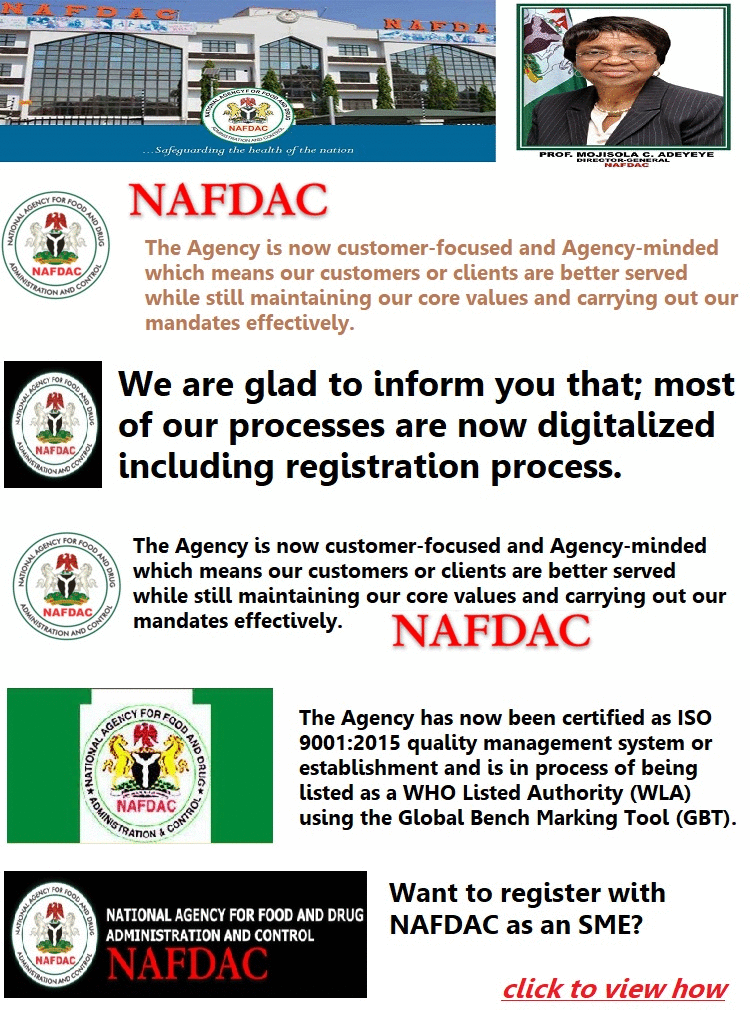
    “The agency is now customer-focused and agency-minded which means our customers or clients are better served while still maintaining our core values and carrying out our mandates effectively.

    “Most of our processes are now digitalised including the registration process.

    “The agency has now been certified as ISO 9001:2015 quality management system or establishment and is in the process of being listed as a WHO Listed Authority using the Global Bench Marking Tool (GBT)” she said.

    She, however, said some challenges were impacting negatively on the operations of the agency.

    The challenges, she said, include lack of vehicles, shortage of staff, poor remuneration, inadequate working tools such as computers and accessories as well as inadequate laboratory equipment.

    The director general also cited the nation’s porous borders through which some products were being smuggled in as some of the challenges being faced by NAFDAC. (NAN)